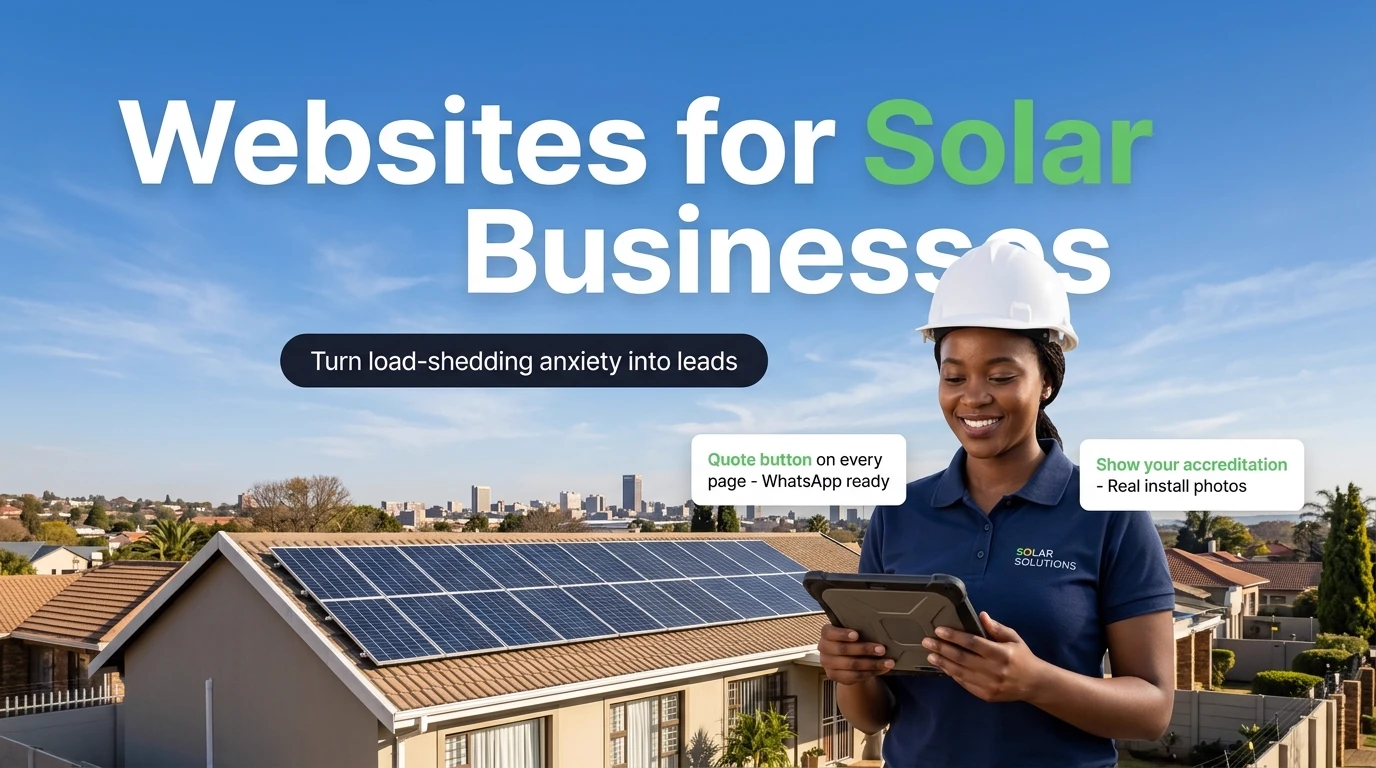
Why Solar Searches Spike, and Why Most Sites Waste Them
Solar is one of the few industries where demand has a visible trigger. A long outage, a new round of load-shedding, a municipal tariff increase or a neighbour's installation can each send a household or a small business owner to Google that same evening. They type things like "solar installers near me", "how much is a solar system for a 3-bedroom house" or "solar for a small business".
That traffic is valuable precisely because it is emotional and time-limited. The visitor is frustrated, has money in mind, and is comparing several installers on their phone. If your site loads slowly, opens with a stock photo of a sunrise and a vague slogan, and hides the contact details, the visitor goes back to the results and tries the next company. You paid for nothing, in time or in marketing.
Note that how often outages happen changes from year to year. Don't build your whole message on load-shedding alone. The reasons people go solar are now a mix: backup during outages, rising electricity bills, running a business through downtime, and keeping a home or office comfortable and secure. A good site speaks to all of them, so it keeps working when the grid has a quiet few months.
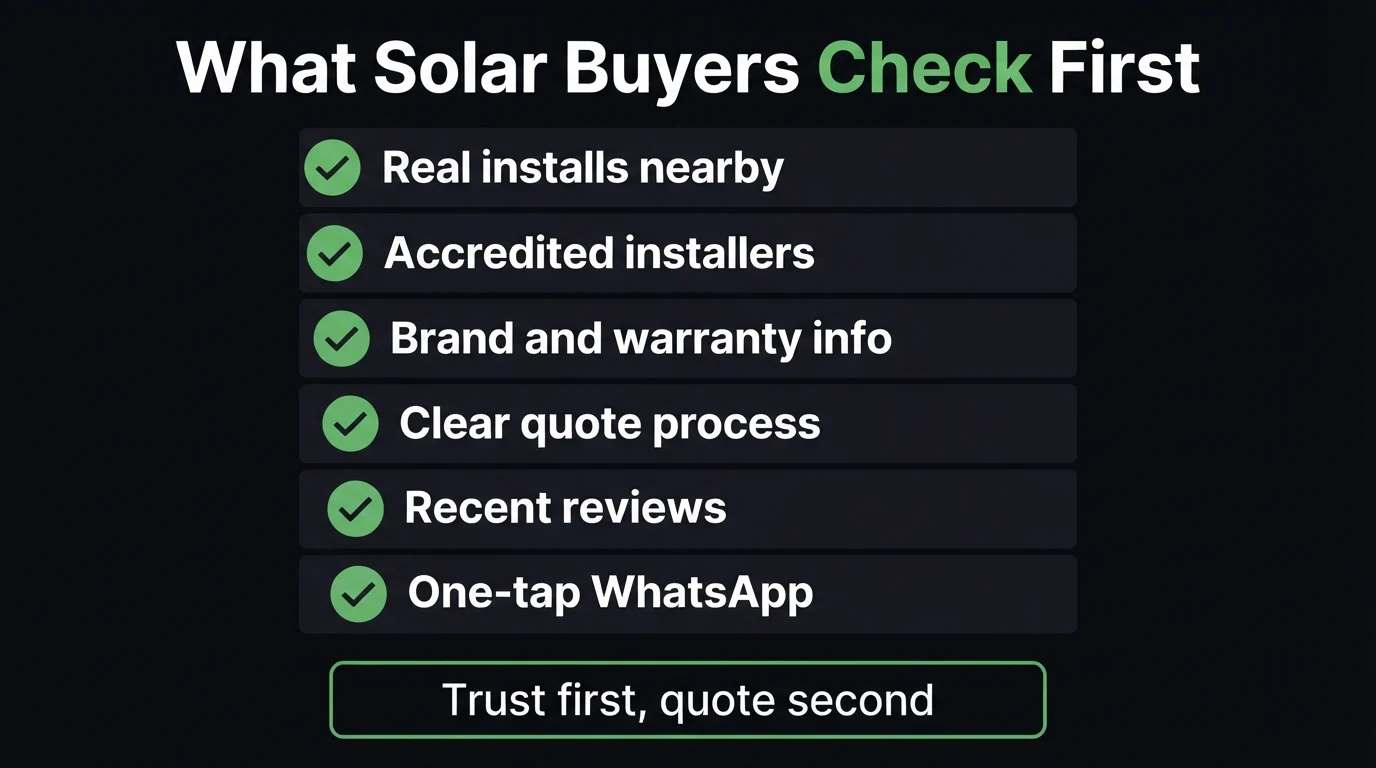
The Six Things a Solar Buyer Checks Before Asking for a Quote
1. Proof that you have installed systems like theirs
A solar system is a big purchase that sits on the roof for many years. Buyers have heard stories about installers who disappeared after the deposit, or fitted something undersized. So the first thing they want is evidence that you do this properly, near them. Show real installations: the system size, the type of property, the suburb, and ideally a before-and-after of the DB board or inverter wall. Three well-documented projects beat thirty generic stock photos. Our piece on stock photos vs real photos explains why this matters so much for trust.
2. Accreditation and who signs the work off
In South Africa, the electrical side of a solar installation has to be done by a registered person, and the installation should come with a Certificate of Compliance. Your insurer may ask for it, and so will any future buyer of the property. State plainly who does the electrical sign-off, which industry bodies or programmes you belong to (the PV GreenCard standards programme is one that careful buyers recognise), and that every installation ends with a Certificate of Compliance. Put it on the home page and on your quote page, not in a footer nobody reads.
3. The brands you supply and the warranties behind them
People will search for the panel, inverter and battery brand before they search for you. Tell them what you fit, why, and what the warranty actually covers (and who services it locally). If you are careful to explain that battery capacity, inverter size and the appliances they want to run are different things, you immediately look more competent than the installer who only quotes "a 5kW system".
4. A clear, honest quote process
"Get a free quote" is not a process. Buyers want to know: do I send photos, do you visit, how long does it take, and when do I pay what? Lay it out in four or five steps. It reduces the fear that they are walking into a high-pressure sales call, and it gets you better enquiries, because people arrive knowing what to expect.
5. Recent reviews from real customers
Solar referrals spread through estate groups, WhatsApp communities and business forums. A review from someone in the next suburb carries more weight than anything you write. Show your Google reviews on the site and make asking for one a routine at handover. Our guide to getting your first Google reviews has a simple script for it.
6. One-tap WhatsApp and call, on every page
A homeowner researching solar at 9pm, with the lights off, is not going to fill in a long form. Give them a click-to-chat button that pre-fills a message ("Hi, I'd like a quote for solar and a battery for a 4-bedroom house in Midrand") and a visible phone number. Where the button sits matters more than most people think; we cover it in turning website visitors into WhatsApp leads.
Quick check: if a stranger landed on your site during tonight's power cut, could they see what you install, who does the electrical sign-off, and how to get a quote, in under ten seconds?
Two Buyers, Two Very Different Journeys
Most solar websites speak to "everyone". In practice you usually have two quite different buyers, and the page that converts one will often bore the other.
- "Will it keep my lights, Wi-Fi and fridge on?"
- "How big a system do I actually need?"
- "Do I need a battery, or just panels?"
- "Will it affect my insurance or the value of my house?"
- "Who do I call when something goes wrong?"
- "How much downtime can this save us?"
- "What is the payback and the financing option?"
- "Can you work around our trading hours?"
- "Do you handle the municipal and compliance paperwork?"
- "Who else of our size do you look after?"
The homeowner is anxious and wants plain-English reassurance and a quick way to start a conversation. The business owner is thinking about continuity and return, and often needs something they can forward to a partner or finance manager. A short "Commercial solar" page with the questions above, a couple of real project descriptions and a clear route to a site assessment is often what gets you shortlisted.
Run a solar business? See your new site before you pay a cent.
We'll build a live demo of your solar website, with your accreditation up front, real installs, a clear quote process and WhatsApp quote buttons, in 48 hours. You only pay if you approve it.
Zero deposit · No lock-in · Based in Centurion, serving all of SA
What a Solar Lead Page Does Differently
The difference between a site that collects dust and one that books site visits is usually not design polish. It is whether each page is built around the decision the visitor is trying to make.
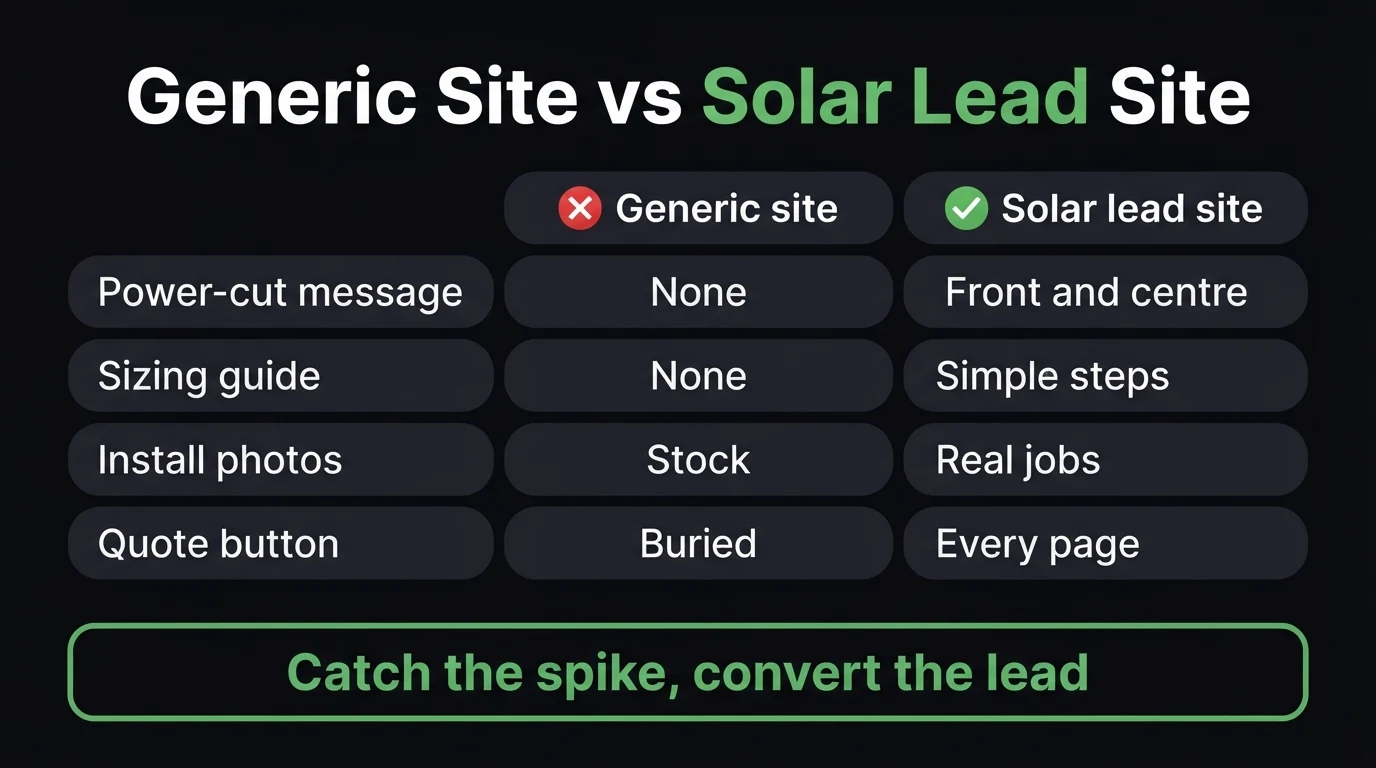
Lead with the problem. The first screen should say what you do in the visitor's own words: keeping the power on, cutting the electricity bill, running the business through an outage. Then show the proof and the next step.
Explain sizing simply. A short "what size system do I need?" section, with two or three typical household examples and the factors that change the answer, positions you as the helpful expert. It also pre-qualifies enquiries, so you spend less time on calls that go nowhere. Avoid fixed prices here; the right answer depends on the roof, the existing DB board and how the building uses electricity.
Be honest about trade-offs. Saying that a battery adds cost, or that a particular roof is a poor candidate, feels counter-intuitive but wins trust. The visitor has probably already read a pushy installer's page.
In solar, the buyer is purchasing confidence in a system they cannot test until the next outage. Everything on your site should either prove you are legitimate (accreditation, Certificate of Compliance, real installs) or prove you understand their situation (sizing, backup versus bill savings, the quote process). Slogans about "powering the future" do neither.
Local Search: Winning "Solar Installers Near Me"
Solar is installed in person, so Google treats it as a local search. A company in Centurion cannot credibly install in Cape Town, and buyers know it. That is good news, because a well-built local presence can beat a national brand in its own patch.
Get your Google Business Profile right. For "solar installers near me" searches, the map results often appear above the normal listings. A complete profile with your address, service areas, real project photos and a steady flow of reviews is essential; it works alongside your site, not instead of it. Our guide to Google Business Profile vs a website explains how they fit together.
Build area pages only where you genuinely install. One honest page per area, covering the typical roof types, any municipal requirements for connecting systems, and examples of projects you have completed there, beats twenty thin pages that swap the suburb name. For a worked example of the right approach, see our Centurion solar page.
Answer the questions people ask AI tools. More buyers now type "how do I choose a solar installer?" into ChatGPT or Google's AI Overviews. Pages with clear, direct answers and a short FAQ are the ones those tools tend to quote, which is why this guide ends with one.
Don't Forget the Legal and Data Basics
Your quote form collects names, addresses and sometimes electricity bills or photos of DB boards. That makes a proper privacy policy and a form that only asks for what you need at quote stage a basic requirement, not a nice-to-have. Our POPIA legal pages guide covers what to include. If you make performance claims, such as savings or payback, keep them realistic and explain the assumptions behind them.
What a Solar Website Should Include, and What It Can Skip
You do not need a fancy calculator or customer portal on day one. Most installers get far more from a fast, credible site that nails the basics.
| Feature | Worth it? | Why |
|---|---|---|
| Real installation gallery | Essential | The strongest proof you can show |
| Accreditation & Certificate of Compliance | Essential | Reassures buyers and their insurers |
| WhatsApp quote button | Essential | How South Africans make first contact |
| How we quote (4-5 steps) | Essential | Removes the fear of a pushy sales call |
| Residential and commercial pages | Strongly recommended | Each buyer finds their own answers |
| Online system calculator | Later, if at all | Often inaccurate; a simple guide does the job |
At CJX Studios, solar and electrical websites sit on the same monthly plans as any other business; the pricing page shows what each tier includes, and our website cost guide explains what drives the price. If you suspect your current site is leaking enquiries, the checklist of signs your website is losing you customers is a quick self-audit.
The Bottom Line
When the power goes out, solar installers get a short window of unusually high interest. A website that proves you are real, accredited and easy to deal with turns that window into quotes; a generic one hands it to a competitor. You do not need a big budget to be the better option in your area. You need real proof, a clear process and a button that works.
Start this week: add three real installs with system sizes and suburbs, state who signs off the electrical work, and put a WhatsApp quote button on every page. That alone puts you ahead of many of the installers your prospects are comparing you against.
- Solar demand is triggered by outages and bills, and those visitors decide fast. Your site must earn trust in seconds.
- Six signals: real installs, accreditation and sign-off, brands and warranties, a clear quote process, recent reviews, and one-tap WhatsApp.
- Serve both buyers: plain reassurance for homeowners, continuity and payback answers for businesses.
Go Deeper: Related Guides
Frequently Asked Questions
Do solar installers really need a website if they get work through referrals?
Yes. Referrals still send people to Google before they call. A homeowner who is told about you will search your name, look for proof that you install what you say you install, and compare you with two other installers. A site with real installs, accreditation and a clear quote process closes that loop; no site, or a thin one, leaks referrals to competitors.
What should a solar company show to build trust online?
Show real installations with the system size and location, your accreditation and the registered electrician who signs off the work, the brands and warranties you supply, and recent reviews. Be clear that every installation comes with a Certificate of Compliance. Stock photos of generic panels do little; photos of your own roofs and your own team do a lot.
Should I put solar prices on my website?
Publish what you honestly can: typical system ranges, what drives the price, and what a site visit or roof assessment involves. Exact quotes depend on the roof, the existing DB board and the usage pattern, so a fixed price list would mislead. A clear 'how we quote' page filters out the unqualified and builds confidence with serious buyers.
How can a solar company rank on Google for its area?
Combine a complete Google Business Profile, steady reviews and one genuinely useful page per area you actually install in, covering typical roof types, local municipal requirements and example projects. Only build pages for areas you really serve; pages that just swap the suburb name tend to do more harm than good.
How much does a website for a solar company cost in South Africa?
At CJX Studios, solar and electrical websites start from R1,200 per month with hosting, maintenance and support included, and no deposit before you approve a free 48-hour live demo. Most installers do not need a calculator or portal on day one; a fast site with real installs, accreditation and WhatsApp quote buttons does the heavy lifting.

Chris Maboyi
I build websites for South African businesses in Centurion, Pretoria and across Gauteng, including trades and service businesses where trust decides the sale, like solar, security and electrical contractors. Every project starts with a 48-hour free demo: real, live, no deposit before you approve it. Get in touch or WhatsApp me directly.