Here's the uncomfortable truth about that "professional team high-fiving in an office" photo on your homepage: it's probably appeared on thousands of other websites — none of which are your business. Visitors don't consciously think "that's a stock photo." They just feel a flicker of something-off, and that flicker chips away at the trust you spent the rest of the page building.
I'm not anti-stock. Used correctly, it has a place. But I've rebuilt enough small business sites in South Africa to know exactly where stock photography helps and exactly where it silently costs you leads. This is the honest breakdown — not the "always use real photos" lecture, and not the "nobody notices anyway" excuse.
Why Visitors Can Tell — Even When They Can't Say Why
Stock photography isn't badly made. That's actually the problem. It's shot by professionals, lit perfectly, and licensed to thousands of buyers — which means the average web user has seen the exact same "smiling consultant on a phone call" or "team gathered around a laptop" photo dozens of times before, on dozens of unrelated sites. Recognition happens faster than analysis.
The tells are subtle but consistent: lighting that's slightly too perfect for the setting described, models who don't match the business's actual scale or location, and props or backgrounds that feel deliberately neutral — because they had to work for every buyer of that photo, not just you.
I replaced the generic "friendly tradesperson" stock photo on a plumbing client's homepage with one real photo of the actual van, actual logo, actual driveway in Eldoraigne. Nothing else changed. WhatsApp enquiries went up noticeably within the first two weeks — the client's own words were "people stopped asking if we were real."
When Stock Photos Are Genuinely Fine
This is the part most "always use real photos" advice skips. Stock is a reasonable choice when a photo is purely decorative and makes no implicit claim about your specific business — an abstract texture behind a section heading, a generic icon-style illustration, or a background image on a page where no one expects to see your actual staff or premises. The rule isn't "never stock." It's never stock where a claim is being made.
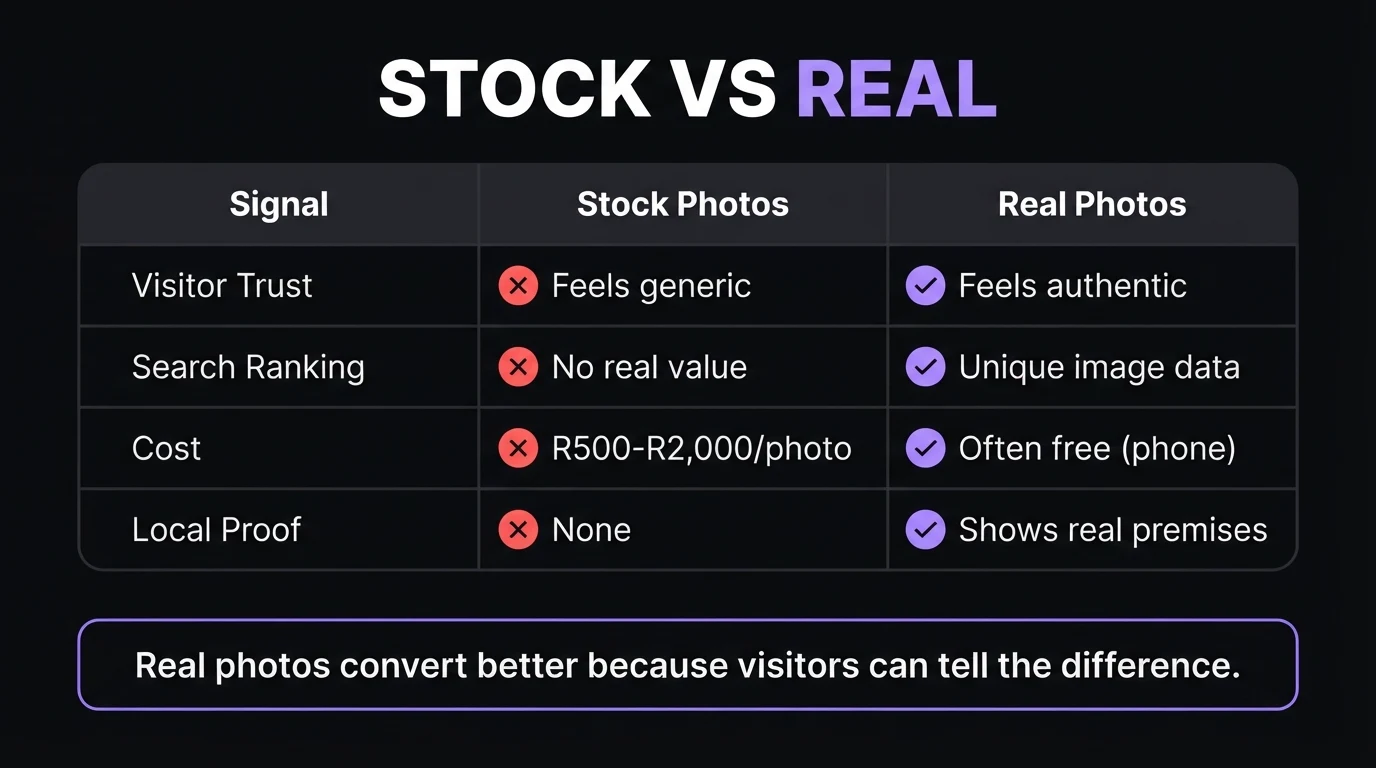
Stock Is Fine For…
- It's a purely decorative background or texture
- No specific claim about your team or premises is implied
- You genuinely can't get a real photo yet (pre-launch, new stock)
- It's clearly illustrative, not presented as "this is us"
- It's meant to show your team, owner, or staff
- It's meant to show your premises, shop, or vehicle
- It's meant to show finished work, products, or results
- It appears near a testimonial or review
Scroll your own homepage right now. How many photos on it are making a claim about your business that isn't actually true of the photo?
The Photos That Actually Move the Needle
You don't need a full brand shoot. You need a small, deliberate set of real photos placed exactly where stock photos usually go. In order of impact:
You, or Your Team, Doing the Work
One clear photo of the owner or a team member — on-site, at the counter, mid-task — does more for trust than any polished headshot library. It answers the unspoken question every visitor has: "is there a real person behind this?"
Your Actual Premises or Vehicle
A shopfront, workshop, office, or branded van tells a visitor exactly where and how you operate — something no stock photo can do. This matters even more for local searches, where "is this a real local business?" is the first question being answered.
Finished Work or Product Photos
Two or three genuine before/after shots, product photos, or completed projects beat a generic "results" stock image every time, because they're the one thing a competitor literally cannot copy.
Real Clients, Where You Have Permission
A short testimonial with a real photo (or first name and suburb, at minimum) reads as dramatically more credible than the same words attributed to a stock headshot — visitors register the mismatch instantly.
A salon owner in Hatfield sent me six photos taken on her own phone — the chairs, a finished colour job, herself at the basin. No lighting kit, no photographer. Those six photos still outperform any stock library because every one of them answers "is this really her salon?" with an immediate yes.
Budget Reality: DIY Phone Photos vs a Pro Shoot
The idea that "real photos" means an expensive photographer is the biggest reason business owners default back to stock. Here's the honest comparison for a typical small business:
| Option | Cost | Turnaround | Quality | Verdict |
|---|---|---|---|---|
| Smartphone, DIY | R0 | Same day | Good enough for 90% of small business sites | Best starting point for almost everyone. |
| Freelance photographer (basic) | R800–R2,500 | 1–3 days | Consistent lighting, sharper detail | Worth it once you can afford it. |
| Full brand shoot | R4,000–R12,000+ | 1–2 weeks | Studio-grade, styled, retouched | Reserve for visually-led brands — architects, retail, hospitality. |
| Stock photo library | R0–R500/photo | Instant | Polished, but shared with thousands of other sites | Decoration only — never as a trust claim. |
Notice what's actually driving the decision: it's not quality, it's whether the photo is true. A smartphone photo of your real shop beats a beautifully lit stock photo of someone else's shop, every time, for trust purposes — because trust is what this page exists to build. Speed and cost matter too, which is exactly why we build every CJX site with a from R1,200/mo plan that includes guidance on exactly which real photos to send us first.
Common Real-Photo Mistakes That Undo the Effort
Switching to real photos only helps if they're taken well. These are the mistakes that quietly sabotage an otherwise good decision:
If you had to send six photos from your phone right now to replace every stock image on your site — could you? If not, that's this week's task.
This is the same principle behind every site we build at CJX: a page can only earn trust with things a visitor can verify. Real photos are the cheapest, fastest version of that — see how we apply it across a full build on our portfolio, or read how it connects to the wider question of whether a website builds customer trust at all.
See your site built with real photos — free, in 48 hours.
Send me your logo, services, and a handful of phone photos of your business. I'll build a live, working, mobile-optimised site around what's actually true of your business — not a stock library. You look at it, test it, show it around. You pay nothing unless you love it.
Zero deposit · No lock-in · Pay only if you love it · Centurion & nationwide
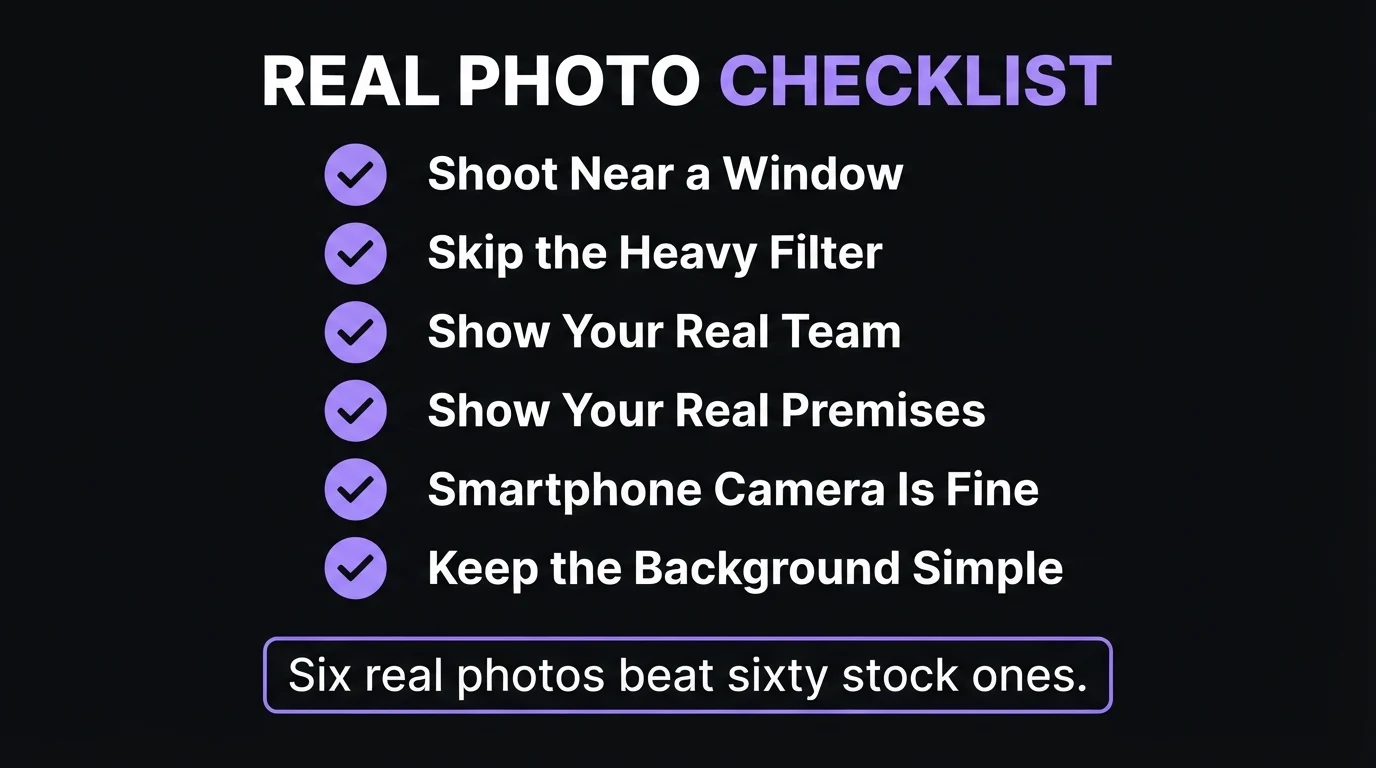
Real Photo Launch Checklist — Six Shots, No Photographer Needed
Frequently Asked Questions
Are stock photos ever okay on a business website?
Yes — for generic decorative backgrounds, abstract section dividers, or industries where showing a real premises isn't practical. What kills trust is using stock photos to represent your team, your premises, or your actual work — the exact places visitors expect to see something real.
How can visitors tell a photo is stock?
Repetition is the biggest tell — the same handful of smiling-team and handshake photos appear across thousands of unrelated sites, so frequent web users recognise them instantly. Beyond that: unnaturally perfect lighting, models who don't match the business's actual location or industry, and props that feel slightly generic.
Do real photos actually help SEO, not just trust?
Yes, indirectly but meaningfully. Real photos are unique image data Google hasn't indexed anywhere else, they support genuine alt text and local schema, and they tend to keep visitors on the page longer — all signals that correlate with better rankings. A stock photo used on thousands of other sites carries none of that.
What's the minimum number of real photos a small business website needs?
Realistically six to ten: one or two of the owner or team, two or three of the actual premises or work in progress, and two or three of finished work or products. That's usually enough to replace every trust-critical stock photo on a typical 5-page site.
Can I just use my smartphone instead of hiring a photographer?
For most small businesses, yes. A modern smartphone shot near a natural light source, with a tidy background and a steady hand, comfortably outperforms a stock photo for trust purposes. A professional shoot is worth it once your brand depends heavily on visual quality, but it's not the barrier most business owners assume it is.
- Stock photos are fine for decoration — never as a trust claim. If a photo implies "this is us," it needs to actually be you.
- Six honest smartphone photos beat a stock library. Your team, your premises, and your real work — that's the whole list.
- Real photos also help SEO, because they're unique image data no other site has — something a stock photo can never offer.
Keep Reading

Chris Maboyi
I build websites for South African businesses in Centurion, Pretoria, and across Gauteng — salons, plumbers, retailers, clinics — who need leads, not lectures. Every site I build comes with a 48-hour free demo: real, live, no deposit, no obligation. Get in touch or WhatsApp me directly.