Your Instagram is doing well. You post consistently. You've built 2,000 followers. Your engagement is decent.
Your Facebook business page has your hours, menu, photos. You respond to DMs. You run the occasional boosted post.
People find you. They message you. Some become customers.
So why would you spend R15,000 on a website?
It's a fair question. And if you're asking it, you're not alone. Every week, I talk to SA business owners who are crushing it on social media and wondering if a website is just an unnecessary expense.
Here's the honest answer — not the one designed to sell you a website, but the truth based on what actually happens to businesses with and without websites in South Africa.
What's in This Guide
- The Brutal Truth About Social Media Reach
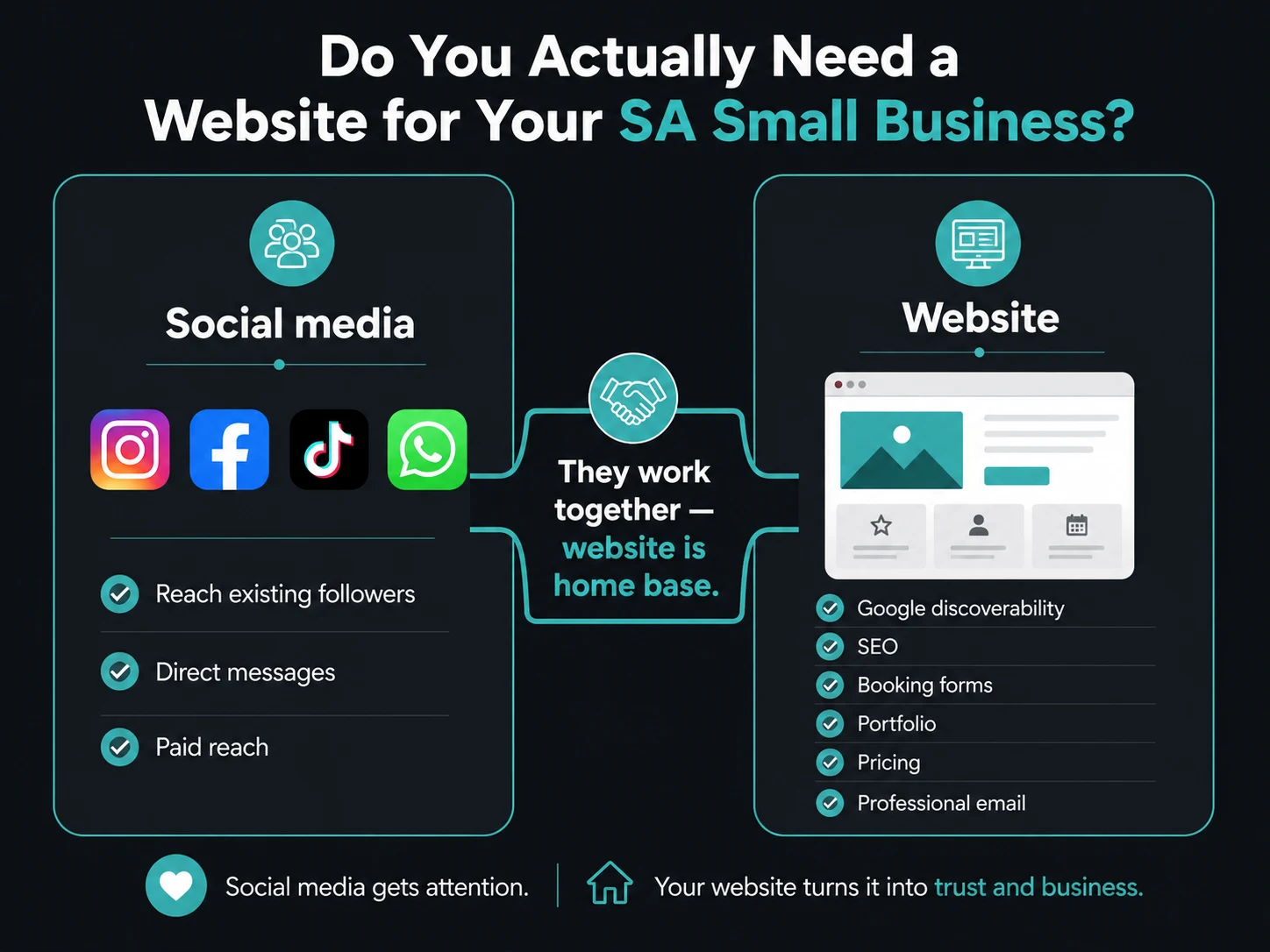
- What Social Media Actually Does Well
- What a Website Gives You (That Social Can't)
- Real Numbers from SA Businesses
- The Cost Comparison Nobody Talks About
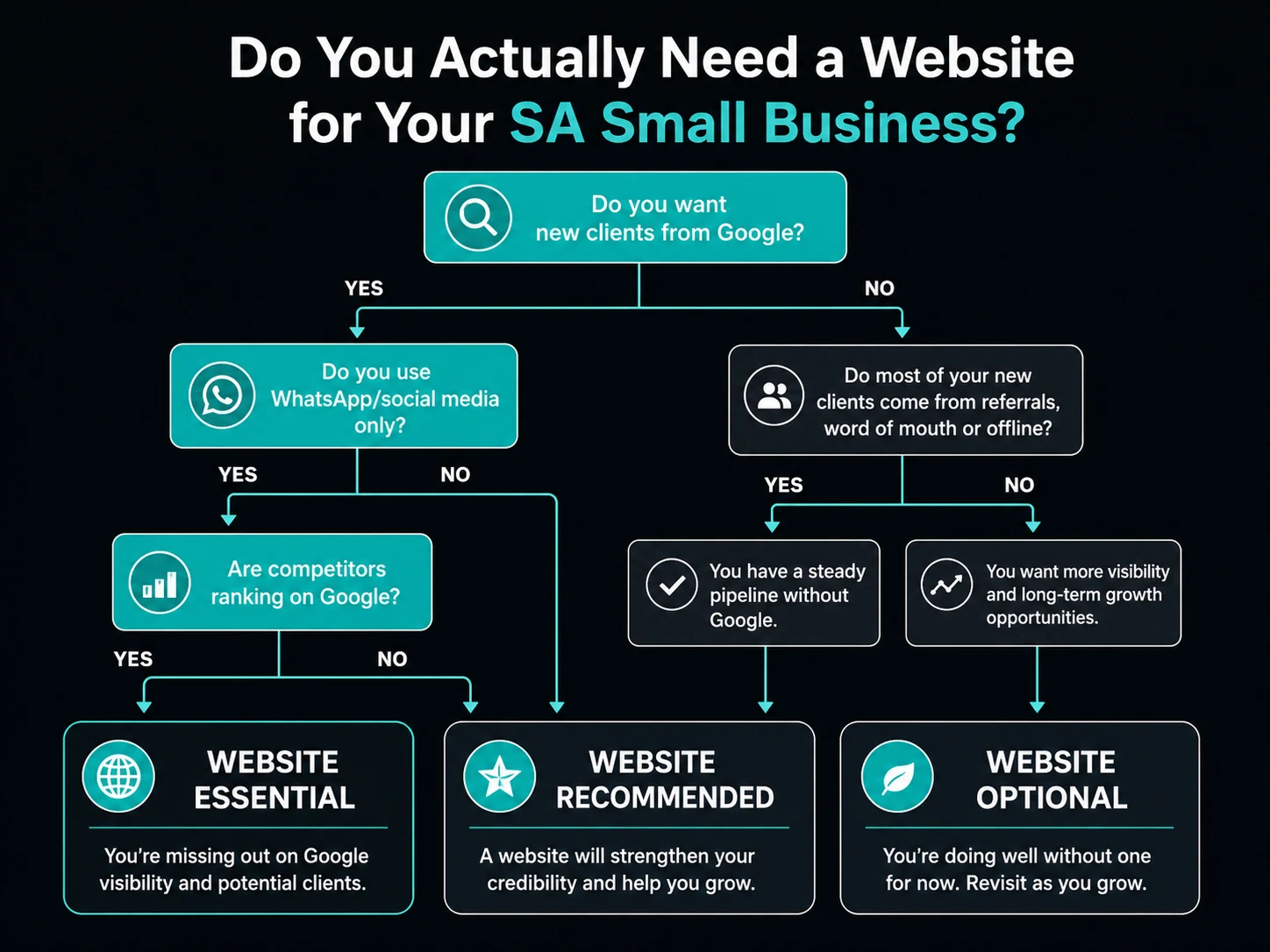
- When You DON'T Need a Website
- When You Absolutely DO Need One
- The Verdict: Best Approach for SA Businesses
The Brutal Truth About Social Media Reach
Let's start with the numbers nobody wants to talk about.
You have 2,000 followers on Instagram. How many of them actually see your posts?
That's not a typo. If you have 2,000 followers and you post something, maybe 100 people see it. Maybe.
Not sure if you need a website?
Message Chris — he'll give you an honest answer for your specific business. No sales pitch. No obligation.
Ask Chris Directly — WhatsAppFacebook and Instagram's algorithms have been throttling organic reach for years. Why? Because they want you to pay for ads.
In practice, this means:
- You work hard to build 2,000 followers
- You create quality content regularly
- Your posts reach 50–150 people
- The other 1,850+ followers never see it (unless you pay to boost)
Even worse: this reach keeps declining. Five years ago, organic reach was around 16%. Now it's under 5%. In another five years? Who knows.
The platform dependency problem: You don't own your social media audience. Facebook owns it. Instagram owns it. If they change the algorithm tomorrow, your reach could drop overnight. If your account gets hacked or suspended, you lose everything. You're building on rented land.
And here's the thing most business owners don't realize until it's too late: you can't export your followers.
If Instagram shut down tomorrow, could you contact those 2,000 people? Do you have their email addresses? Their phone numbers?
Probably not.
What Social Media Actually Does Well
Before I sound like I'm bashing social media — I'm not. Social media is incredibly powerful for specific things.
Social media is excellent for:
1. Building Awareness and Community
Instagram and Facebook are perfect for showing your personality, sharing behind-the-scenes content, and building a community around your brand.
People don't follow businesses on social media to see product catalogs. They follow for entertainment, inspiration, education. Social media is where you build the "know, like, trust" factor.
2. Real-Time Engagement
Someone asks a question in your DMs at 8pm on a Saturday. You can respond immediately. You can run polls, post Stories, share customer photos, react to trending topics.
This real-time interaction is something a website can't match.
3. Targeted Advertising
Facebook and Instagram ads are incredibly good at targeting. You can show your ad specifically to women aged 25–40 in Pretoria who are interested in yoga and earn R15,000+ per month.
That level of precision is hard (and expensive) to replicate elsewhere.
4. Visual Storytelling
If you're a photographer, restaurant, salon, or any business where visuals sell — Instagram is unbeatable for showcasing your work quickly and beautifully.
So social media isn't useless. It's just incomplete.
Think of social media as the top of your sales funnel. It's where people discover you, get interested, start to trust you.
But then what?
What a Website Gives You (That Social Can't)
Here's what happens when someone discovers you on Instagram and wants to learn more:
Scenario 1: You only have social media
- They scroll through your Instagram posts (messy, inconsistent, disappears after 24 hours)
- They try to find your pricing (it's buried in a Story highlight from 6 months ago)
- They want to see your full menu/service list (scattered across 50 different posts)
- They try to book or order (they have to DM you and wait for a response)
- They Google your business name (nothing shows up, or just your Facebook page appears)
Scenario 2: You have a website
- They click the link in your bio → land on your professional website
- They see your full service menu with clear pricing
- They book an appointment or place an order instantly (even at midnight)
- They Google your business name → your website ranks first
- They leave feeling like they just dealt with a real, legitimate business
Which experience do you think converts better?
What a Website Gives You:
1. You Actually Own It
2. Google Can Find You
3. It Builds Instant Credibility
4. It Actually Converts Visitors into Customers
5. It Works 24/7 Without You
6. It's Stable and Permanent
Real Numbers from SA Businesses
Let me show you what happens when SA businesses add a website to their social media strategy.
Situation: Small bakery doing decent business via Instagram and Facebook. Around 2,500 followers combined. Selling mostly through DMs and WhatsApp.
Action: Invested R18,000 in a simple 7-page website with online ordering.
Results after 6 months:
What happened? The website captured customers who were Googling "bakery delivery Cape Town" — people who never would have found them on social media. Plus, existing followers could now order directly instead of the back-and-forth DM process.
This isn't an isolated case.
A Johannesburg engineering firm grew organic leads by 318% in 6 months after launching their website and doing basic SEO.
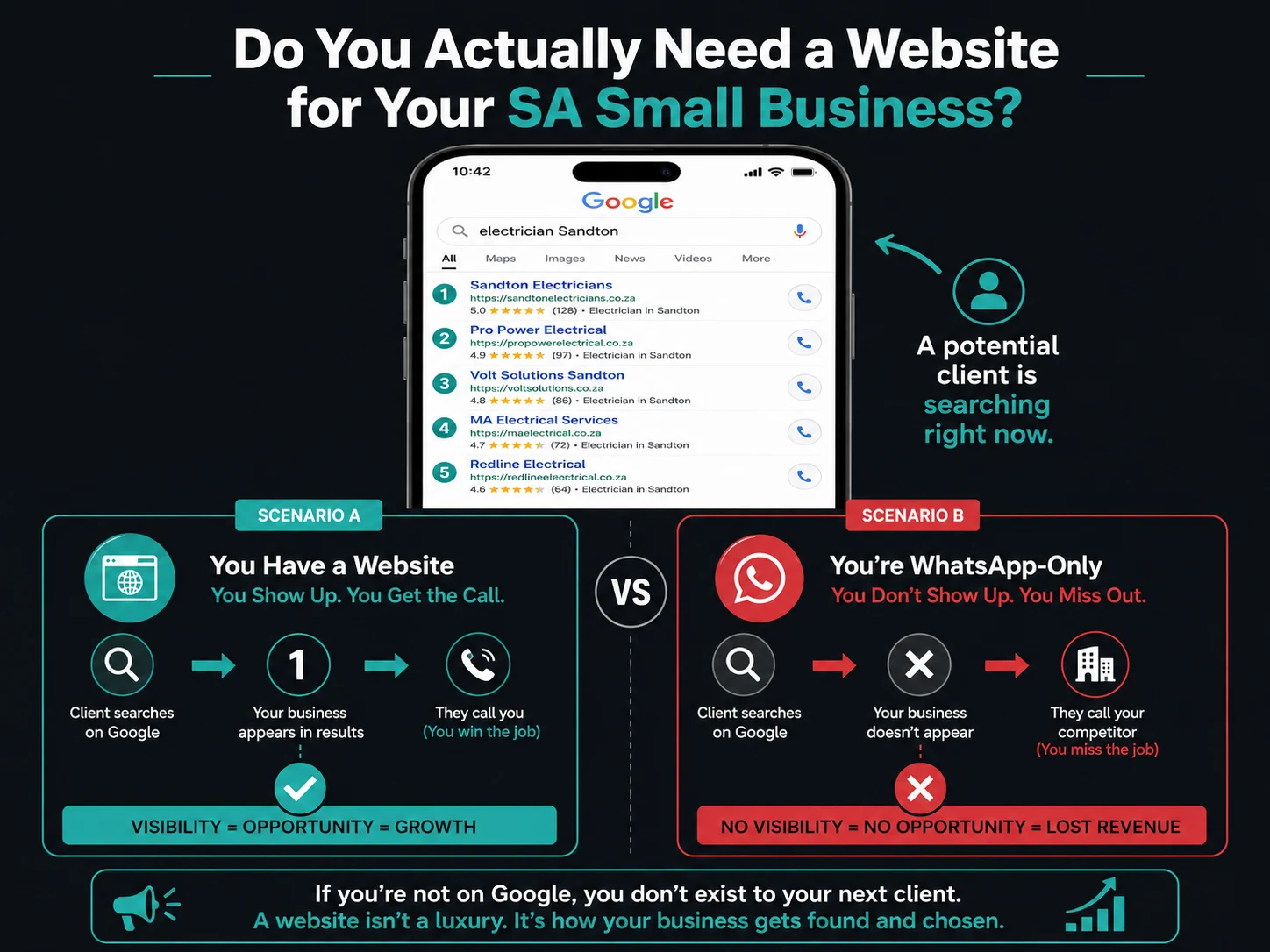
Why? Because people who are ready to buy Google your business name or category. If you're not there, your competitor is.
The search behavior pattern: Someone sees your Instagram post → gets interested → Googles your business name (or "your industry + your city") → if they find a professional website, they trust you and buy. If they find nothing or just a Facebook page, they keep scrolling.
The Cost Comparison Nobody Talks About
Here's the argument I hear most often: "Websites are expensive. Social media is free."
Let's do the real math.
Year 1 Cost Comparison
Website + Social Strategy:
Notice what happened?
The website strategy is actually CHEAPER in Year 1 (R48,800 vs R57,000) because:
- You spend less on social ads (the website captures organic Google traffic)
- You spend less time managing social (the website handles enquiries automatically)
- You get better conversions (so your ad spend is more efficient)
And in Year 2? The gap widens dramatically:
- Social-only Year 2 cost: ~R55,000 (ongoing ads and time)
- Website + Social Year 2 cost: ~R33,000 (no build cost, just hosting and reduced ads)
Over 3 years, a website saves you R50,000+ compared to relying solely on paid social media. CJX Studios' Starter plan starts at R1,200/month — a fraction of what most businesses spend on social ads alone.
The compounding effect: Social media posts have a 48-hour lifespan. A website blog post written today will bring in traffic for YEARS. Your investment compounds over time instead of evaporating.
When You DON'T Need a Website (Be Honest)
Okay, let's be real. Not every business needs a website right now.
You probably don't need a website if:
1. You're Testing a Side Hustle
If you're selling brownies on weekends to see if there's demand, start with Instagram. Validate the business first. Build the website when you're confident this is long-term.
2. Your Entire Business Model is Social-First
If you're a social media influencer or content creator where Instagram IS your product (not a marketing channel FOR your product), then social is your platform. You still might want a simple landing page eventually, but it's not urgent.
3. You're 100% Word-of-Mouth and Hyper-Local
If you run a tuckshop or spaza shop in a township where all your customers are neighbors within walking distance, a website probably won't bring you business. Focus on Google Business Profile and WhatsApp.
4. You Have Zero Budget and Zero Tech Skills
If building a website means going into debt or spending your last R5,000, don't. Start with free tools (Google Business Profile, a Facebook page, WhatsApp Business). Build revenue first, then invest in a website.
For everyone else? You need a website.
When You Absolutely DO Need a Website
You NEED a website if:
Sound like your situation?
Chris builds your full website in 48 hours — you see it live before paying a cent.
Get My Free Website DemoZero deposit · 48-hour demo · Pay only if you love it
1. You Sell Products (Retail or E-Commerce)
If you're selling physical products and relying on Instagram DMs for orders, you're losing 70% of potential sales.
Why? Because people research. They compare prices. They want to see all your products in one place with clear pricing, shipping info, and return policies.
A proper e-commerce website with a shopping cart and payment gateway will 3x your sales. This is not an exaggeration.
Most of those purchases happened on websites, not social media shopping features.
2. You Offer Professional Services
Lawyers, accountants, consultants, agencies, architects, engineers, financial advisors — if you sell professional services, a website is non-negotiable.
Nobody hires a lawyer based on their Facebook page. They Google "property lawyer Pretoria," click on the top 3 results, and pick the one with the most professional website.
A Facebook page makes you look like you're running a hobby. A website makes you look like a professional.
3. You Take Bookings or Appointments
Salons, spas, clinics, gyms, tutors, consultants — if your business runs on appointments, you need online booking.
Imagine this: someone sees your Instagram post at 10pm. They want to book a haircut. With a website, they book instantly. Without one, they DM you and wait until tomorrow for a response. By tomorrow, they've forgotten or booked with someone else.
You lose 30–40% of potential bookings from this friction alone.
4. You Serve Customers Who Google Before Buying
If your customers are over 30, earn R15,000+/month, or make considered purchases (not impulse buys), they're Googling you.
68.7% of South Africans use the internet to research products and brands before buying.
If you're not showing up in that research phase, you're not making the shortlist.
5. Your Competitors Have Websites
If your competitors have professional websites and you don't, you look less credible by comparison. Simple as that.
When someone Googles your industry + your city and finds 10 competitors with websites and you with just a Facebook page, who do you think they'll trust?
6. You Want to Scale Beyond Your Current City
Social media reach is limited geographically unless you're spending heavily on ads.
A website with good SEO can bring you customers from across Gauteng, across South Africa, or even internationally — without ongoing ad spend.
If you want to grow beyond your immediate area, you need discoverability. That means Google. That means a website.
The Verdict: What SA Businesses Should Actually Do
Here's what works in 2026 for South African small businesses:
Don't choose between social media OR a website. Use both strategically:
Social Media's Role
- Build awareness and community
- Show personality and behind-the-scenes
- Engage in real-time
- Drive traffic TO your website
- Run targeted ads for specific campaigns
Website's Role
- Capture Google search traffic
- Convert visitors into customers
- Process bookings/orders 24/7
- Build credibility and trust
- Own your customer data
- Create long-term compounding value
Think of it this way:
- Social media = Your storefront window. It attracts attention and gets people interested.
- Your website = The actual store where transactions happen.
You need both.
The Phased Approach for Budget-Conscious Businesses
If you're bootstrapping, here's how to build your online presence over time:
Phase 1 (Months 1–3): Free Foundations
- Set up Google Business Profile (completely free, shows up in Google Maps)
- Create professional social media profiles (Facebook, Instagram)
- Use WhatsApp Business for customer communication
- Build to 500–1,000 followers organically
Phase 2 (Months 4–6): Simple Web Presence
- Create a basic landing page with a link-in-bio tool (Linktree, Carrd) — free or R100/month
- Start collecting email addresses (even if just in a Google Sheet)
- Run small test ads (R500–R1,000) to see what converts
Phase 3 (Months 7–12): Invest in a Real Website
- Once you're making consistent revenue, invest R10,000–R20,000 in a proper website
- Migrate your content from social to the website
- Set up online booking/payments/ordering
- Start basic SEO (blog posts answering customer questions)
Phase 4 (Year 2+): Optimize and Scale
- Use social ads to drive traffic to high-converting website pages
- Build your email list through website forms
- Track everything in Google Analytics
- Double down on what works, cut what doesn't
Skip the Guesswork. Get a Free Website Demo.
CJX Studios builds conversion-focused websites for SA businesses. See exactly what you're getting with a free live demo in 48 hours — before you pay anything.
Book Your Free Demo →The Bottom Line
Your Instagram followers are valuable. Your Facebook community matters. Social media absolutely has a place in your strategy.
But social media alone is not a sustainable long-term strategy for most businesses.
Here's why:
- You don't own it (Meta does)
- Organic reach keeps declining (now under 5%)
- It doesn't show up in Google search
- It disappears (posts, Stories, engagement all vanish quickly)
- You can't export your followers if the platform changes or your account gets suspended
A website is:
- Yours forever (you own the domain and content)
- Discoverable on Google (where 84% of SA users search for info)
- Permanent (blog posts from 2023 still bring traffic in 2026)
- Convertible (designed specifically to turn visitors into customers)
- Credible (75% of consumers judge trust by website design)
Think of it this way: Social media is renting. A website is owning. Both have value. But only one builds equity.
The businesses thriving in South Africa right now aren't choosing between social media OR a website.
They're using social media to build awareness and community, then directing that traffic to a website that converts and captures customer data.
That's the strategy that works.
That's the strategy that scales.
And if you've read this far, you probably already know you need to stop procrastinating and build the damn website.
So what are you waiting for?
Related Reading
- How Much Does a Website Cost in South Africa? (2026 Pricing Guide)
- Looking for a Web Designer in Pretoria? Read This First
- CJX Studios Website Design Services
- Transparent Pricing: From R1,200/Month
About the author: Chris Maboyi is the founder of CJX Studios, a web design studio in Centurion. He's helped 27 SA businesses transition from social-only strategies to integrated web+social approaches, with an average 40% increase in qualified enquiries. He probably spends too much time ranting about Facebook's declining organic reach.
Ready to see what a website could do for your business?
Chris builds a complete, live demo in 48 hours — before you pay a single rand. 27 SA businesses have already made the switch.
Get My Free Website Demo — R0 UpfrontZero deposit · 48-hour demo · Pay only if you love it · Cancel anytime
See a live website built for your business — free, in 48 hours.
CJX Studios handles your domain, hosting, SSL, design, and SEO — all in one fully managed plan. Your live website is built and shown to you within 48 hours. You pay nothing until you see it and love it.
Zero deposit · No lock-in · Pay only if you love it · Based in Centurion, serving all of SA
- The cheapest option is rarely the cheapest in the long run. A R2,000 website that converts no customers and ranks on no search results costs more than one that works.
- South African businesses need SA-hosted websites. A Johannesburg server loads 40–65% faster for local visitors than a US server — and Google's algorithm notices.
- The smartest first step is a free live demo. See the real site before paying anything. If you don't love it, you owe nothing.
Keep Reading

Chris Maboyi
I build websites for South African businesses in Centurion, Pretoria, and across Gauteng — handling everything from domain registration to hosting, SSL, design, and SEO. Every site starts with a 48-hour free demo: real, live, no deposit, no obligation. Get in touch or WhatsApp me directly.