
A plumber in Lyttelton was getting zero enquiries from his website. His neighbour — same suburb, same services, same prices — was booked out two weeks ahead. The difference wasn't who was better. It was who Google could find.
That story plays out in every suburb, every industry, across South Africa every single day. And most business owners assume the fix is expensive, technical, or requires an agency on retainer. It isn't. It doesn't.
SEO — getting your business to appear organically on Google's first page — is mostly a checklist problem. There are known things Google rewards. Known things it ignores. Known things it penalises. If your website does the first list and avoids the third, you rank. It takes time. But it's not a mystery.
What follows is that checklist — the exact framework I apply to every CJX website I build, pulled from Google's own documentation, South African industry data, and six years of watching what actually moves Gauteng businesses up the rankings.
Google has one job: find the best answer to a searcher's question. Your entire SEO strategy is just proving, over and over, that your business is the best answer to the questions your customers are typing. Everything in this guide serves that single idea.
That last number is the one that should keep you up at night. Three quarters of the people searching for exactly what you offer — right now, in your city — will never see you if you're not on page one. They're not going to page two. Nobody goes to page two.
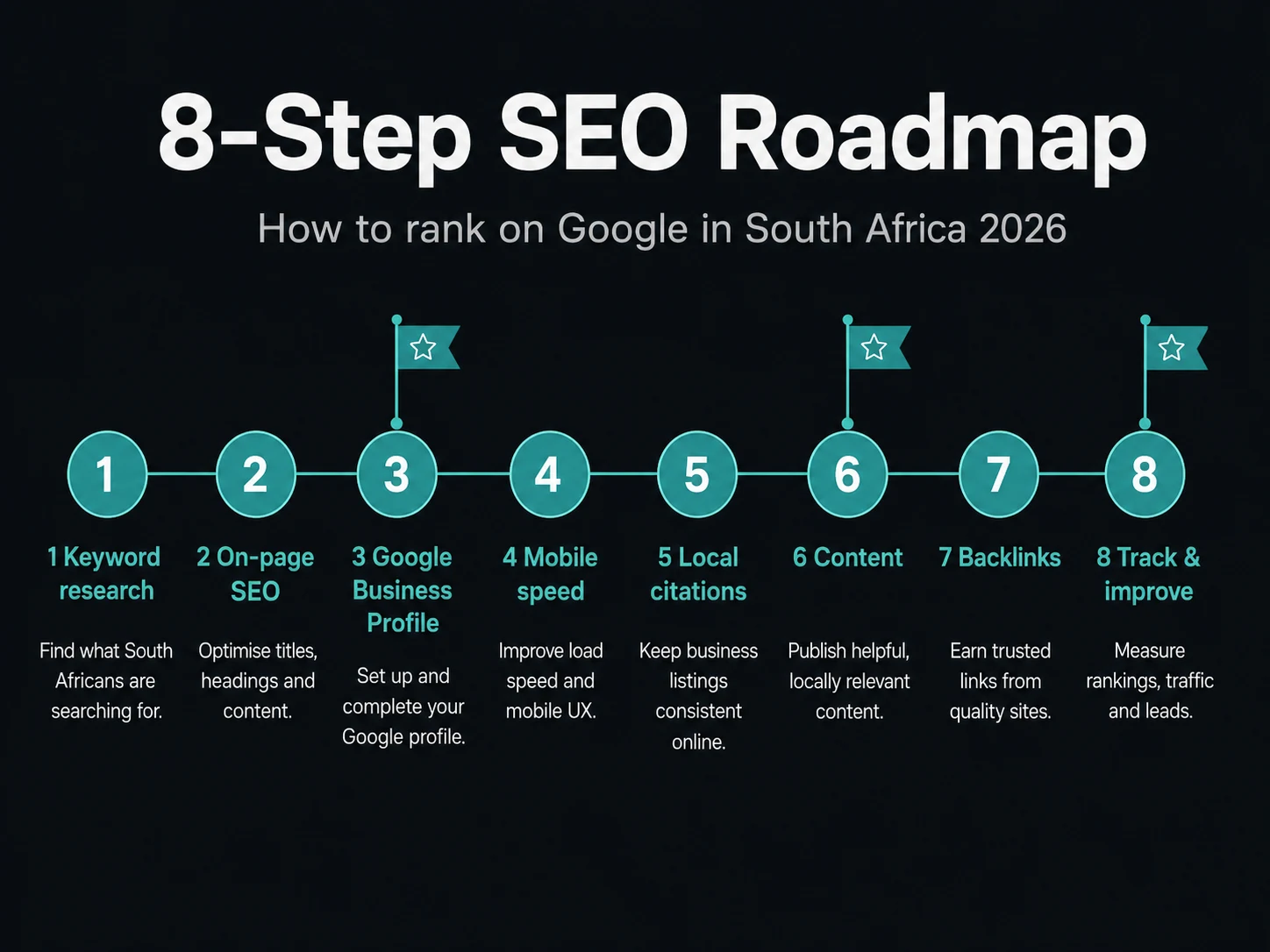
Step 1: Claim Your Google Business Profile — Your Most Powerful Free Tool
Before you touch your website, do this. Your Google Business Profile (GBP) is the listing that appears in the map pack — those three businesses with stars, addresses and phone numbers that dominate local search results. On mobile, it appears before everything else.
Half of South African small businesses either haven't claimed their profile or have claimed it and left it half-complete. That's the equivalent of having a shop but removing your sign. Google Maps is where "plumber Centurion" and "salon near me" searches get answered. If your profile isn't there, you simply don't exist for those searchers.
- Claim and verify your listing at business.google.com — takes 5 minutes and a phone call or postcard
- NAP consistency — your exact business Name, Address, and Phone number must match everywhere: GBP, website, Facebook, every directory
- Choose the right category — your primary category is one of the most important ranking signals in local search. Be precise: "Electrician" not "Home Services"
- Upload real photos — your shopfront, team, products, workspace. Listings with genuine photos get dramatically more clicks and calls
- Add all services with descriptions — list every service you offer with a brief description. Google uses this to match you to specific searches
- Actively collect reviews — ask every satisfied customer. Reviews are a direct ranking factor in local search. Respond to every review, good and bad
- Post regular updates — GBP posts (specials, announcements, seasonal offers) signal an active business to Google's algorithm
The Durban physiotherapy clinic in the research data grew appointment requests significantly using only local SEO — no ad spend. Their GBP optimisation was the centrepiece. If you do nothing else from this guide, do this step. It's free, it's fast, and it affects your visibility today, not in three months.
Step 2: Find the Words Your Customers Actually Type (Not the Words You Think They Do)
This is where most business owners go wrong. They optimise for what they'd call their service. Their customers search for something different.
An attorney might call their service "estate planning and testamentary matters." Their potential client types "how to write a will in Pretoria." An electrician says "residential electrical installations." Their customer types "electrician near me" or "lights tripping Johannesburg." The gap between professional language and how real South Africans actually search is where rankings are won and lost.
Google Keyword Planner (free, set location to South Africa), Ubersuggest, or just Google's own autocomplete are your starting tools. Type your main service and see what Google suggests. Those suggestions are based on what people actually search — not what businesses think they search.
Focus on long-tail, locally modified keywords. Not just "plumber" — "emergency plumber Centurion" or "burst pipe Pretoria North." These longer, more specific phrases have less competition and, critically, they come from people ready to act right now. Someone typing "emergency plumber Centurion" is not browsing. They have water on their floor. That's the customer you want.
Every service page on your site should include your suburb, city, and region naturally in the text. "We provide electrical installations across Centurion, Pretoria and the greater Tshwane area." This isn't keyword stuffing — it's how Google matches your page to searches that include location. If your page doesn't mention where you work, Google can't rank you for local searches.
Open your website right now. Does your homepage actually say what city and suburb you serve — clearly, in text, not just in your contact address? If not, Google might not know either.
Step 3: On-Page Optimisation — The 20% of Work That Drives 80% of Results
This is the technical-sounding part that's actually very simple. Each page on your website needs to clearly tell Google three things: what it's about, who it's for, and where you are. Here's how.
Title Tags and Meta Descriptions
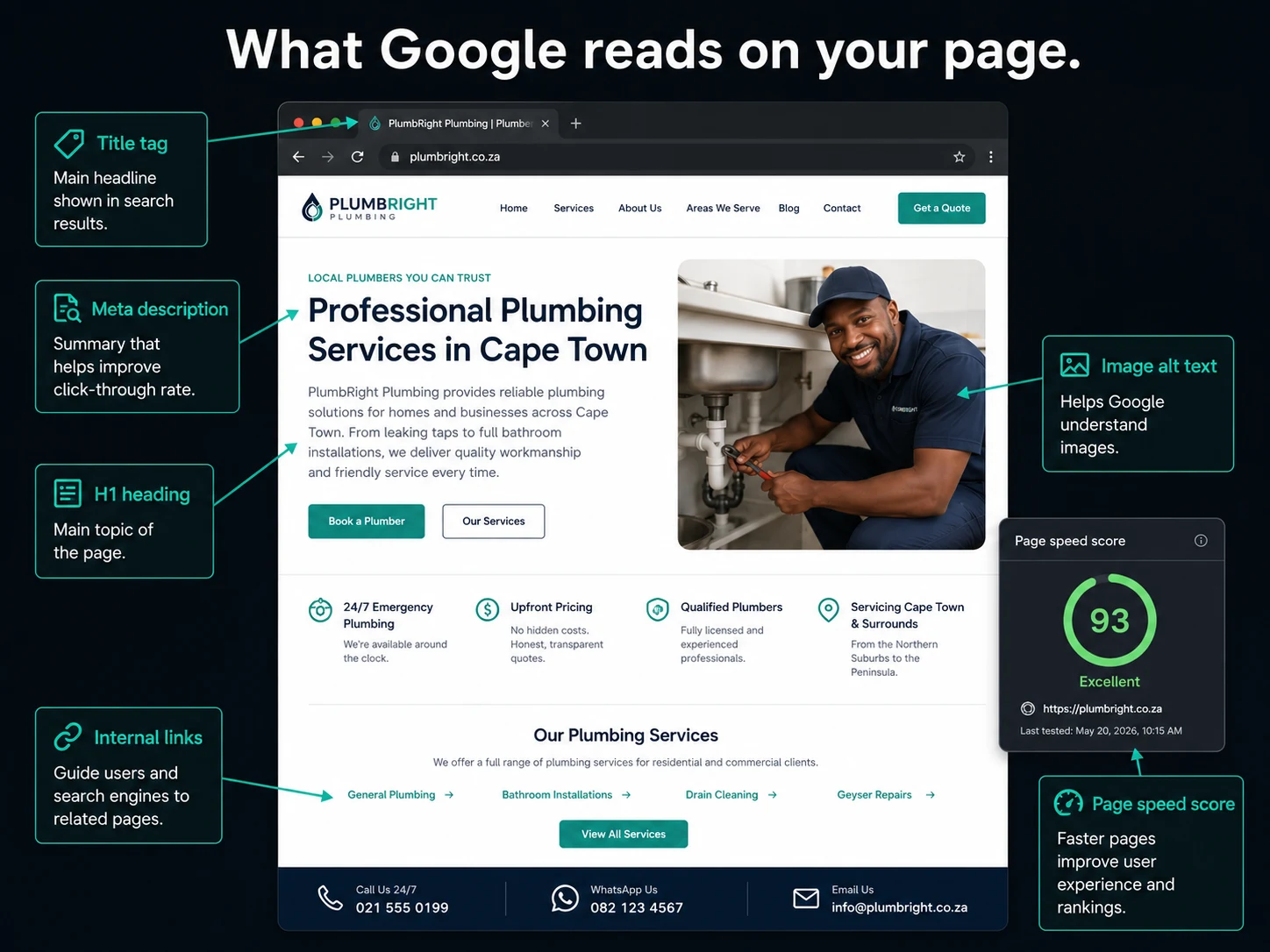
The title tag is the blue clickable headline that appears in Google search results. Meta description is the text beneath it. Most SA small business websites either leave these blank, use the same ones on every page, or write something useless like "Home | Business Name."
Write a unique title tag (under 60 characters) for every page that includes your primary keyword and location. Example: "Emergency Electrician Centurion | 24/7 | CJX Electric" — not "Home" or "Welcome to Our Website." Meta descriptions (under 155 characters) won't directly improve rankings, but a well-written one dramatically improves click-through rate — the percentage of people who actually click your result.
Headings and Content Structure
Your H1 (the main heading on each page) should include your primary keyword. Every page should have exactly one H1. Use H2 and H3 subheadings throughout to break up content and include secondary keywords naturally.
Write like a human explaining something to another human. Google's 2024 and 2025 algorithm updates have been systematically removing thin, generic content from rankings. The pages winning in 2026 are the ones that actually answer questions with specific, local, experience-backed information.
Image Alt Text
Every image on your site should have an alt text description. Google can't see images — it reads alt text to understand what's in them. "img_0034.jpg" tells Google nothing. "Chris Maboyi web designer Centurion office" tells Google exactly where you are and what you do.
- Unique title tag with primary keyword + location, under 60 characters
- Compelling meta description with a clear value prop, under 155 characters
- One H1 per page that includes the primary keyword
- H2/H3 subheadings throughout that include secondary keywords naturally
- Location mentioned in body text — not just the address, but woven into the copy
- Alt text on every image — descriptive, keyword-relevant, not keyword-stuffed
- Internal links to other relevant pages on your site — keeps visitors (and Google) exploring
- A clear call-to-action — "Call now," "Get a free quote," "Book an appointment." Every page should have one.
Step 4: Technical SEO — The Foundation That Makes Everything Else Work
You can have the best content in Gauteng and still rank on page 8 if your website's technical health is broken. Google won't rank a slow, mobile-unfriendly site highly — no matter how well-written it is. These are the non-negotiables.
Mobile-First (Not Optional in 2026)
Google primarily uses your mobile site to determine your ranking — not your desktop site. In South Africa, where a majority of internet usage happens on smartphones, a site that looks or loads poorly on mobile isn't just bad UX. It's an active ranking penalty. Test your site at search.google.com/test/mobile-friendly right now.
Core Web Vitals — Site Speed in Numbers
Google's Core Web Vitals are three specific speed and stability metrics that directly influence your rankings. Think of them as your site's report card.
- LCP (Largest Contentful Paint) under 2.5 seconds — how long it takes the main content of your page to appear. Slow sites lose visitors before they've even seen what you offer.
- INP (Interaction to Next Paint) under 200ms — how responsive the page feels when someone clicks or taps.
- CLS (Cumulative Layout Shift) under 0.1 — whether elements on your page jump around as it loads. Nothing drives people away faster than trying to click a button that keeps moving.
Common fixes: compress images and serve them in WebP format, minify your CSS and JavaScript files, use browser caching, and critically — don't use giant hero images with no size attributes. This single issue causes more CLS problems on SA small business sites than anything else.
HTTPS, Sitemaps, and the Basics
Your site must be served over HTTPS (the padlock in the browser bar). This is a ranking signal and a trust signal. If your site still shows "Not Secure," fix it today — most hosting providers offer free SSL certificates. Submit a sitemap.xml to Google Search Console so Google knows exactly which pages you want indexed. Fix any 404 broken links — Google sees these as signs of a poorly maintained site.
Step 5: Content — The Engine That Compounds Over Time
Here's what the Johannesburg décor retailer understood that most SA small businesses don't: every useful piece of content you publish is a new door into your website. Each one can rank for a different search. Each one can bring a different customer. And unlike an ad, once it's ranking, it keeps working forever.
That retailer grew organic traffic by 150% in six months — not by spending more, but by writing content their customers were searching for. Local design trends. How-to guides. Answers to common questions. Information people were already looking for, with the retailer's expertise woven through.
The most powerful content structure for local SA businesses is the hub-and-spoke model: one comprehensive "pillar" page covering your main service broadly, linked to several deeper "spoke" pages covering specific questions, locations, or sub-services. A plumber might have a pillar page for "Plumbing Services Pretoria" linking to spoke pages for "Geyser Replacement Centurion," "Drain Unblocking Midrand," and "Emergency Plumbing 24/7 Pretoria."
Aim for consistency over volume. One well-researched, genuinely helpful piece per month, published reliably, will outperform ten rushed, generic posts. Especially in 2026 — Google's March 2024 core update specifically targeted mass-produced low-quality content, and that signal has only strengthened since. Write about your actual experience. Use specific local examples. Mention real places. Say things your competitors are too generic to say.
When last did a customer ask you a question you found yourself explaining in detail? That explanation — the specific, experience-backed answer you gave — is a blog post. It's also a page one opportunity that no national competitor can replicate.
Step 6: Local Citations and Backlinks — How Google Decides If You're Trustworthy
Google doesn't just look at your website. It looks at what the rest of the internet says about you. Every other website that mentions or links to you is a vote of confidence — and the more credible the voter, the more weight it carries.
For local SA businesses, start with citations — consistent mentions of your business name, address and phone number on South African directories. BrightLocal identifies these as a foundational step for local SEO. The key directories: Yellow Pages (Brabys), Bizcommunity, Kompass ZA, your local chamber of commerce, and industry-specific portals. The NAP must be identical on every listing — not "Chris Maboyi Web Design" on one and "CJX Studios" on another.
For backlinks, quality matters far more than quantity. One link from a .gov.za or .ac.za domain — a government department, a university, a municipality — is worth more than fifty links from low-quality directories. Practically, this means: get listed on your local chamber of commerce website, get mentioned in a local news article, write a guest post for an SA industry blog, sponsor a local event (with a web credit). These are slow to build. They compound massively over time.
Never buy backlinks. Never use link farms. Google's algorithm specifically penalises "scaled content abuse" and artificial link schemes. A penalty can remove you from search results entirely — and recovering takes months. Build links the slow way. It's the only way that lasts.
Step 7: The 6 SEO Mistakes Still Costing SA Businesses Thousands in 2026
Knowing what to do is half the job. Knowing what's silently killing your rankings is the other half.
Step 8: Measuring What Actually Matters
SEO without measurement is a prayer, not a strategy. Set up these two tools — both free — before you do anything else on this list.
Google Search Console shows you every search term your site appeared for, how many times it appeared (impressions), how many times someone clicked (CTR), and your average position. This is the most important data in SEO. Look for pages with high impressions but low CTR — those are opportunities to rewrite your title tags and meta descriptions to get more clicks from rankings you already have.
Google Analytics 4 shows you what people do after they land on your site — how long they stay, which pages they visit, and whether they complete your goals (form submissions, phone clicks, bookings). Without conversion tracking, you have no idea if your SEO is producing business — only if it's producing traffic.
Set a monthly check-in with these tools. Note where rankings are improving. Note where traffic is landing but not converting — those pages need better CTAs or clearer content. In three months, you'll have the data to double down on what's working and cut what isn't.
The 12-Month SA SEO Roadmap (Plain English)
SEO Tactics at a Glance: Effort vs. Return
| Tactic | Effort | ROI for SA Local Business | When to start |
|---|---|---|---|
| Google Business Profile optimisation | Low | Very High | Day 1 |
| Title tags & meta descriptions | Low | High | Day 1 |
| SA directory citations (NAP) | Low | High (local) | Week 1 |
| Mobile & Core Web Vitals | High | Medium–High | Month 1 |
| Content creation (blog / service pages) | High | Very High (long-term) | Month 2–3 |
| Keyword research | Low | High (guides everything) | Month 1 |
| Local link building | High | Very High (authority) | Month 3+ |
| Schema markup | Low | Medium (rich results) | Month 2 |
| GSC + GA4 tracking | Low | High (informs all else) | Day 1 |
The Part Nobody Talks About: Your Website Is the Foundation of All of This
Here's the uncomfortable truth that ties everything in this guide together: SEO can't save a bad website.
Google's algorithm has one question: is this website the best result for this search? "Best" means fast, mobile-optimised, easy to navigate, credible-looking, and filled with genuinely useful content. If your site is slow, amateur-looking, or technically broken — the SEO work you layer on top will underperform. You're building on sand.
The Johannesburg décor retailer that grew 150% organically? They built their SEO on a properly optimised, fast, well-structured website. The Cape Town tour operator that doubled their bookings? Same story. The technical foundation didn't get the credit in the headline numbers — but without it, the content and links wouldn't have worked.
This is the part of my work I'm most deliberate about. Every site I build at CJX comes with proper title tags, clean code, fast load times, mobile-first design, and an SEO structure that gives your content the best possible chance of ranking. Most of my clients are business owners — not developers. They shouldn't have to think about Core Web Vitals or schema markup or canonical URLs. That's my job. Their job is to run their business.
If you want to see what a properly built, SEO-ready website looks like for your specific business — I'll build you a free demo in 48 hours. A real, live website. You test it. You love it, we talk. You don't, you walk away with nothing lost.
Your page one ranking starts with the right website foundation.
I build SEO-ready websites for South African businesses in 48 hours — with proper title tags, fast load times, mobile-first design, and local SEO structure built in from day one. See yours before you pay a cent.
Zero deposit · No lock-in · Pay only if you love it · Centurion & nationwide
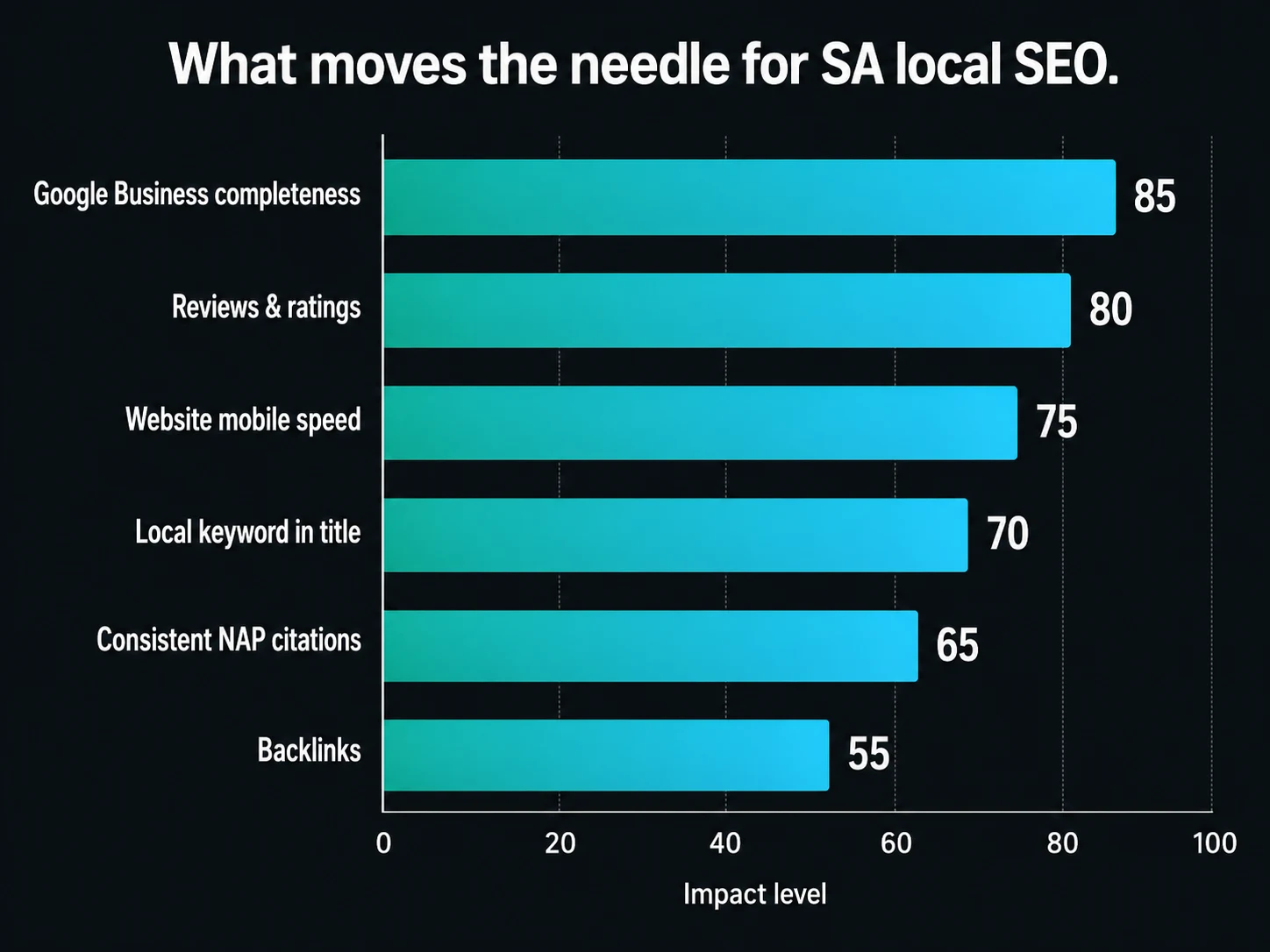
- Start with Google Business Profile. It's free, it's fast, and it's the highest-ROI action a local SA business can take. An optimised GBP listing appears in map results before your website ever does.
- SEO is a 6–12 month game — but it compounds forever. Each well-written page, each citation, each backlink adds to an asset that keeps generating leads without ongoing spend. The businesses ranking on page one today started 12 months ago.
- None of it works without a fast, mobile-first, properly structured website. Content and backlinks are the fuel. Your website is the engine. Build the engine first — everything else follows.