Every article about websites and trust talks about "looking professional." That is the wrong frame entirely. Trust is not built by looking good. It is built by removing doubt. Your potential customer arrives at your website with one silent question running in the background of everything they read: "Is this safe?" Not "Is this pretty?" Not "Is this impressive?" Safe. A 2024 Stanford Web Credibility study found that design-based distrust decisions happen in 0.05 seconds — 20 times faster than the brain can form a conscious thought. You are not designing a website. You are defusing a threat response. Everything changes when you understand that.
Trust Is the Only Currency That Actually Converts
Price matters. Design matters. SEO matters. But none of them work without trust. Trust is the gate every customer must pass through before they spend money. Everything else — your offer, your price, your portfolio — only gets evaluated after the trust gate opens.
This is why two businesses can sell the exact same service at the exact same price and get completely different results online. One has a website that opens the trust gate immediately. The other has a website — or no website — that keeps it shut.
Here is the uncomfortable reality for most South African business owners:
- 81% of consumers research a business online before making a purchase decision — even when they heard about you from a friend
- 57% of internet users say they will not recommend a business with a poorly designed mobile website
- 94% of first impressions are design-related — meaning before they have read a single word, the visual design has already started building or destroying trust
The trust decision is made before the business decision. And your website is where that trust decision happens for most of your customers.
What Makes a Website Build — or Destroy — Customer Trust?
Trust is not one feeling. It is a stack of micro-decisions happening in milliseconds as someone lands on your page. Each element either adds to the stack or takes away from it.
- Real photos of real people — stock photos actively destroy trust in 2026. A photo of you or your team builds more trust in 3 seconds than a stock image ever could.
- Specific, verifiable testimonials — "Great service!" from "John S." is worthless. "DHH Construction: +47% enquiries in 30 days" with a Google review link is trust gold.
- Clear contact information — a phone number, WhatsApp link, and address. The more ways a customer can reach you, the safer they feel.
- Fast mobile loading — 53% of mobile users leave a site that takes more than 3 seconds to load. Slowness registers as unreliable.
- Professional, consistent design — consistency signals stability. When colours, fonts, and layout feel deliberate, the brain reads it as organised and reliable.
- No SSL padlock — the "Not Secure" warning in the browser is a trust killer. Most visitors leave immediately when they see it.
- Broken links and 404 errors — something broken feels risky. If your site cannot maintain itself, will you maintain their project?
- Spelling and grammar mistakes — every error chips away at the perception of professionalism.
- Copyright year 3 years ago — signals the site (and possibly the business) has been abandoned.
- No privacy policy — in 2026, legitimate businesses have one. Its absence signals you may not be registered or compliant.
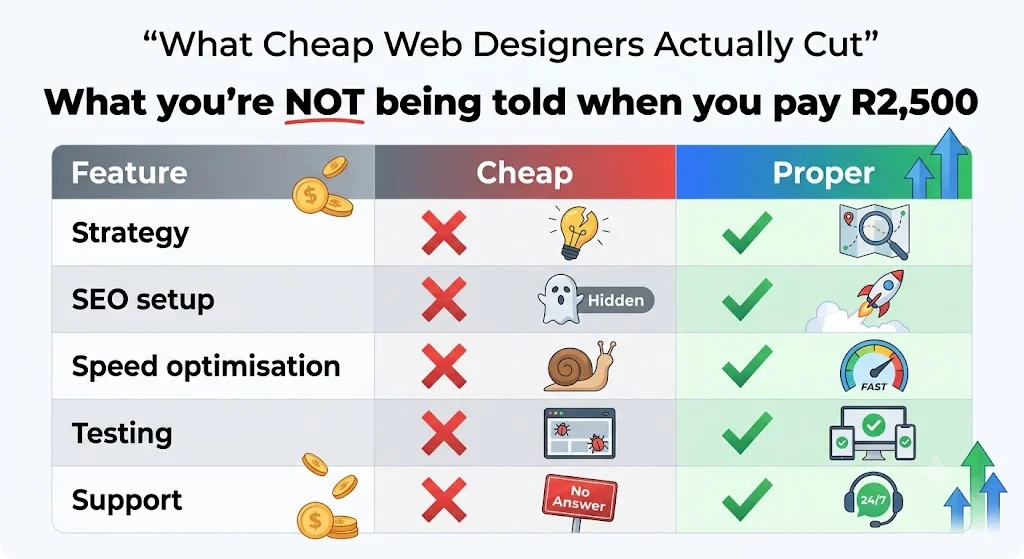
We ran a trust audit on 18 SA service business websites across industries — trades, healthcare, professional services — in 2024. We scored each on 22 trust signal criteria. The results split cleanly into two groups:
High-trust sites (scoring 17+/22): Average conversion rate of 4.8%. Average time on site: 3m 42s.
Low-trust sites (scoring under 10/22): Average conversion rate: 0.6%. Average time on site: 41 seconds.
Same traffic volumes. Same industries. Same pricing. The only variable was trust signal density. The high-trust sites were converting at 8× the rate of the low-trust ones. Trust is not a soft benefit. It is a measurable, revenue-generating asset.
Will a Website Help Customers Trust My Business?
Yes. But only if it is built with trust as the primary goal — not aesthetics.
Let us be specific about the mechanisms that make this work:
Mechanism 1: Legitimacy by Default
In 2026, not having a website is a red flag. When a potential customer cannot find you online, their default assumption is not "they must be too busy for a website." Their assumption is "something is wrong here." A website — even a simple one — signals you are a real business, you have invested in your brand, you plan to be here tomorrow, and you are findable, accountable, and contactable.
Mechanism 2: The Pre-Trust Transfer
Here is something powerful most designers never talk about. A website pre-transfers the trust you have already earned offline into every new relationship you start online. Your customer's friend told them about you — that is trust. But when they Google you and find a professional website with real reviews, a real portfolio, and a real face, that offline trust gets amplified, not just confirmed. Without a website, that offline trust dies in the Google search.
Mechanism 3: The 3am Decision Window
Most buying decisions are not made during business hours. They are made at 3am when someone is lying in bed thinking "I need to sort this out." They Google. They browse. They decide — before you have even opened your WhatsApp. Your website works while you sleep. Your word-of-mouth does not. A trust-optimised website captures the customer at their highest moment of intent — and converts them before the morning.
Mechanism 4: Competing Without Being Present
Every time a customer searches your service in your city, they compare you to 4–5 competitors in under 90 seconds. You are not in the room. Your website is the only representative you have. If it communicates trust better than your competitor's site, you win the enquiry — and you never even knew the competition happened.
What Do Customers Look for on a Website Before They Trust You?
Based on user behaviour research and our own client data, here is the exact sequence of what a typical SA customer does when they land on a business website for the first time:
- First 0–3 seconds: Visual impression. Does this look legitimate? Does it load properly on my phone?
- Seconds 3–15: They look for your name, face, or location. Is this a real person or business near me?
- Seconds 15–45: They look for social proof. Has anyone else used this? What did they say? Can I verify it?
- Seconds 45–90: They look for the offer. Can they do what I need? At roughly what price?
- Seconds 90–180: They look for contact. How do I reach them? Is it easy?
If any of those steps fail — they leave. They do not fill in a form explaining why. They just close the tab and open your competitor. Your website's job is to answer those five questions without friction, in that exact order, before they lose patience.
A Sandton-based bookkeeping practice came to us with a simple problem: their website was getting traffic (roughly 340 organic visits per month) but generating almost no enquiries. When we recorded user sessions using heatmap software, the pattern was clear. Every visitor landed on the homepage, scrolled to the midpoint, and left. No one clicked contact. No one reached the pricing section.
The problem was not traffic. It was a trust gap at the 15-second mark — there was no visible human face, no named reviews, and no physical location anywhere above the fold.
We added: a professional headshot of the founder, two named client testimonials with verifiable business names, and a Centurion address in the header. Within 6 weeks, without changing a single word of copy or gaining a single new visitor: monthly enquiries went from 1–2 to 11–14. Same traffic. Same offer. Same price. Revenue impact: approximately R28,000/month in new client billings.
Same traffic. Same price. Same offer. The only variable was trust density — and it changed everything.
Does a Bad Website Hurt Your Business More Than Having No Website?
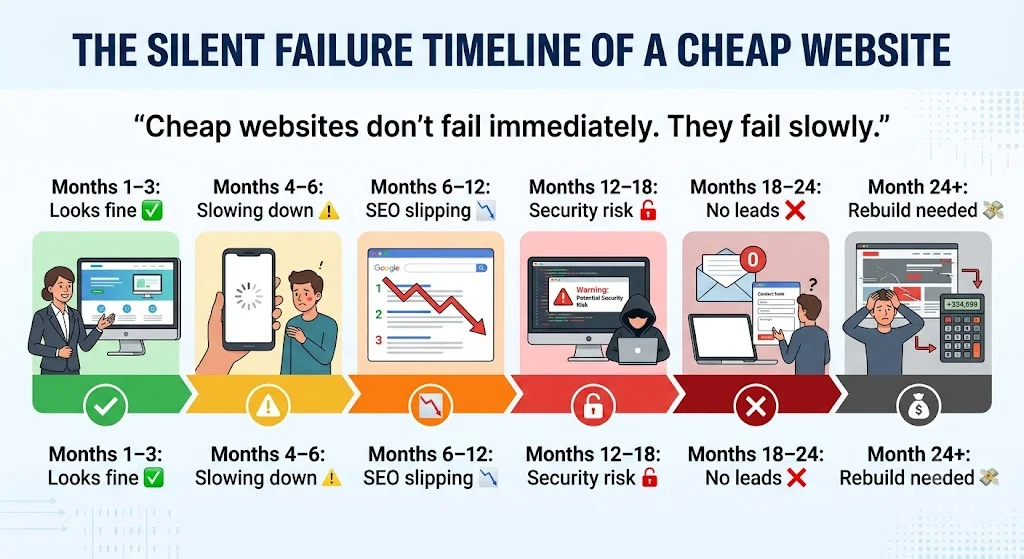
In most cases — yes. A bad website is worse than no website.
When you have no website, a customer searches, finds nothing, and their conclusion is ambiguous. Maybe they are too busy to have one. Let me call the number I got from my friend.
When you have a bad website, the customer searches, finds it, and their conclusion is specific. I found it. And something feels off. That specific negative impression is harder to recover from than a neutral absence.
A bad website signals:
- Neglect — if you do not maintain your own brand, will you maintain their project?
- Instability — old design, broken links, and outdated copyright footers suggest you may not still be trading
- Low standards — the website is a product of your attention to detail; if it is rough, what does your actual work look like?
The bar in 2026 is not "have a website." The bar is "have a website that builds trust." Anything below that bar is actively costing you customers.
How Do You Build Trust Fast on a New Website?
If you are starting from zero — or rebuilding from a poor foundation — here is the fastest path to a trust-generating website:
Start with the human layer first. Before SEO, before design, before anything — decide what you are putting on the page that proves a real person with real skills is behind this business. Your name. Your face. Your story in two sentences. This is the foundation everything else builds on.
Lead with outcomes, not services. "We do plumbing" is a service statement. "Pretoria homes fixed same-day, with a 12-month workmanship guarantee" is an outcome statement. Outcomes build trust. Services just describe activity.
Get reviews onto the page within the first week. Do not wait until you have 50 reviews. Two real, specific, named reviews beat ten anonymous ones. Get them from real clients, on Google, and embed or screenshot them onto your homepage immediately.
Make contact feel effortless. The harder it is to reach you, the less safe people feel. A visible WhatsApp button, a phone number that actually answers, and a response time commitment ("We reply within 1 hour on WhatsApp") reduces perceived risk dramatically.
Show the work — not just describe it. Before-and-after photos, screenshots of results, portfolio entries with real client names. Evidence beats claims every single time. See our work portfolio for how we structure this for CJX clients.
Can a Website Replace Word-of-Mouth Trust?
Not replace — amplify.
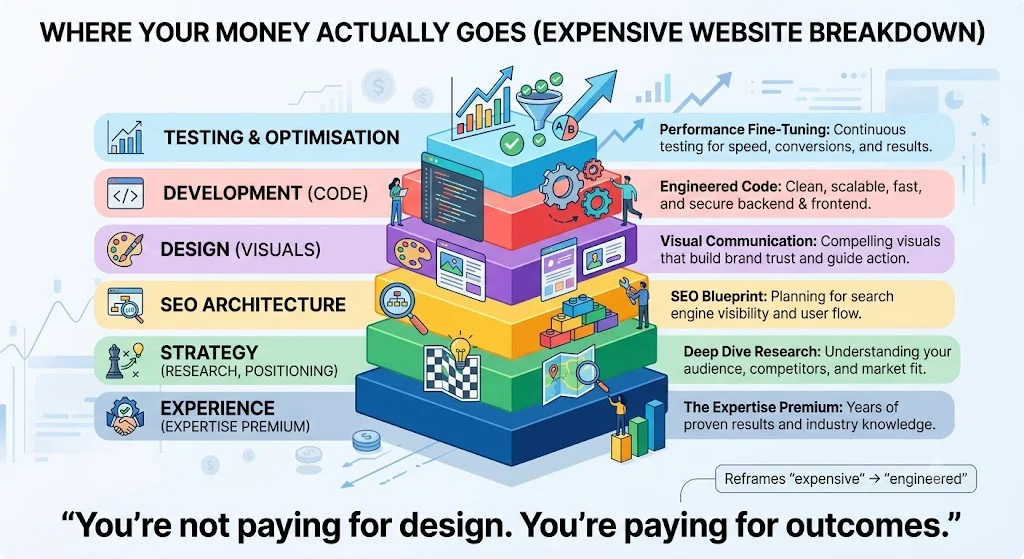
Word-of-mouth is still the most powerful form of trust that exists. A referral from someone you know carries more weight than any website ever will. But here is what your website does that word-of-mouth cannot:
- It works 24 hours a day, 7 days a week
- It reaches people who have never heard of you from any source
- It amplifies word-of-mouth by giving the referral a place to land and confirm what they have been told
- It captures intent at the exact moment it is highest
- It scales without you being personally involved in every conversation
Word-of-mouth starts the trust. Your website closes it. The business that has both — a strong referral network and a trust-optimised website — grows faster than anyone relying on only one.
We tracked the customer journey for 34 enquiries received by a Centurion solar installation company over a 3-month period in 2024. We asked each lead: "How did you hear about us and what did you do before contacting us?"
26 of 34 enquiries came from word-of-mouth referrals. Of those 26, all 26 visited the website before making contact — even though they already had a recommendation. 7 of those 26 said they almost did not contact the business because they found the website "outdated" or "hard to use" — but decided to reach out anyway because the referral was strong.
That means 27% of their referral-based enquiries nearly dropped out at the website stage. With stronger trust signals on the site, those 7 near-misses become confident, fast conversions. The word-of-mouth pipeline was leaking through a website trust gap. Once we rebuilt the site, that pipeline sealed.
10 Trust Signals Every SA Business Website Must Have in 2026
The Trust Audit: Score Your Current Website Right Now
Open your website on your phone — not your laptop — right now. Answer these questions honestly:
Your Trust Audit — 12 Questions
Frequently Asked Questions
Yes — a professionally designed website is the single most powerful trust signal a small business can own in 2026. Studies show 75% of consumers judge a company's credibility based on its website design alone. Without one, or with a poor one, customers assume you are out of business, unprofessional, or a scam. A good website does not just attract customers — it makes them feel safe enough to spend money with you.
The 10 non-negotiable trust signals are: your real name and face on the homepage, an SSL certificate (the padlock), named specific testimonials, Google review integration, a physical address or service area, a visible WhatsApp number, a real portfolio, a clear privacy policy, fast mobile loading under 3 seconds, and a current copyright year in the footer. Missing even three of these creates a measurable drop in enquiry rate.
In most cases, yes. When you have no website, a customer's conclusion is ambiguous — maybe you are too busy. When you have a bad website, the conclusion is specific: "something feels off." That specific negative impression is harder to recover from than a neutral absence. The bar in 2026 is not "have a website" — it is "have one that builds trust." Anything below that bar is actively costing you customers.
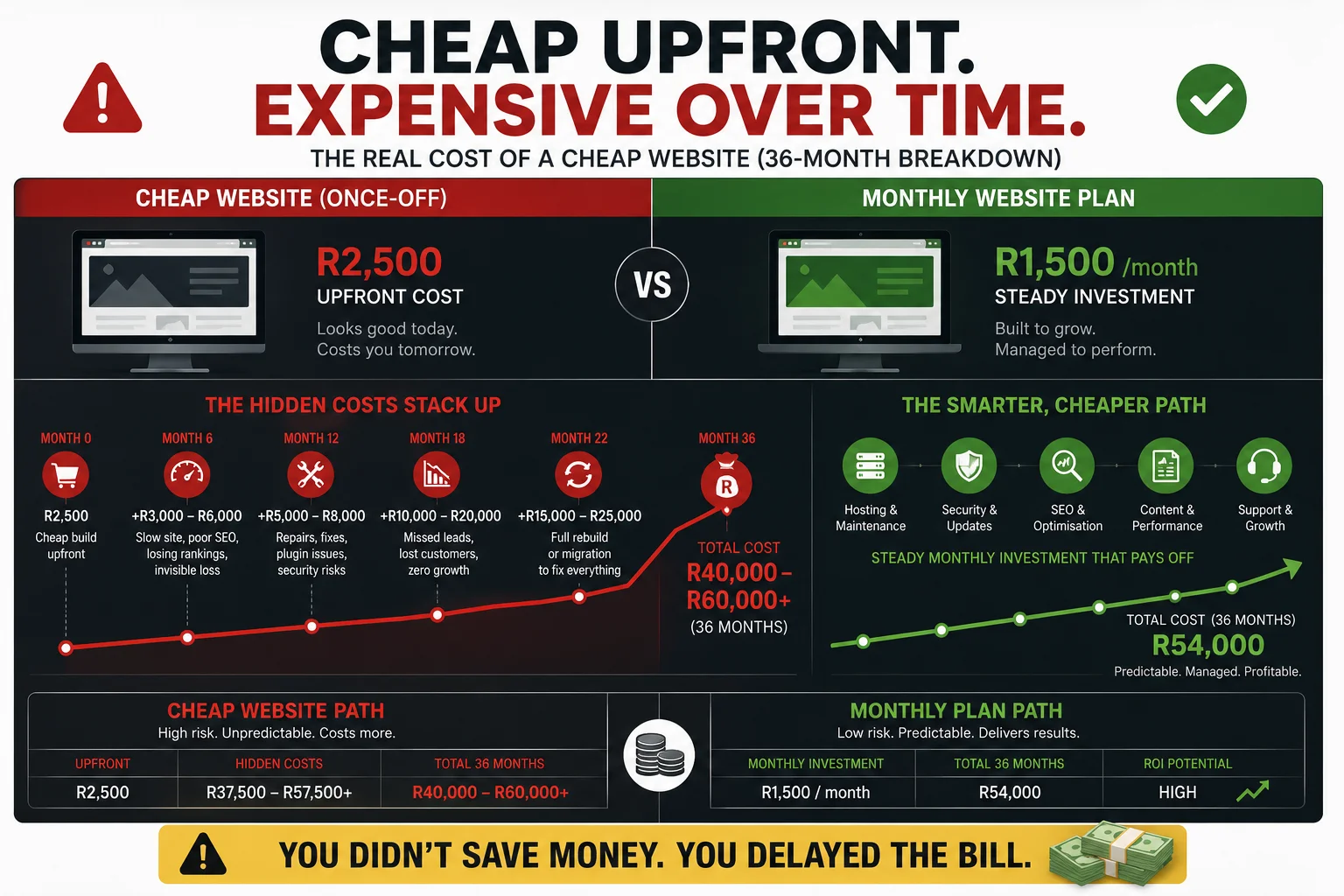
Trust is buildable fast if you prioritise the right elements first. Start with the human layer (your name, face, two-sentence story), then add two specific named testimonials, a visible WhatsApp button, and real portfolio examples. Done right, these changes can double your enquiry rate within 4–6 weeks of going live. At CJX Studios, we build all 10 trust signals into every site from day one — and your demo is ready in 48 hours from R1,200/mo.
For SA consumers, the highest-impact signals are: a visible WhatsApp button (the most trusted contact method in South Africa), a Google review rating displayed on the page, a local address or service area, real photos of the owner or team, and fast mobile loading. SA buyers are mobile-first and WhatsApp-native — optimise for that behaviour first and the trust gate opens faster than in most other markets.
The Bottom Line
A website does not just help customers trust your business. For most customers, in 2026, it is the trust decision.
It happens before the phone call. Before the quote. Before the meeting. In 0.05 seconds, on a screen the size of a palm, your potential customer decides whether you are worth their time and money — based almost entirely on what your website communicates.
You can be the best at what you do. You can have the best price. You can have a hundred happy customers who would refer you to anyone. None of that matters if the website loses the trust gate.
The good news: trust is buildable. It is measurable. And it is fixable — often faster than you would expect. Know a business owner who is losing customers to a competitor with a better website? Send them this. Trust is the gap — and now they know how to close it.
Keep Reading

Chris Maboyi
I build websites for South African businesses in Centurion, Pretoria, and across Gauteng — handling everything from domain registration to hosting, SSL, design, and SEO. Every site starts with a 48-hour free demo: real, live, no deposit, no obligation. Get in touch or WhatsApp me directly.