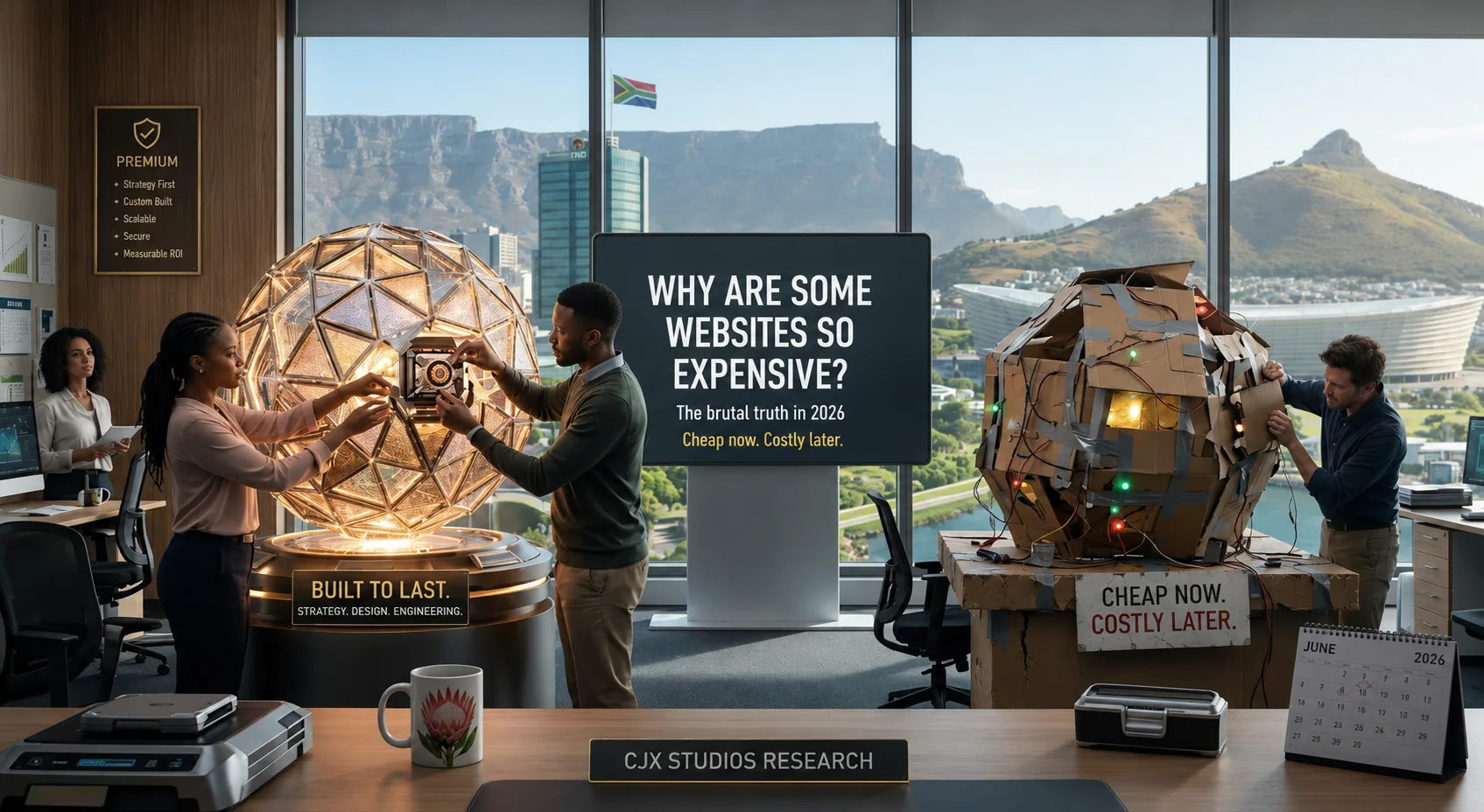
Websites cost more when they are built to actually work: fast loading, Google-optimised, secure, mobile-first, and designed to turn visitors into enquiries. Cheap websites usually cut strategy, clean code, SEO architecture, testing, and support. They can look similar on day one, but six months later the stronger build is far more likely to rank, convert, and stay stable.
What makes a website expensive?
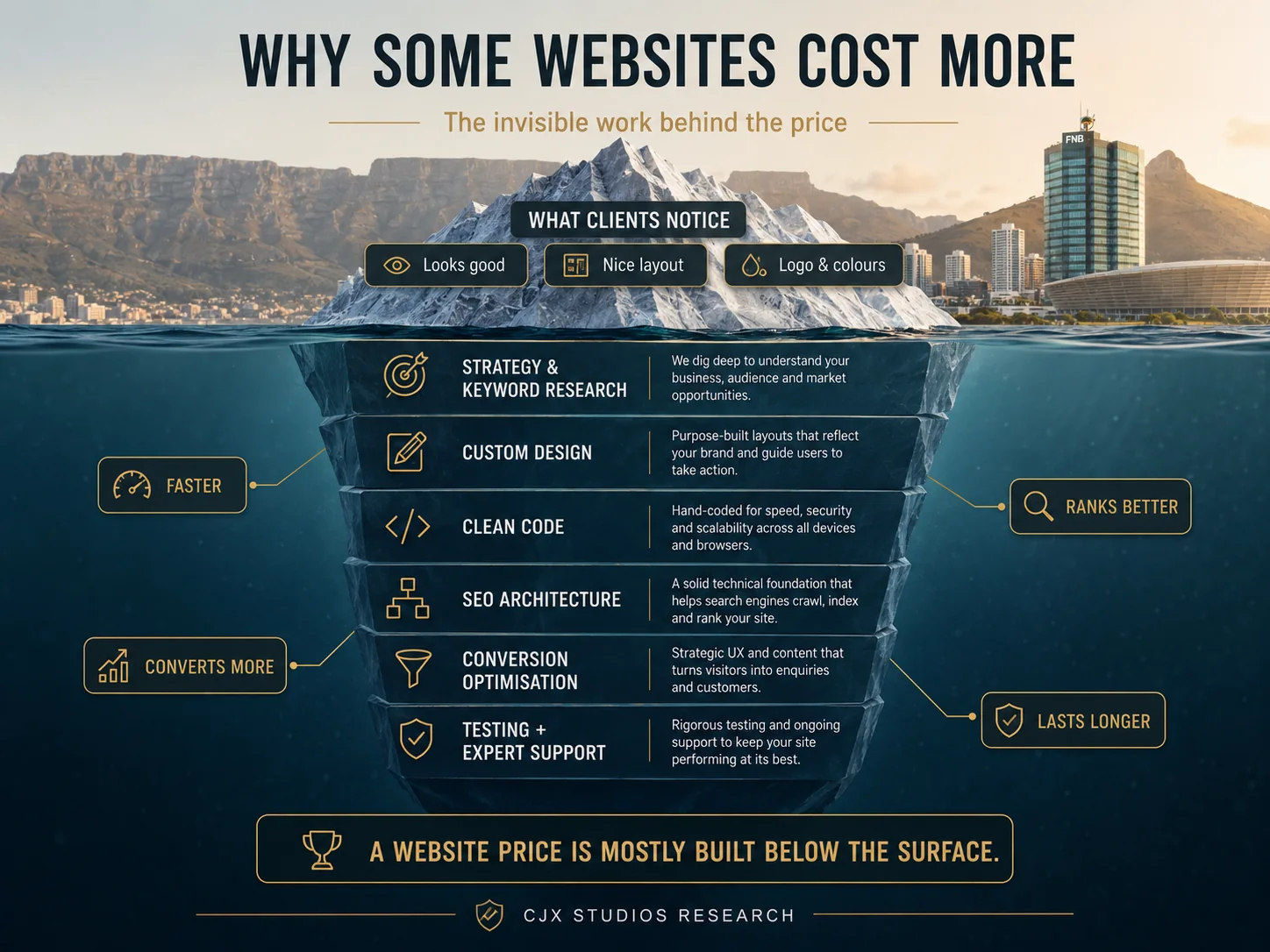
A website becomes expensive when the builder is paid for business outcomes, not only pages on a screen. You are paying for decisions that influence whether Google can crawl the site, whether a visitor trusts it, whether the contact form works, and whether the site keeps performing after launch.
The uncomfortable truth: a R2,500 site and a R25,000 site can both look "professional" in a browser screenshot. The difference sits under the surface, where most first-time buyers are not trained to look.
1. Strategy before design
A serious build starts before colours and layouts. The designer should understand what you sell, which customers matter most, what those customers search, what your competitors say, and what action the website must produce. For a service business, that action is usually calls, WhatsApps, quote requests, or bookings.
Skip this phase and you get a pretty site with no commercial spine. It may describe the business, but it does not guide the buyer.
2. Custom structure instead of template dragging
Templates are not evil. Using one blindly is. A cheap build often starts with a layout made for everyone and then swaps in your logo, a few images, and generic service text. A stronger build shapes the page around your offer, trust signals, buyer objections, and local search intent.
3. Clean code and performance
Google does not admire your homepage like a human. It reads the code, layout shifts, headings, image weight, links, and speed. Bloated page builders can produce a site that looks fine while loading slowly and confusing search engines.
This is why the Wix vs custom website debate matters for businesses that rely on Google. The tool is not the issue. The technical ceiling is.
4. SEO architecture built in from day one
Retrofitting SEO onto a weak website is like fixing plumbing after the tiles are already on the wall. It can be done, but it costs more and takes longer. A proper build includes heading hierarchy, page titles, meta descriptions, schema markup, internal links, image alt text, crawlable URLs, and a sitemap.
If your website is meant to bring in search traffic, read the SA ranking checklist before accepting a quote. It gives you the baseline items that should not be optional extras.
5. Conversion planning
A website that gets visitors but no leads is an expensive brochure. Conversion work includes CTA placement, mobile button design, contact form friction, proof, reviews, service-area clarity, and the order in which information appears. These choices are not decorative. They are the difference between "nice site" and "new enquiry".
Why are some websites so much cheaper?
Because someone is cutting work you cannot easily see. That does not make every low-cost provider dishonest. Some are students, part-time freelancers, or newer designers trying to build a portfolio. The risk is that your business becomes their training ground.
Cheap quotes usually cut:
- Research: no keyword, competitor, or buyer-intent work.
- Custom design: template first, business second.
- Code quality: heavy plugins, inline clutter, weak semantics.
- SEO setup: maybe a plugin, rarely an actual search strategy.
- Testing: looks good on one laptop, not across real mobile devices.
- Support: the WhatsApp replies slow down after the final payment.
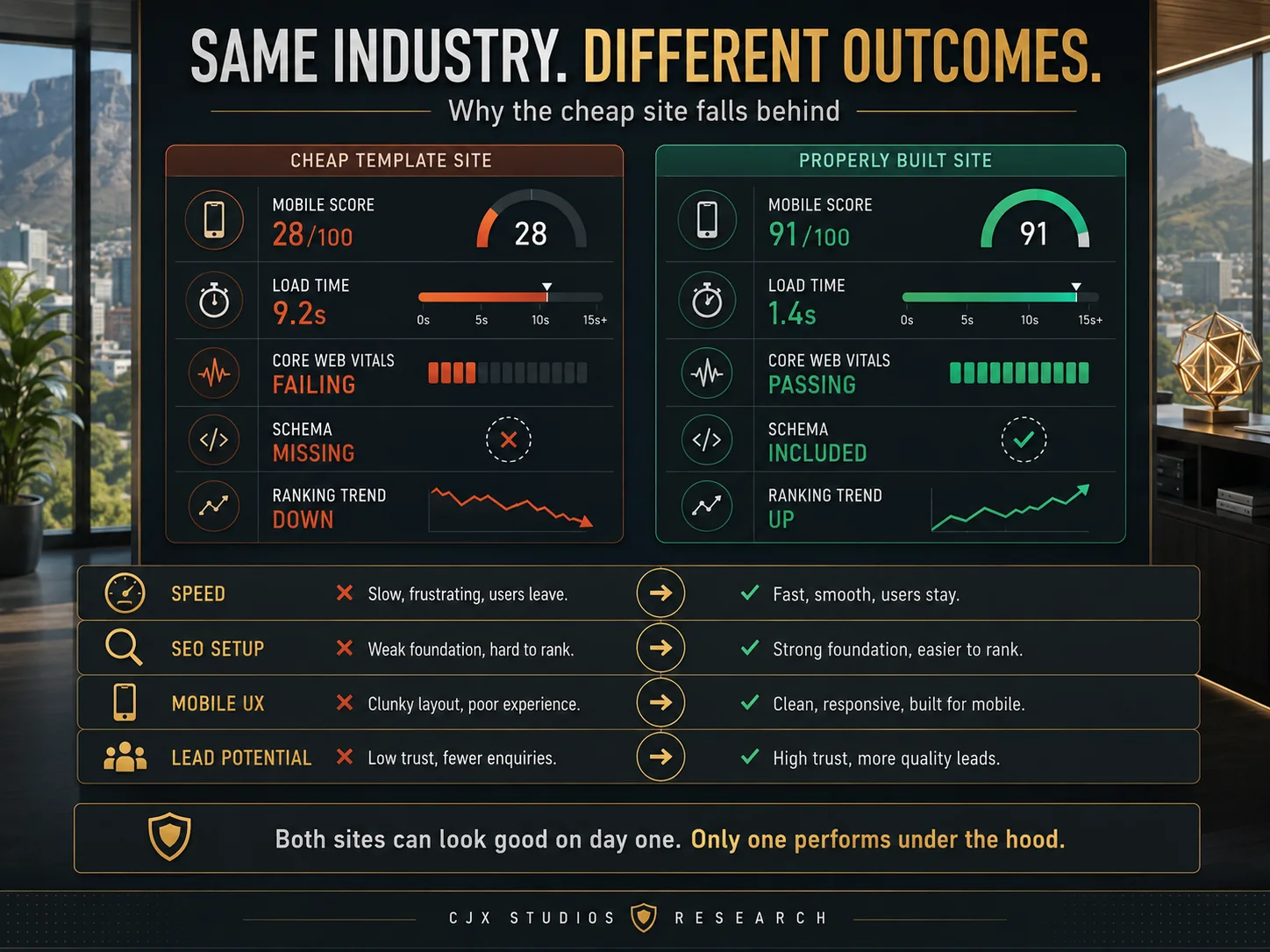
We often see SA service businesses with a cheap website that has no schema, missing meta descriptions, oversized images, no Search Console setup, and a contact form that nobody has tested in months. The owner thinks the site is "not working". The sharper diagnosis is simpler: it was never built as a lead system.
What does a cheap website cost long-term?
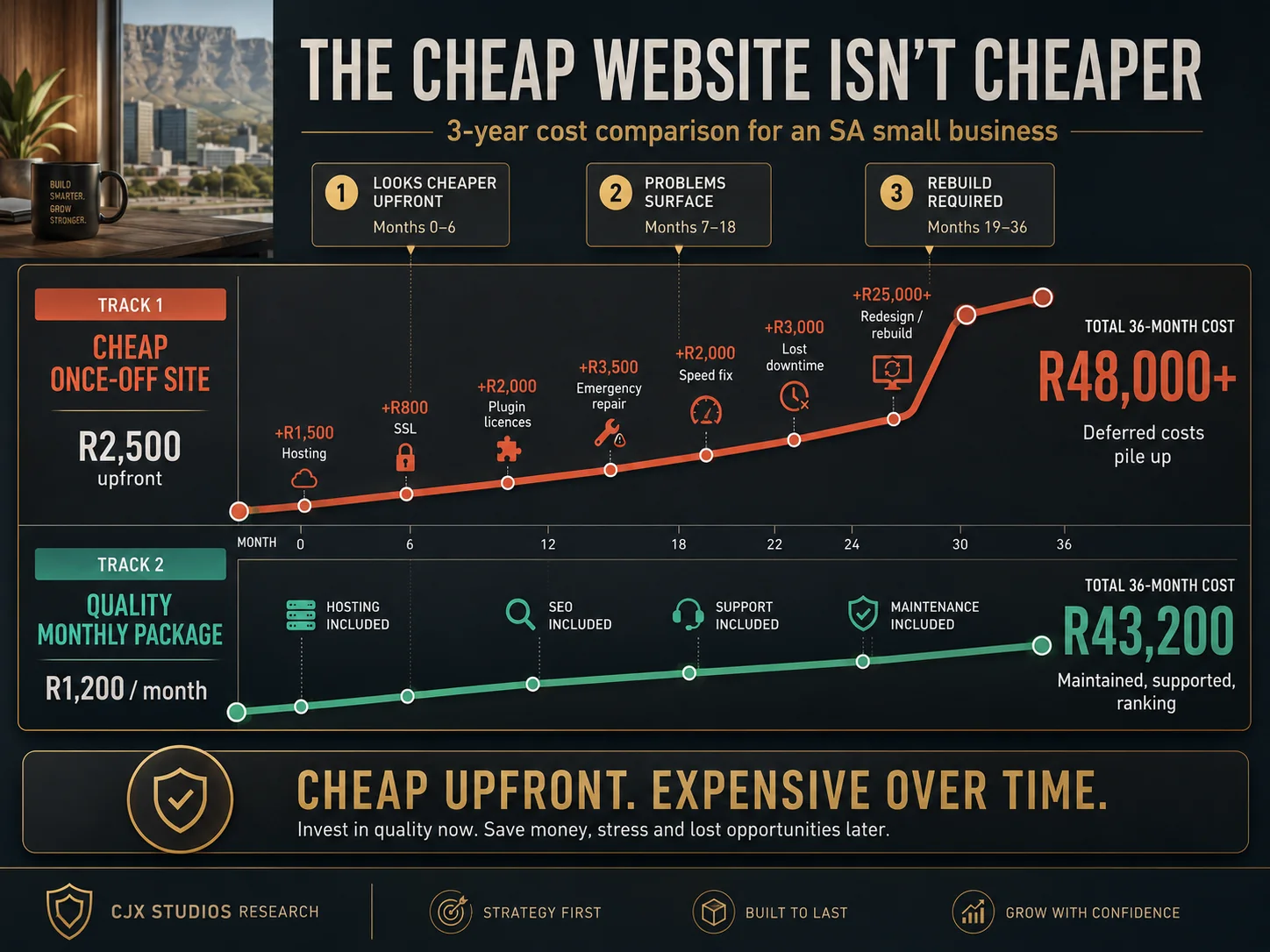
The cheap website is rarely cheaper. It is often deferred expensive. The first invoice is low because the second, third, and fourth invoices are hiding in the future: repairs, plugin conflicts, poor hosting, SEO rescue work, content rewrites, and finally a rebuild.
Cheap site risk
- Slow mobile load time
- No technical SEO foundation
- Weak ownership terms
- Unclear support after launch
- Higher chance of rebuild in 18-24 months
Proper build advantage
- Built around search intent
- Cleaner code and stronger speed
- Clear calls to action
- Measured support process
- Easier to optimise month after month
Is an expensive website always better?
No. Price is not proof. Some agencies charge premium prices for templated work, weak SEO, and vague reporting. What you want is evidence of outcomes: live client sites, rankings, speed scores, support terms, ownership clarity, and a written scope.
Ask for live URLs, not screenshots. Run them through PageSpeed Insights. Search for the client's main service plus their city. If the provider's existing work is slow and invisible, your expensive quote may just be expensive.
The better question is not "Why is this website expensive?" It is "What revenue risk disappears if this is built properly?"
How much should a website cost in South Africa in 2026?
For most SA small businesses, a fair website price depends on the commercial job the site must do. A brochure site for credibility is not priced like a local SEO lead machine. An e-commerce store is not priced like a five-page service website.
| Provider type | Typical range | What you usually get | Best fit |
|---|---|---|---|
| Student / side hustle | R800-R3,000 | Template setup, basic pages, little SEO | Very early idea validation |
| Part-time freelancer | R3,000-R8,000 | Better design, limited support, basic setup | Small brochure site |
| Dedicated web studio | R8,000-R20,000 | Custom structure, SEO setup, support, testing | Businesses needing leads |
| Monthly package | R1,200-R3,500/mo | Build, hosting, maintenance, SEO care, updates | Owners who want momentum without a large deposit |
| Full-service agency | R25,000-R80,000+ | Large scope, team delivery, custom integrations | Bigger brands and complex projects |
For a deeper market breakdown, compare this with our guide to website costs in South Africa and the once-off vs monthly website package cost curve.
What should be included in the price?
A professional website quote should make the invisible work visible. If these items are missing, either the quote is incomplete or the price should be lower.
- Mobile-first design tested on real screen sizes
- Clear page structure with one H1 and logical H2/H3 hierarchy
- SEO title and meta description for each core page
- Compressed images with useful alt text
- SSL certificate and secure hosting setup
- Google Analytics and Search Console integration
- XML sitemap and indexable URLs
- Contact form testing before launch
- Post-launch support window and response process
CJX packages put this into a monthly system instead of a once-off handover. See the current website pricing or the service breakdown on our website design services page.
How do you know if a website quote is fair?
Use a simple five-point test. It is not perfect, but it catches most expensive mistakes before money moves.
- Ask for live client URLs. Screenshots do not show speed, code, or search visibility.
- Check mobile speed. If their client sites score badly, ask why yours will be different.
- Search the client on Google. A designer who talks SEO should have examples that rank.
- Ask who owns the domain and content. You should not be trapped by your own website.
- Get the scope in writing. "Trust me" is not project management.
9 hidden costs of a cheap website
- Hosting billed separately after launch.
- SSL setup or renewal surprises.
- Premium plugin licences nobody explained.
- Emergency hack cleanups.
- Speed optimisation after users start leaving.
- SEO consultant fees because the build skipped the foundation.
- Content rewrites to replace thin, generic copy.
- Redesign costs when the template stops fitting the business.
- Lost revenue from downtime, broken forms, and poor rankings.
The bottom line
Expensive websites cost more because they do more. Not always, and not automatically, but when the work is real, the price reflects strategy, technical quality, SEO, conversion, testing, and support.
Cheap websites are not a bargain if they make your business invisible. A website is infrastructure. Build it like something customers and search engines need to rely on.
Website cost FAQs
Why do some websites cost so much?
Websites cost more when they include strategy, custom design, clean code, SEO architecture, speed optimisation, security, conversion planning, testing, and ongoing support. The visible design is only one part of the price.
Is a cheap website bad for SEO?
A cheap website is not automatically bad, but many low-cost builds skip technical SEO, structured headings, schema, fast hosting, image optimisation, internal links, and Core Web Vitals. Those gaps make ranking harder later.
How much should a business website cost in South Africa in 2026?
Most South African small business websites fall between R3,000 and R20,000 once-off, while quality monthly packages usually sit around R1,200 to R3,500 per month. The right price depends on strategy, SEO, support, and how much the website needs to produce.
Is an expensive website always better?
No. Price alone does not prove quality. A fair quote should be backed by live client examples, page speed, SEO setup, ownership terms, support process, and clear scope. Some expensive agencies still sell templated work.
What should be included in a professional website quote?
A professional quote should include mobile-first design, SEO titles and descriptions, clean page structure, SSL, analytics, Search Console setup, sitemap submission, contact form testing, speed optimisation, and post-launch support.

Written by Chris Maboyi
Chris is the founder of CJX Studios, a Centurion-based web design and SEO studio helping South African businesses build websites that load fast, rank properly, and turn search traffic into enquiries.