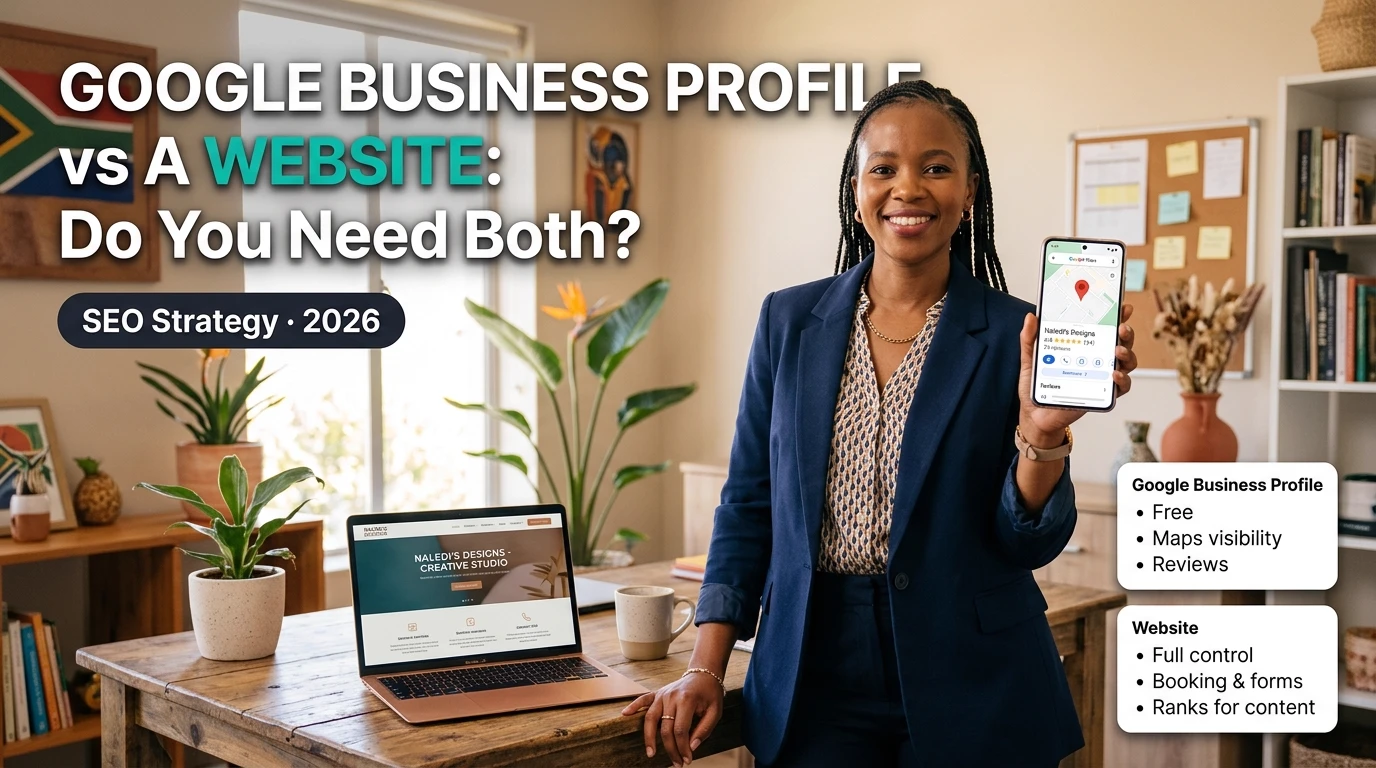
Two Different Jobs, Not Two Versions of the Same Thing
Every few months a business owner asks me some version of the same question: "I already have a Google Business Profile — do I actually need a website too?" It's a fair question. GBP is free, it takes twenty minutes to set up, and for a lot of searches, it's the first thing a potential customer sees. So why spend money and time on a website on top of that?
Here's the honest answer, and it's not the one that sells the most websites: a GBP and a website aren't substitutes for each other. They sit at different points in the same journey. Your GBP answers "does this business exist near me, and is it any good?" Your website answers "can I trust this business enough to actually hand over my money or my details?" One gets you discovered. The other gets you chosen.
Treating them as interchangeable is where most SA small businesses lose leads without ever knowing it happened.
1. What a Google Business Profile Actually Does For You
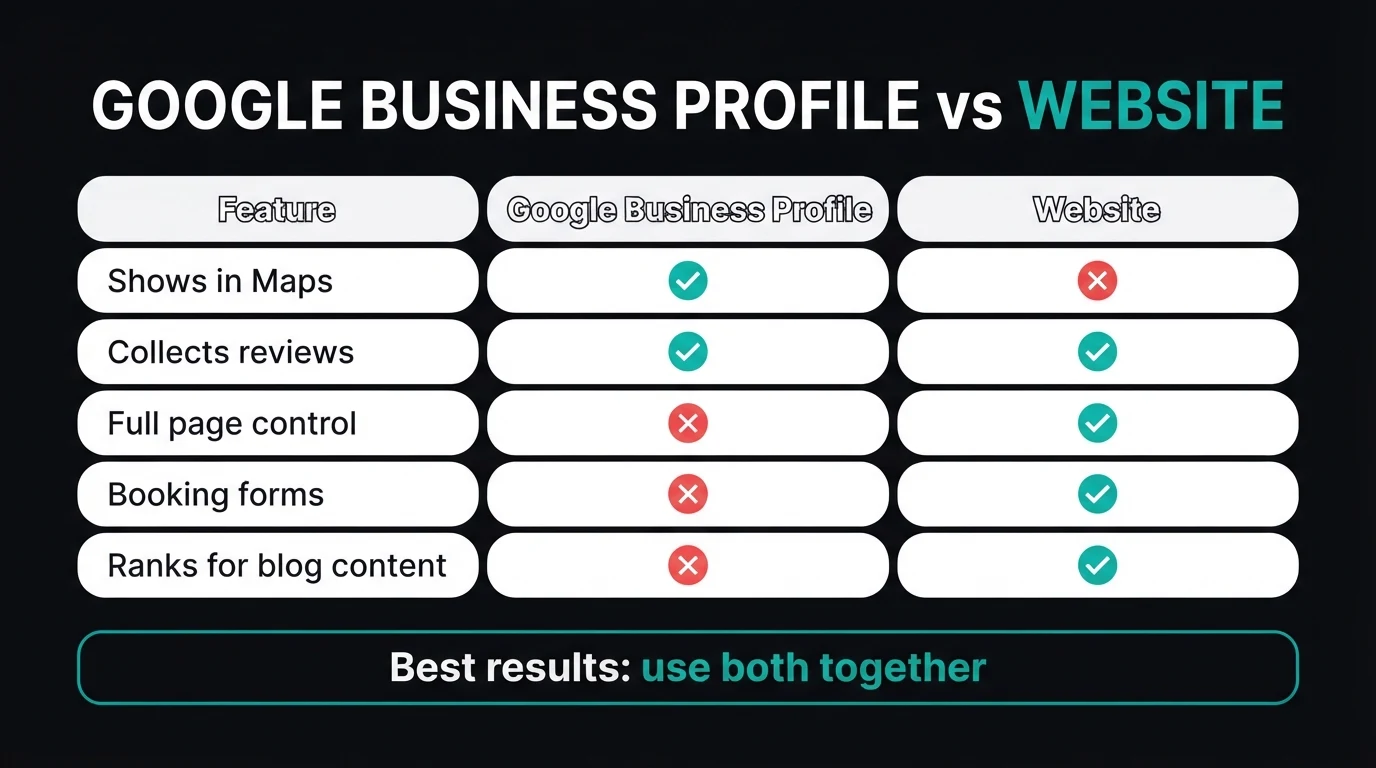
A Google Business Profile is your business's identity card inside Google Search and Maps. Done properly, it shows your hours, your location pin, your phone number, your category, your photos, and — critically — your reviews. For local, "near me" style searches, it's often the very first thing a searcher sees, sometimes before any website appears at all.
That's genuinely valuable, and it's free. If you haven't claimed and verified yours yet, that's the highest-leverage twenty minutes you can spend on your business's visibility this month — here's the full step-by-step setup guide we published earlier this year.
2. Where a Google Business Profile Hits Its Ceiling
The problem isn't that GBP is bad — it's that it's fixed. Google controls the layout, the fields, and what you're allowed to add. There's no space for a real explanation of how you work, no way to run a proper booking flow, no gallery that tells a story, and no way to publish content that ranks for the dozens of specific questions your customers are typing into Google before they ever search your business name directly.
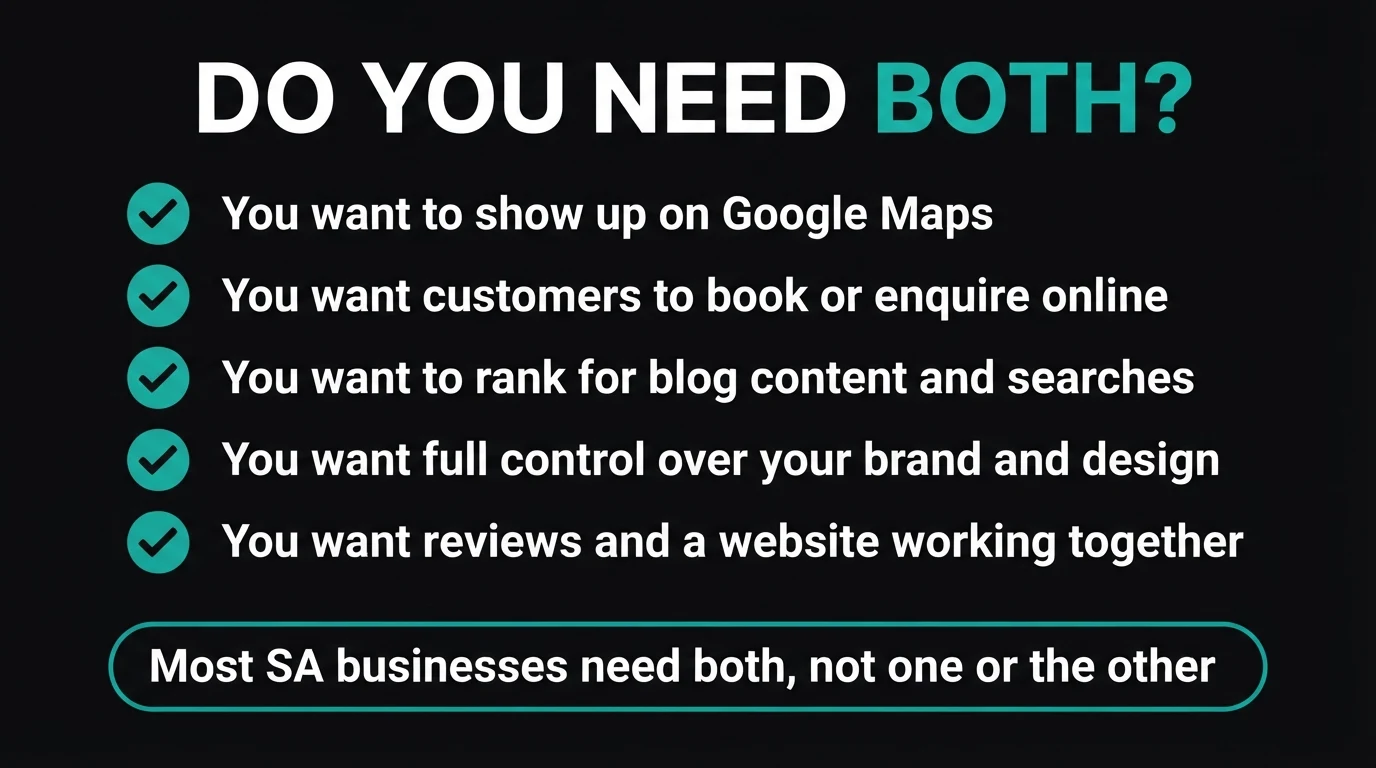
- Run a very local, walk-in or call-in business with little competition nearby
- Have no online booking, quoting, or product catalogue to manage
- Are testing an idea before committing budget to a full website
- Rely almost entirely on word-of-mouth and repeat customers
- Compete with businesses that already have a proper website in the same search results
- Want to take bookings, quote requests, or online payments without a back-and-forth
- Have a story, portfolio, or credentials that a five-field profile can't hold
- Want to rank for informational searches, not just "[service] near me"
I see the same pattern across plumbers, salons, and small consultancies I've built sites for around Centurion and Pretoria: the GBP brings the click, but a bare profile with no website loses the decision to whichever competitor's name in the same search results leads to a real page. The businesses that convert best usually aren't the ones with the most reviews — they're the ones where a searcher can tap through from Maps to a page that actually answers the next three questions on their mind: what does this cost, what does the work look like, and how do I book without waiting for a reply.
Quick gut-check: has a customer ever told you they "couldn't find pricing" or "weren't sure what you actually do" after finding you on Google? That's usually a website gap, not a GBP gap.
3. Which Should You Set Up First?
If you have neither yet, the order matters less than actually doing both — but here's the sequence that gets you a visible win fastest without wasting either investment:
- Claim and verify your Google Business Profile today. It's free, and it can be live within days. This is the fastest way to appear on Maps while everything else gets built.
- Build your website next, sized to your budget. It doesn't need to be a 20-page site on day one — a focused 5-page site with clear contact and booking paths already outperforms a GBP-only setup.
- Make sure the two point back to each other. Your GBP's website field should link straight to your site, and your site's contact details should match your GBP exactly — same name, same address format, same phone number.
4. How a Website Makes Your Google Business Profile Perform Better
This is the part most "GBP vs website" arguments miss: the two aren't just complementary, they actively strengthen each other. Google's local ranking depends on relevance, distance, and prominence — and prominence is shaped by signals from across the web, including your website's SEO, its backlinks, and how consistently your business details appear between your site and your profile. A GBP sitting on top of no website, or an inconsistent one, gives Google less to work with when it decides how prominently to rank you.
A website also gives you somewhere to send the traffic your GBP earns through reviews and photos — instead of a searcher tapping "Website" and landing nowhere, or landing on a Facebook page that hasn't been updated in a year.
Go Deeper: Related Guides
Your GBP brings the click. Let's build what happens after it.
CJX Studios builds websites that work alongside your Google Business Profile — matching details exactly, linking both ways, and giving you a booking-ready page to send that traffic to. From R1,200/month, live in 48 hours, no deposit before you approve the demo.
Zero deposit · No lock-in · Pay only if you love it · Based in Centurion, serving all of SA
Frequently Asked Questions
Do I need a website if I already have a Google Business Profile?
Can I just use my Google Business Profile as my website?
Does having a website help my Google Business Profile rank higher in the Map Pack?
What should I set up first — my GBP or my website?
How much does a website cost if I already have a free GBP listing?
- A GBP and a website do different jobs. One gets you found on Maps for free. The other converts that visibility into a booking, quote, or sale — and it's the only one you fully control.
- Claim your GBP first — it's free and fast. Then build a website sized to your budget, and make sure both list identical business details and link to each other.
- Most SA small businesses need both, not one instead of the other. The businesses losing leads quietly are usually the ones relying on a GBP alone once a competitor shows up with a real page behind theirs.
Keep Reading

Chris Maboyi
I build websites for South African businesses in Centurion, Pretoria, and across Gauteng — and I help clients get their Google Business Profile set up correctly alongside every site. Every build starts with a 48-hour free demo: real, live, no deposit, no obligation. Get in touch or WhatsApp me directly.