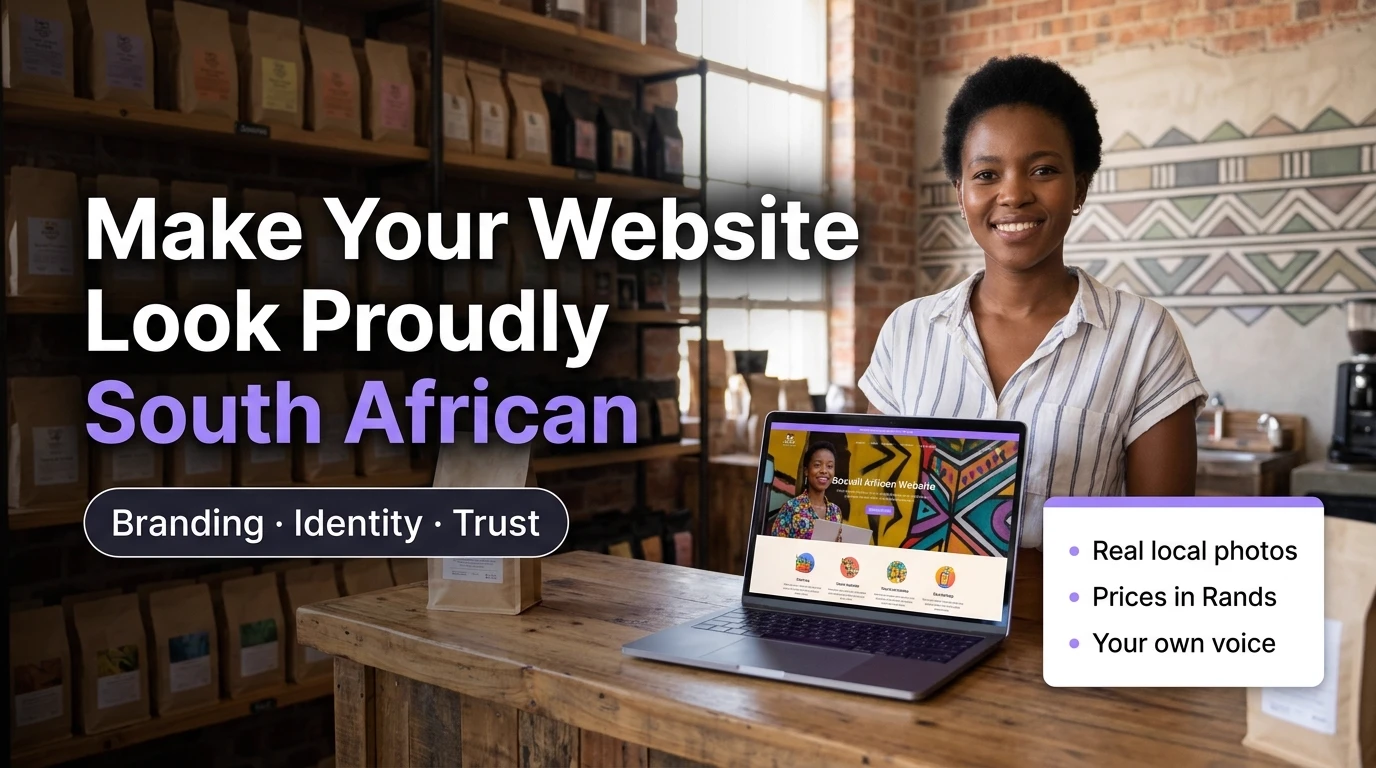
What "Looking South African" Actually Means (It's Not Flags and Beadwork)
When business owners hear "make your site look local", many picture a protea in the logo, a Ndebele border down the side, or a flag in the footer. Those can work for some brands, but they are decoration. Local identity on a website is mostly about evidence: small, concrete signals that tell a visitor you operate here, understand how things work here, and can be reached here.
Think about what a customer in Centurion, Durban or Gqeberha is trying to work out in the first ten seconds. Is this business actually near me? Will they understand my situation? What will it cost, in money I recognise? Can I just WhatsApp them? Every one of those questions is answered, or ignored, by your design choices.
That is why identity is a conversion issue, not an aesthetic one. A beautifully designed site that dodges all four questions will lose to a plainer site that answers them.
Why Generic Global Templates Quietly Cost You Enquiries
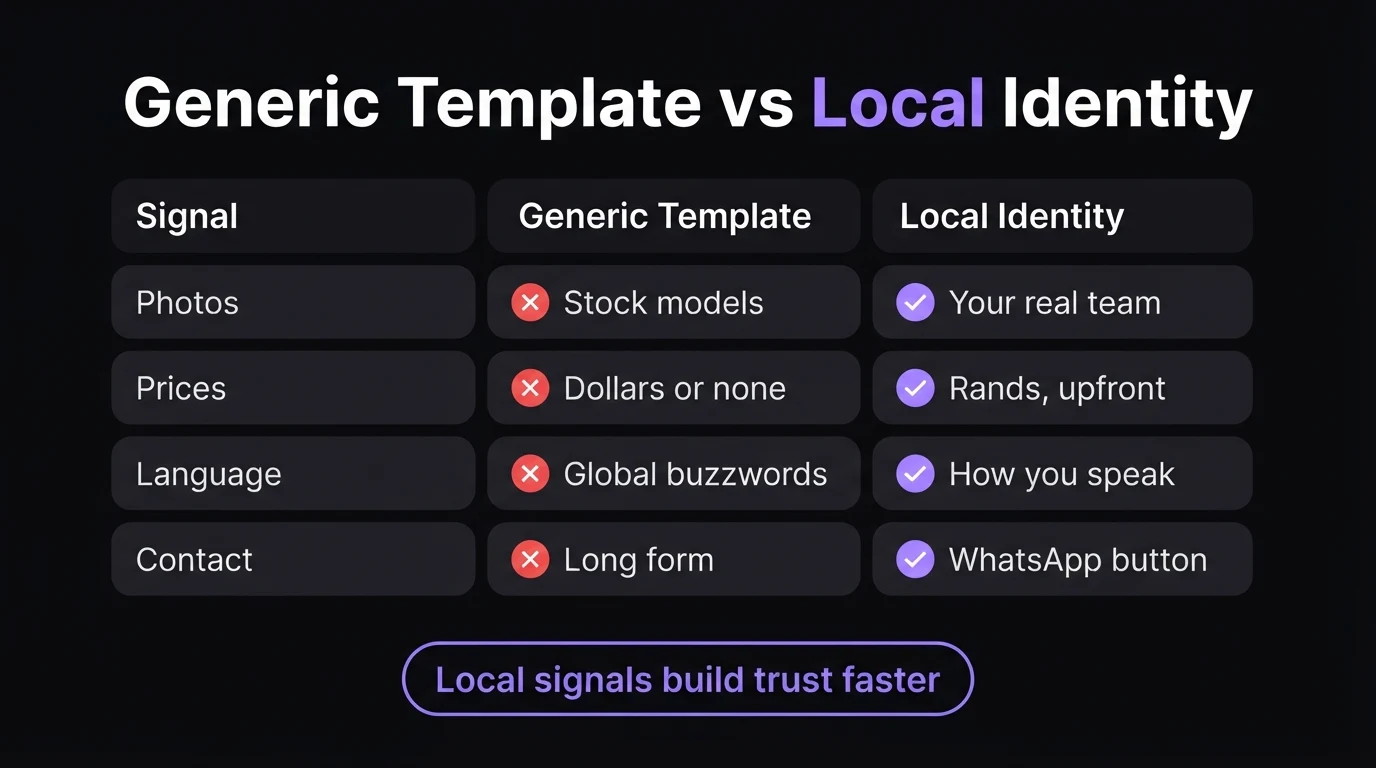
Most website builders and theme marketplaces are designed for a global, mostly American, audience. Use one straight out of the box and you inherit its assumptions: stock photos of people who do not look like your customers, "Get started today!" buttons that lead to a long form, prices in dollars (or no prices at all), and copy about "solutions" and "synergy" that nobody in Pretoria actually says.
None of this is wrong on its own. The problem is the cumulative effect. A visitor cannot tell where you are, who is behind the business, or whether you have ever done work in their area. In a market where people are cautious about fly-by-night operators and online scams, ambiguity feels like risk. They do not email you to ask; they simply go back to the search results and click the next business that looks like it lives down the road.
We see the same pattern when we audit sites for clients: the template is fine, the colours are fine, but nothing on the page proves the business is here. The fix is rarely a full redesign. It is replacing the borrowed parts with your own.
Quick check: cover your logo and business name on your home page. Could a stranger still tell that you are a South African business, and roughly where you work?
The Six Local Signals That Build Trust Fastest
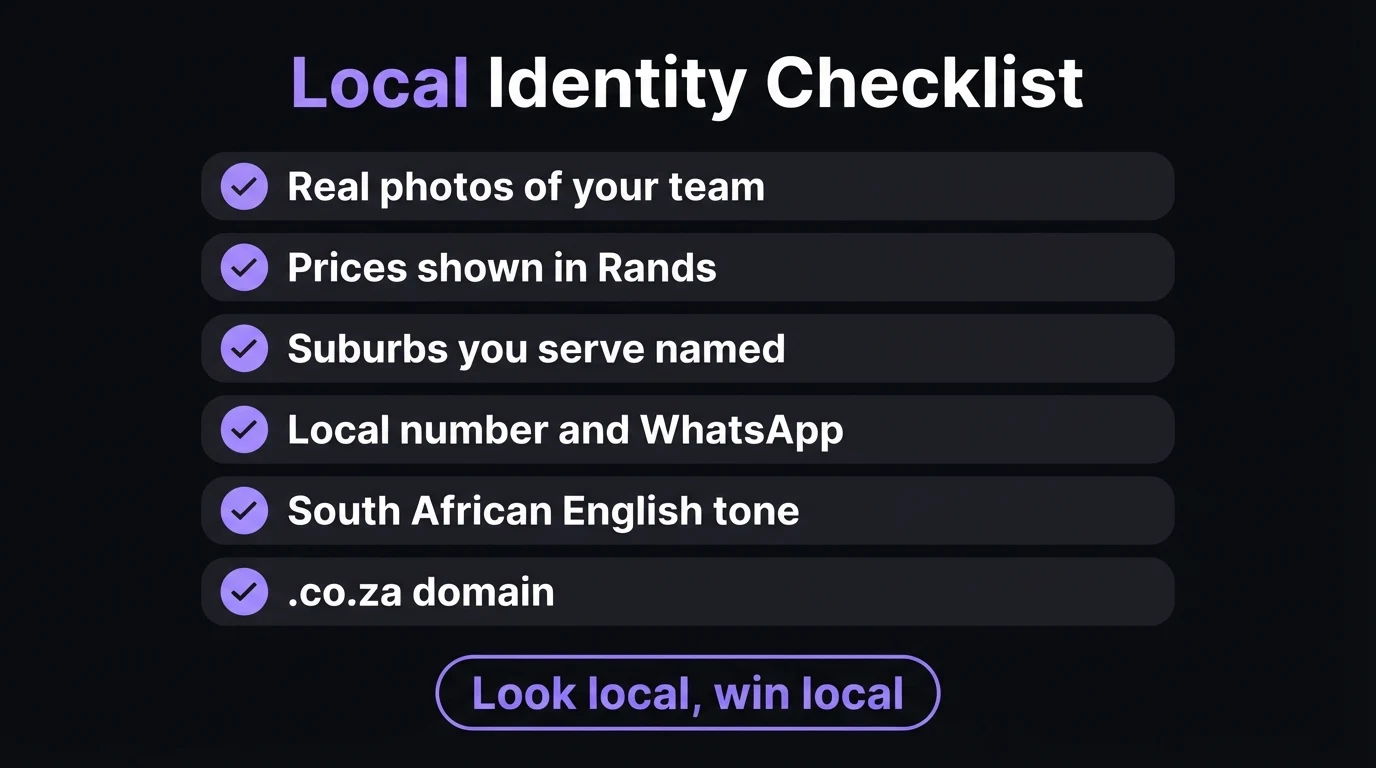
1. Real photos of your own people and place
This is the single biggest lever. A photo of you behind your counter, your team on site in branded shirts, or your actual workshop in Silverton tells a visitor more than any headline. It also does something stock photography cannot: it lets a customer recognise you when you arrive. Phone photos taken in good daylight are perfectly fine. We go deeper into this in stock photos vs real photos.
2. Prices in Rands, or at least honest price guidance
Seeing "from R450" or "packages from R1,200/mo" instantly tells the visitor three things: you are local, you are open about money, and they can probably afford to ask. If your work is quoted case by case, explain what drives the price and give a typical range. Silence on price is one of the most common reasons people leave without making contact.
3. The suburbs and towns you genuinely serve
"Serving Gauteng" is vague. "We work across Centurion, Midrand, Irene and Pretoria East" is specific, believable and good for local search. Only name areas you really cover; a long list of every town in the province looks like padding and can backfire with Google too.
4. A local number and a WhatsApp button
South Africans make first contact on WhatsApp far more readily than through a contact form. A visible 0xx number and a click-to-chat button with a pre-filled message remove the friction completely. Our guide to turning website visitors into WhatsApp leads covers where to place it so it actually gets tapped.
5. Copy that sounds like you, in South African English
Write "colour", "programme" and "organise". Say "load-shedding", "bakkie" or "braai" if those words belong in your trade. Mention municipal compliance, a Certificate of Compliance or POPIA when they are relevant. You do not need slang; you need to sound like a person your customer could phone. Our guide on writing website copy that sells shows how to swap generic lines for specific ones.
6. A .co.za domain
A .co.za address is a small but immediate cue that a business is registered and based here, and it tends to be what local customers expect to type. If you are weighing it up, our breakdown on whether to use a .co.za domain covers the trade-offs.
Want a website that looks unmistakably like your business?
We'll build a live demo using your real photos, your prices in Rands, the areas you serve and a WhatsApp button on every page, in 48 hours. You only pay if you approve it.
Zero deposit · No lock-in · Based in Centurion, serving all of SA
Heritage as Branding: When Cultural Design Helps, and When It Feels Forced
Cultural and heritage design elements, such as patterns, colours, languages and craft references, can be powerful when they are genuinely part of who you are. A Zulu-owned catering company that greets visitors with "Sawubona", a Cape Malay bakery that tells the story of a family recipe, or a Soweto tour operator whose photography is rooted in the township it shows: in each case the heritage is the product, and showing it builds both trust and memorability.
- The heritage is part of your real story or offer
- You use your own photos, people and places
- A greeting or phrase in the language your customers use
- Patterns and colours that echo your premises or product
- It supports the message rather than replacing it
- Borrowed cultural motifs with no link to the business
- Stock "African" imagery that could be any country
- A flag or protea added only for Heritage Month
- Busy borders that slow the page and hide the content
- Decoration in place of prices, proof and contact details
The test is simple: would a regular customer recognise this as you? If the answer is yes, lean in. If the design element would make sense on a competitor's site just as easily, it is decoration, and decoration does not build trust on its own.
Identity is not a colour palette; it is proof. Customers do not reward you for looking South African in the abstract. They reward you for looking like the specific, reachable, local business they hoped to find. Every element on the page should either show who you are, show where you work, or make it easy to talk to you.
A Practical Local-Identity Audit You Can Run This Week
You do not need a rebrand. Work through this table on your current site and fix the gaps in order; most take an afternoon.
| Check | Priority | Quick fix |
|---|---|---|
| Hero photo is your own team or premises | Essential | Shoot five daylight phone photos this week |
| Phone number and WhatsApp visible above the fold | Essential | Add a click-to-chat button with a pre-filled message |
| Prices or price guidance in Rands | Essential | Add "from" prices or a typical range with what drives it |
| Named service areas | Strongly recommended | List the 4–6 suburbs or towns you really cover |
| Copy in South African English, in your voice | Strongly recommended | Rewrite the hero and About page out loud, as you'd say it |
| Reviews from named local customers | Strongly recommended | Embed your Google reviews and ask at every handover |
| Cultural or heritage design elements | Only if authentic | Use them where they genuinely reflect your story |
Reviews deserve a special mention. A review from "Thandi, Lyttelton" carries more weight than a paragraph you write about yourself, and it is local proof Google can see too. Our guide on getting your first Google reviews has a simple ask-and-follow-up script.
How Local Identity Helps With Google and AI Search Too
The same signals that reassure a customer also help search engines place you. Named suburbs, a consistent business address and phone number, a .co.za domain and reviews that mention real locations all reinforce that you are a local business serving a specific area. That matters for "near me" searches and for the map results, which work hand in hand with your site; our comparison of Google Business Profile vs a website explains how.
AI tools such as Google's AI Overviews and ChatGPT increasingly answer questions like "who does good websites in Centurion?" by pulling from pages that state clearly who they are, where they work and what they offer. A site that is specific about its location and identity is simply easier for those tools to understand and quote than one written in generic, placeless marketing language.
At CJX Studios, every site we build starts from this principle: your real photos, your areas, your prices and your voice. You can see how that plays out in our portfolio, and our pricing page shows what each monthly plan includes.
The Bottom Line
Heritage Month comes once a year, but the question it raises is one your customers ask every time they land on your site: is this a real business, here, that understands me? A global template cannot answer that for you. Your own photos, your prices in Rands, the places you serve, a WhatsApp button and copy that sounds like you can.
Start with the hero: replace the stock image with a real photo of you or your team, add your WhatsApp button, and name the areas you serve. Those three changes alone will make your site feel more trustworthy than most of the competitors your customers are comparing you with.
- Local identity is evidence, not decoration. Customers want proof you are real, nearby and reachable.
- Six signals: real photos, Rand prices, named areas, a local number with WhatsApp, South African English, and a .co.za domain.
- Use heritage design only where it is genuinely yours. If it would fit a competitor's site just as well, it is not doing the work.
Go Deeper: Related Guides
Frequently Asked Questions
Why should my website look like a South African business?
Because South African visitors are checking whether you are real, local and reachable before they make contact. Real photos of your team, prices in Rands, the suburbs you serve, a local number with WhatsApp and a South African voice answer that in seconds. A generic global template looks polished but gives them no reason to trust you over the next result.
Do I need African patterns or heritage colours in my branding?
No. Cultural design elements work well when they are genuinely part of your story, product or premises, but they are not required. Local identity is mostly evidence: your own photos, your areas, your prices and your contact details. If a pattern or flag would fit a competitor's site just as easily, it is decoration rather than identity.
Is it bad to use a website template or stock photos?
A template is fine as a starting point; the problem is leaving its borrowed parts in place. Replace stock photos with your own team and premises, swap global buzzwords for how you actually speak, show Rand prices and add a WhatsApp button. Those changes make a template feel like your business without a full redesign.
Does a local-looking website help with Google rankings?
It helps local visibility. Named service areas, a consistent address and phone number, a .co.za domain and reviews mentioning real places all reinforce that you serve a specific area, which supports 'near me' and map searches. Clear, specific pages are also easier for AI search tools to understand and quote.
How much does a locally branded website cost in South Africa?
At CJX Studios, websites start from R1,200 per month with hosting, maintenance and support included, and there is no deposit before you approve a free 48-hour live demo. Every site is built around your real photos, your prices in Rands, the areas you serve and WhatsApp-first contact.

Chris Maboyi
I build websites for South African businesses in Centurion, Pretoria and across Gauteng, using real photos, local pricing and WhatsApp-first contact so each site looks like the business behind it. Every project starts with a 48-hour free demo: real, live, no deposit before you approve it. Get in touch or WhatsApp me directly.