Open ten small business homepages right now and count how many start with the word "we". We are a leading provider. We have over ten years of experience. We pride ourselves on quality. None of that is false. All of it is invisible — because the visitor didn't come to learn about you, they came to solve a problem, and "we" is the wrong first word for that job.
I've rewritten this exact pattern dozens of times across CJX client sites, and the fix is rarely about writing better sentences. It's about writing them in the right order. This is the formula, with real before-and-after examples, so you can apply it to your own site this afternoon — no copywriter or marketing degree required.
Why "About Us" Copy Doesn't Sell
Brochure copy describes the business. Sales copy describes the reader's situation, then positions the business as the fix. It sounds like a small distinction until you notice how much of a typical homepage is written the first way: history, mission, values, credentials — all before a single sentence acknowledges why the visitor is actually there.
That order matters because visitors arrive already mid-thought. Someone searching "plumber Centurion emergency" isn't curious about your company's founding story — they have water on the floor. Someone comparing accountants isn't reading for pleasure — they're worried about a SARS deadline. Copy that opens with their situation feels like it was written for them. Copy that opens with your company feels like it was written for you.
A bookkeeping client's homepage opened with "Established in 2018, we offer a full range of accounting services." I changed the first line to "Missed a SARS deadline again this year?" — nothing else on the page moved. Enquiries through the contact form roughly doubled the following month, because the first sentence finally matched what the visitor was actually worried about.
The Four-Part Copy Formula
This works for a homepage hero, a service page intro, or a single product description. It doesn't need to be long — it needs to happen in this order:
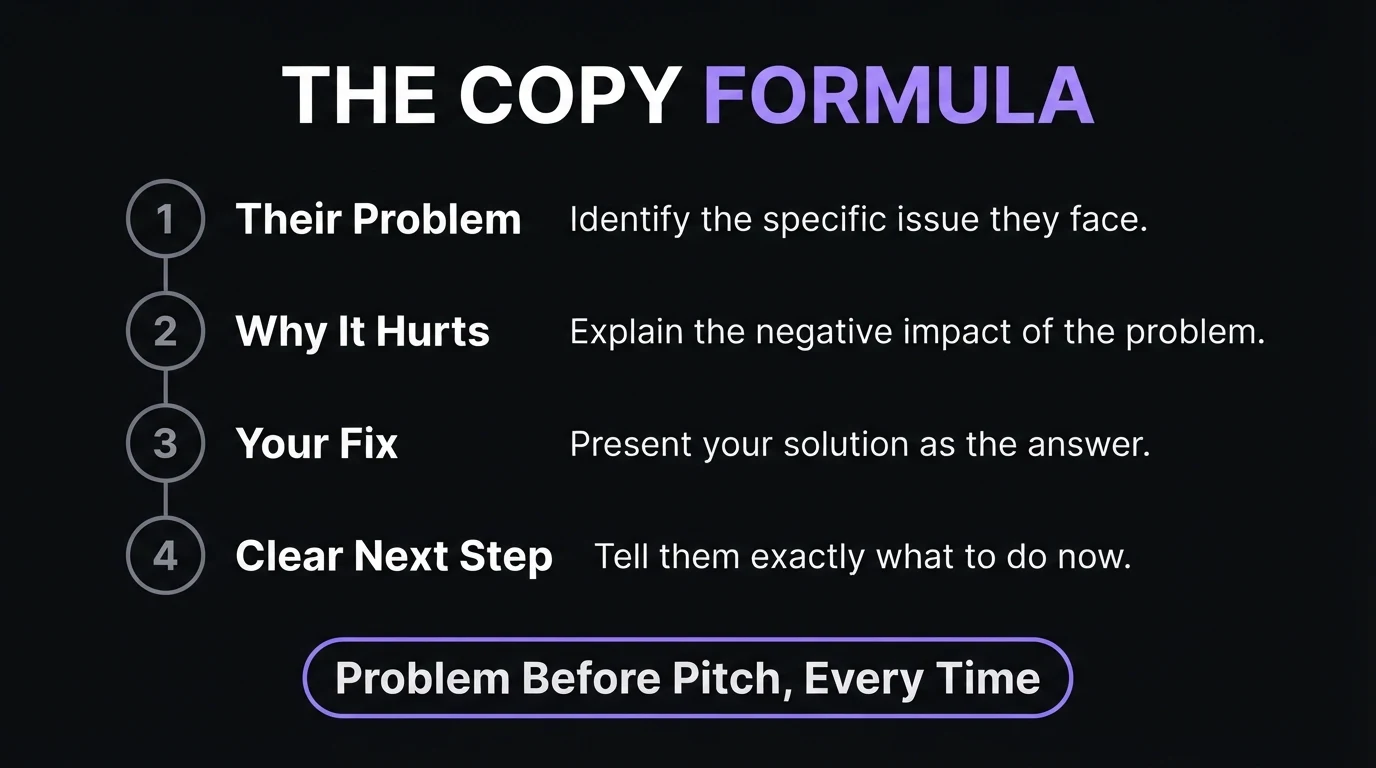
Name Their Problem, Specifically
Not "looking for a website?" but "tired of WhatsApp quotes going unanswered for days?" The more specific the problem, the more the reader feels understood — vague problems could belong to anyone, specific ones belong to them.
Say Why It Actually Hurts
One sentence on the real cost of the problem — a lost sale, a missed appointment, a competitor who answered faster. This is what turns a mild annoyance into something worth acting on today rather than "later".
Present Your Fix — Not Your Features
Skip the feature list and say what changes for the reader. "A live site in 48 hours" sells more than "responsive design, SEO optimisation, and hosting included" — even though the second list might be more accurate.
Give One Obvious Next Step
One button, one action, phrased as something easy to say yes to — "See your free demo" beats "Contact us" because it tells the reader exactly what happens if they click.
Read your own homepage's first sentence out loud. Is it about your business, or about the visitor's problem?
Before and After: Real Rewrites
The formula is easier to feel than to explain, so here are three common openings rewritten using the same information — nothing invented, just reordered and made specific:
Brochure Copy vs Sales Copy
- "We are a leading provider of quality plumbing services in Centurion."
- "Our experienced team offers a wide range of accounting solutions."
- "Welcome to our website — established in 2015 with a passion for design."
- "Burst geyser at 11pm? We answer the phone after hours — no callout surcharge."
- "Missed a SARS deadline again? We take over your filing before the next one."
- "Tired of a website that looks fine but never rings the phone?"
Notice the second column never mentions the company by name in the opening line. That's deliberate — the reader doesn't care who you are yet. They care whether you understand their situation. Trust and credibility have their place further down the page, often paired with real proof — see our post on why real photos build more trust than polished stock images, which works on exactly the same principle.
An electrician's site listed six services in a bulleted list with no context. I rewrote the top of the page around one sentence: "Load-shedding killed your fridge stock again? Ask about a same-week inverter quote." That single service started outselling the other five combined within a month — not because it was priced differently, but because it was the one sentence that named an actual, current pain.
Headline Formulas Worth Stealing
If you're stuck on where to start, these four structures cover most small business pages. Swap in your own specifics — the structure does the heavy lifting:
| Formula | Example | Best For |
|---|---|---|
| The Question | "Tired of quotes that never get answered?" | Trades, home services |
| The Timeframe Promise | "A live website in 48 hours — you approve before you pay." | Any service with a fast turnaround |
| The Specific Number | "Six real photos beat any stock library — here's why." | Guides, comparison content |
| The Direct Address | "For SA business owners who are done chasing WhatsApp quotes." | Niche or specialist audiences |
Whichever formula you use, keep it built around a single reader and a single problem. A headline trying to speak to everyone usually ends up speaking to no one — the same reason we recommend keeping a small business site to a handful of focused pages rather than one page trying to cover everything.
Copy Mistakes That Quietly Kill Conversions
Even once the formula clicks, these habits creep back in. Watch for them on your next edit:
If a competitor copied your homepage and swapped in their logo, would anything on the page still sound wrong for them?
This is the same discipline behind every page we build at CJX — it's why the actual brief process matters as much as the writing itself. If you haven't put your requirements in writing yet, our guide on writing a brief your designer will actually understand covers exactly the information a copywriter needs before the first word gets written.
See your site rewritten around your customer — free, in 48 hours.
Send me your current copy, your services, and who you actually want to reach. I'll build a live, working, mobile-optimised site with copy that leads with their problem, not your history. You look at it, test it, show it around. You pay nothing unless you love it.
Zero deposit before approval · From R1,200/mo · No lock-in · Centurion & nationwide
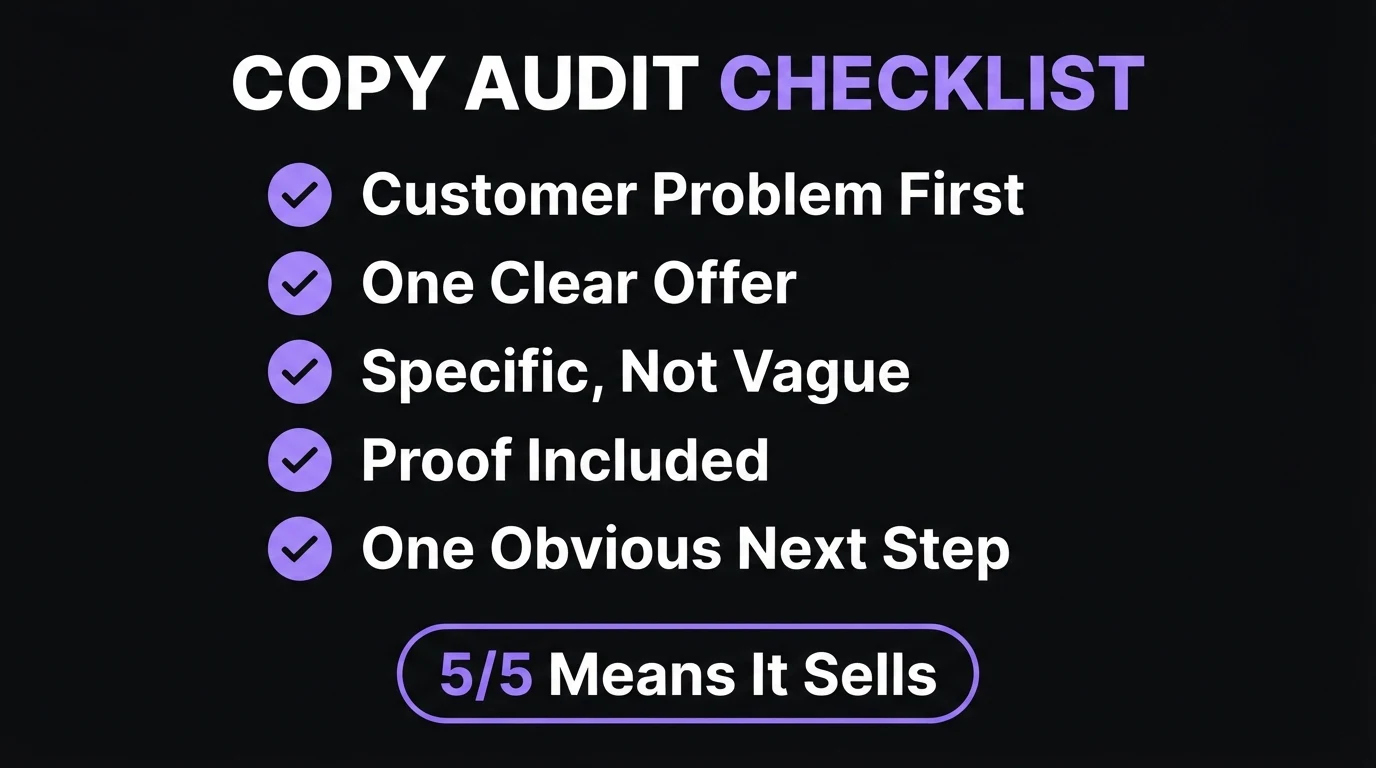
Copy Audit Checklist — Five Checks Before You Publish
Frequently Asked Questions
What's the single biggest website copy mistake small businesses make?
Leading with the company instead of the customer. Most homepages open with "Founded in 2015, we are a leading provider of..." when the visitor is actually thinking about their own problem. Flip the order — name their problem in the first sentence, introduce yourself as the fix in the second.
Do I need to hire a copywriter, or can I write this myself?
Most small business owners can write good enough copy themselves once they know the formula: problem, why it hurts, your fix, clear next step. A copywriter earns their fee when you need volume — many pages, ongoing content — or when phrasing needs polishing, not because the formula itself is complicated.
How long should my homepage copy actually be?
Long enough to answer the visitor's real questions, short enough that nothing is padding. A trades or local-service homepage often needs under 300 words above the fold. A considered B2B purchase needs more room to build a case. Length should follow what the reader needs to decide, never a word count target.
Should every page end with a call to action?
Yes, but it should match where the reader is in their decision. A homepage or service page can ask for a call or WhatsApp message. A blog post or guide page usually earns a softer next step first, like reading a related article, before asking for contact details.
How do I write copy for a business I'm not an expert in?
Interview the business owner with one question repeated in different forms: "what does a customer say right before they finally book with you?" Their frustrations, hesitations, and the words they actually use are the raw material for copy that sounds like it understands them — better than any generic template.
- Problem before pitch, always. Name the reader's situation before you mention your business.
- Specific beats polished. A precise number or timeframe outsells any vague adjective like "quality" or "professional".
- One offer, one action. A page with five equal calls to action usually gets fewer clicks than one with a single obvious next step.
Keep Reading

Chris Maboyi
I build websites for South African businesses in Centurion, Pretoria, and across Gauteng — salons, plumbers, retailers, clinics — who need leads, not lectures. Every site I build comes with a 48-hour free demo: real, live, no deposit, no obligation. Get in touch or WhatsApp me directly.