Ask any business owner to describe their business and they'll talk for twenty minutes without pausing. Ask them to describe the website they want, and most go quiet — or reach for words like "modern," "clean," and "something that pops." None of those words mean anything specific to a designer. They mean something different to every single person who says them.
That gap — between knowing your business inside out and being able to translate it into a brief a designer can actually build from — is where most website projects lose their first two weeks. Not to bad design. Not to a difficult client. To a brief that never said enough to start.
What a Designer Actually Needs to Hear
Here's the part most guides skip: a designer isn't trying to understand your business the way an investor or a journalist would. They're trying to make a series of specific decisions — what goes on the homepage, what the call-to-action says, which three services get top billing, whether there's a booking form or a WhatsApp button. A brief that's full of adjectives gives them nothing to decide with. A brief that's full of specifics does almost all the thinking for them.
That's the real purpose of a brief. It's not a formality before the "real work" starts — it is the real work, compressed into a page you can write in fifteen minutes instead of a back-and-forth that eats two weeks.
A Centurion-based electrician once opened a call with us saying he wanted a site that looked "professional, but not corporate." Neither of those words told us anything on their own. What actually unlocked the brief was one follow-up question: "When someone lands on your site, what do you want them to do in the next ten seconds?" His answer — "call me, or send a WhatsApp with their address and what's broken" — became the entire homepage structure. That one sentence did more work than twenty minutes of adjectives.
The 7 Things Your Brief Must Answer
Work through these in order. You don't need finished, polished answers — you need honest, specific ones. A rough answer to all seven beats a perfect answer to two.
Who is this business for?
Not "everyone." Name the actual customer — homeowners in a specific suburb, small business owners, brides planning a 2027 wedding. The narrower and more specific this answer, the sharper every design decision downstream becomes.
Which pages do you actually need?
List them: Home, Services, About, Gallery, Contact — whatever applies. Don't guess at "however many pages a website needs." A five-page brochure site and a twenty-page catalogue are different projects with different timelines.
What must the site be able to do?
A booking calendar, a WhatsApp click-to-chat button, an online store, a quote form — list the features you can't launch without. Everything else is a nice-to-have that can wait for phase two.
What brand assets do you already have?
Logo file, brand colours, real photos of your team or premises, testimonials. If you don't have some of these yet, say so — it changes the plan, but it's far better known upfront than discovered mid-build.
Is your content written, or does it need writing?
Service descriptions, an About section, pricing — do these exist already, even roughly, or does someone need to write them from scratch? This alone shifts a project timeline by days, sometimes weeks.
What's your budget range?
Not because a designer needs to know your ceiling — because a realistic range stops them from proposing an e-commerce platform when you need a one-page brochure, or a one-page brochure when you need a full booking system.
When do you need it live?
A launch date — even an approximate one — turns "sometime soon" into a schedule. If there's a real deadline (a trade show, Black Friday, a season opening), say so. It changes how the whole project gets sequenced.
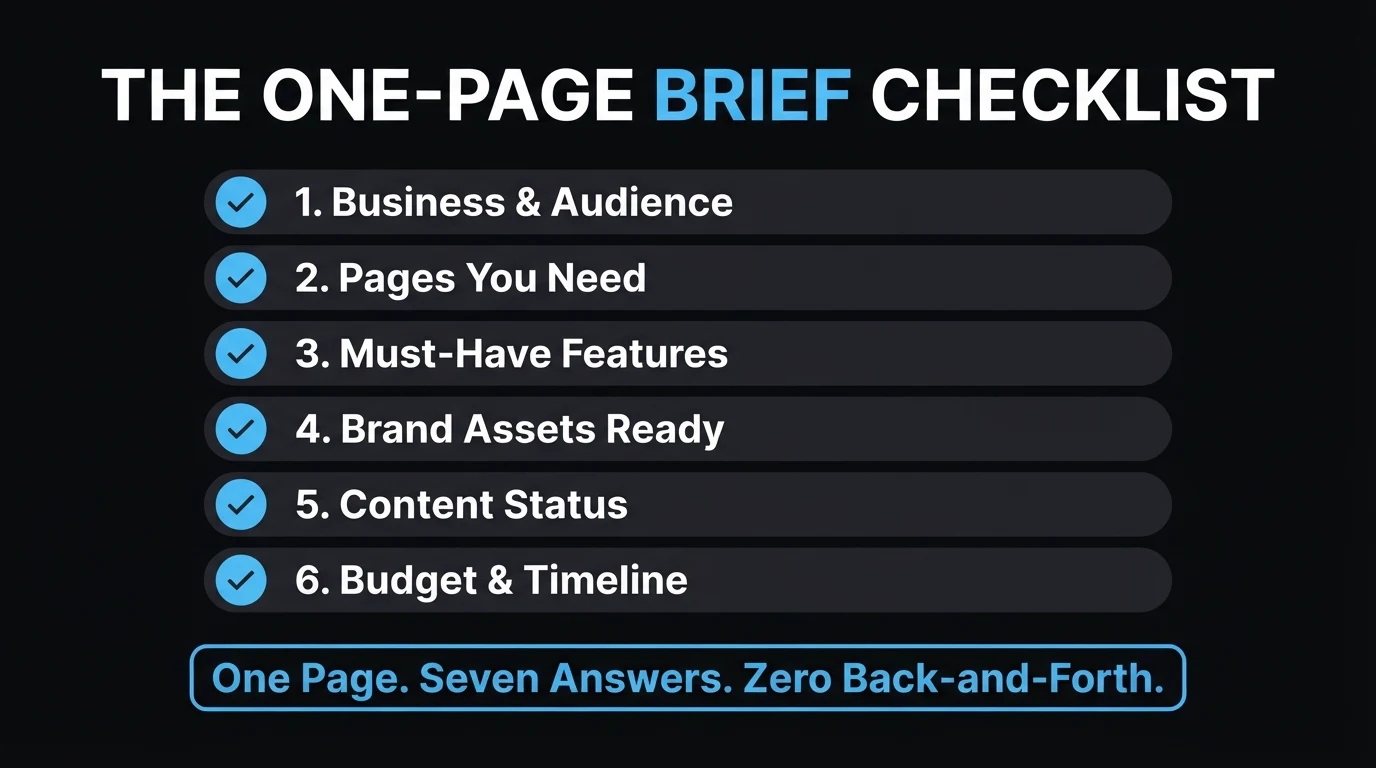
The One-Page Brief Template CJX Uses
Copy this. Fill it in as roughly or as neatly as you like — a voice note answering each line works just as well as typed text. The point isn't presentation. It's completeness.
The CJX One-Page Brief
"A good brief isn't a formality. It's the difference between a designer guessing and a designer building."
Common Brief Mistakes That Slow Everything Down
Most of these aren't about laziness — they're about not knowing what a designer actually needs. Watch for these in your own first draft.
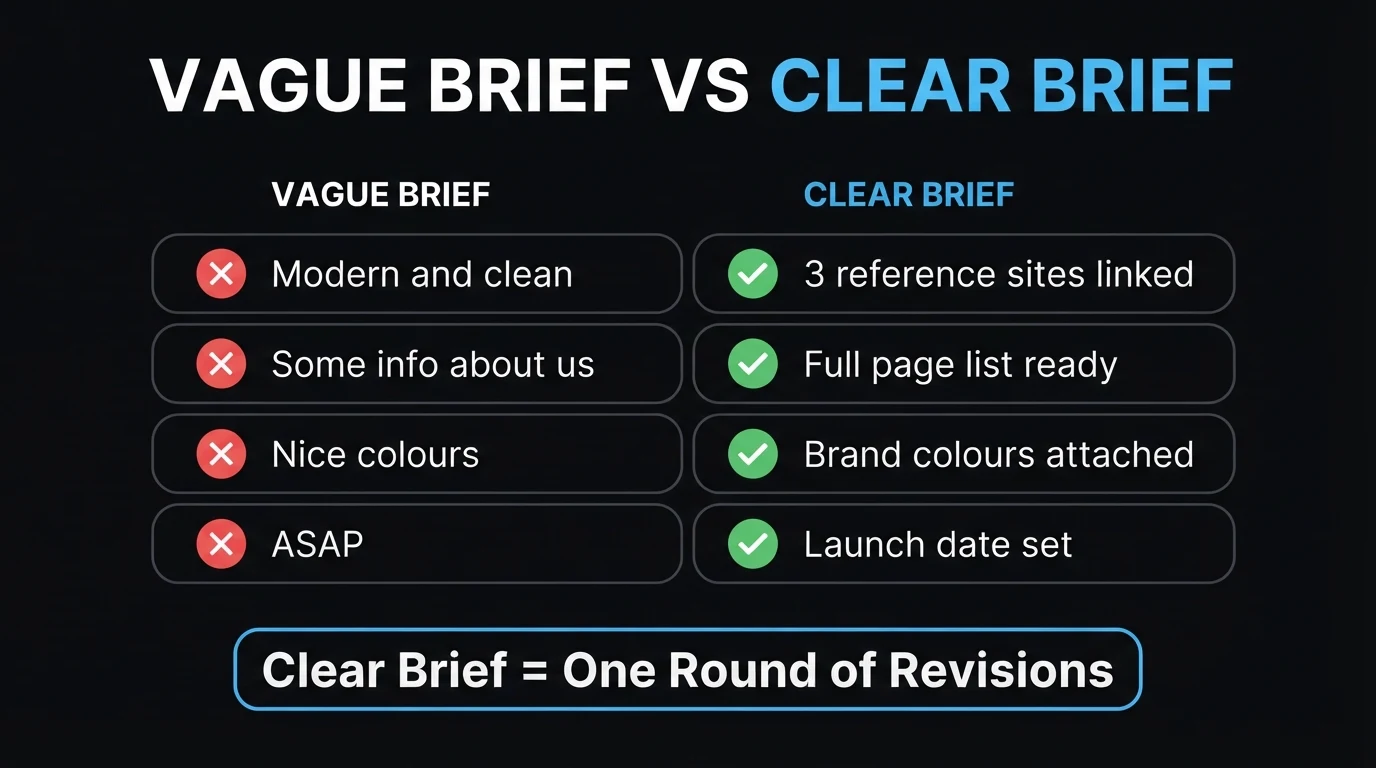
A guesthouse owner in the Waterberg came to us with one WhatsApp voice note answering all seven questions on our brief — including three reference sites and a firm date tied to a booking season. We had a live demo back to her in under 48 hours, and she approved it with a single small change: a bigger "Check Availability" button on the homepage. Compare that to a similar project the same month where the brief was "something nice, you're the expert" — that one took four rounds of revisions and three weeks longer to launch, simply because every round was spent discovering requirements that could have been in the brief from day one.
What Happens After You Send the Brief
At CJX, you don't need to arrive with a finished document — Chris walks new clients through the seven questions directly on a WhatsApp call, usually in under fifteen minutes. From there, a full, live demo of your actual website is built within 48 hours, with no deposit due before you see it. You only pay once you've approved the live site — which is a large part of why a clear brief matters so much: the more specific it is, the closer that first live demo lands to something you'll say yes to immediately.
Skip the back-and-forth. Send your brief today.
WhatsApp Chris the seven answers — voice note or text, either works — and get a free, live demo of your actual website within 48 hours. No deposit, no obligation until you approve it.
Zero deposit · No lock-in contract · Pay only if you approve the live site
Frequently Asked Questions
What should I include in a website brief?
A good website brief covers seven things: who your business serves, which pages you need, your must-have features, your brand assets (logo, colours, photos), your existing content, your budget range, and your ideal launch date. You don't need design experience or technical language — just clear, specific answers to those seven questions.
How long should a website brief be?
One page is enough. A brief that runs to five pages usually buries the useful information under generic mission-statement language. Designers need specifics they can act on — a one-page brief that answers seven direct questions beats a ten-page document full of vague aspirations.
Do I need to know design terms to write a brief?
No. Phrases like "modern and clean" or "pop" mean something different to every designer and every client. Instead of design language, use reference sites, specific examples, and plain descriptions of what you want visitors to do on your site. A good designer translates plain English into design decisions — that's their job, not yours.
What happens if my brief is vague?
A vague brief doesn't stop a project — it just moves the missing questions later, usually into two or three rounds of revisions after the first draft is already built. That costs time on both sides. A clear brief upfront typically means one round of revisions instead of three to five.
Can CJX Studios help me write my brief?
Yes. CJX Studios uses a one-page brief template and walks new clients through it directly over WhatsApp — you don't need to arrive with a finished document. Most clients complete it in under 15 minutes, and CJX builds a free, live 48-hour demo from it before any payment is due. See our full range of services or get in touch to start.
- A brief needs answers, not adjectives. "Modern and clean" tells a designer nothing. Specific pages, features, and references tell them everything.
- Seven questions cover it. Audience, pages, features, brand assets, content status, budget, and launch date — one page, no design vocabulary required.
- A clear brief means fewer revisions. CJX projects that start with a complete brief average one revision round instead of three to five.
More From the Blog

Chris Maboyi
I build websites for South African businesses in Centurion, Pretoria, and across Gauteng — handling everything from design and SEO to hosting, security, and content updates. Every project starts with a short brief and a 48-hour free demo: real, live, no deposit, no obligation. You see it working before you pay anything. Get in touch or WhatsApp me directly.