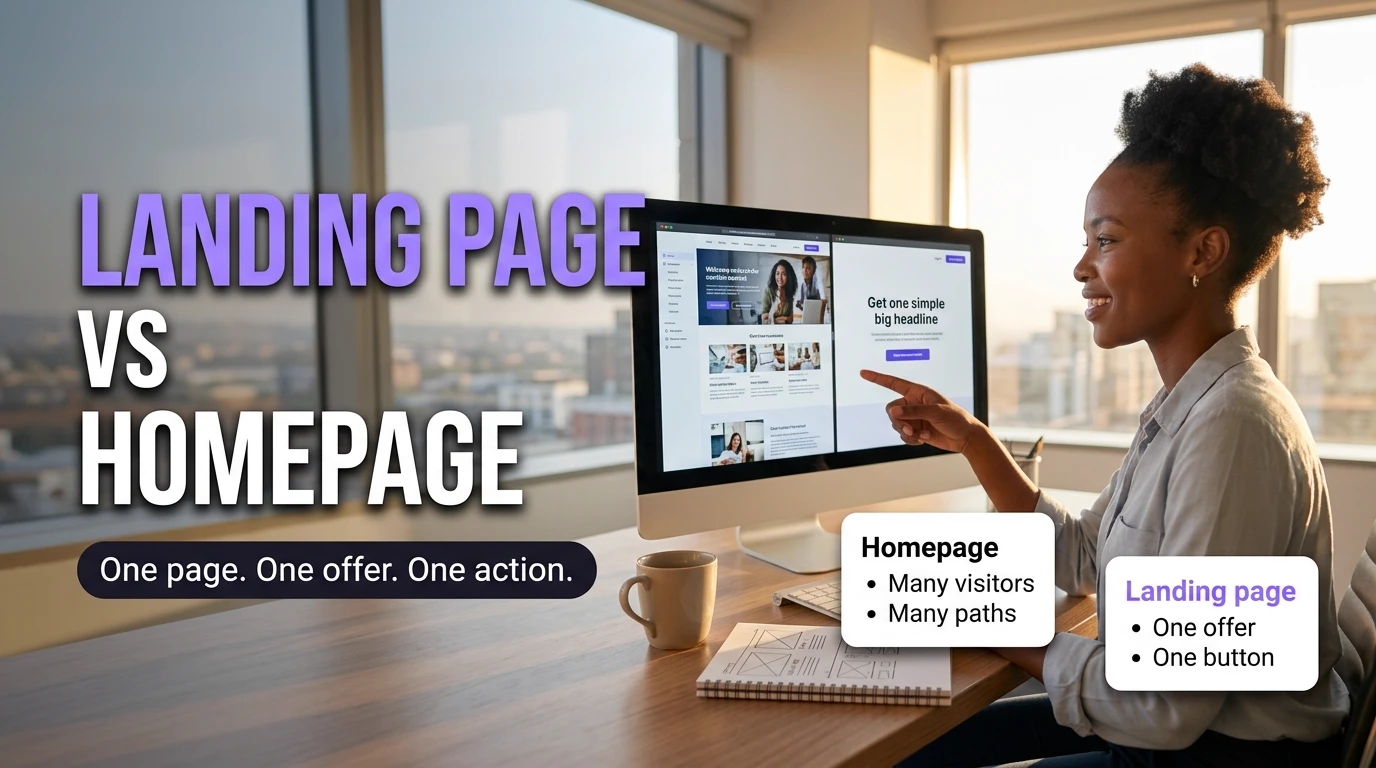
The Short Answer: One Page, One Job
Think of your homepage as reception and a landing page as a salesperson who already knows why you walked in. Reception has to greet the delivery driver, the job applicant, the existing client and the new prospect — so it offers directions. A landing page greets one kind of visitor, who came for one reason, and gets straight to it: here's the offer you clicked on, here's why it's credible, here's the button.
That's the whole idea. A landing page isn't a special kind of technology or a different type of website. It's any page designed around a single conversion — a quote request, a booking, a WhatsApp message, a download — with everything that doesn't serve that goal stripped out.
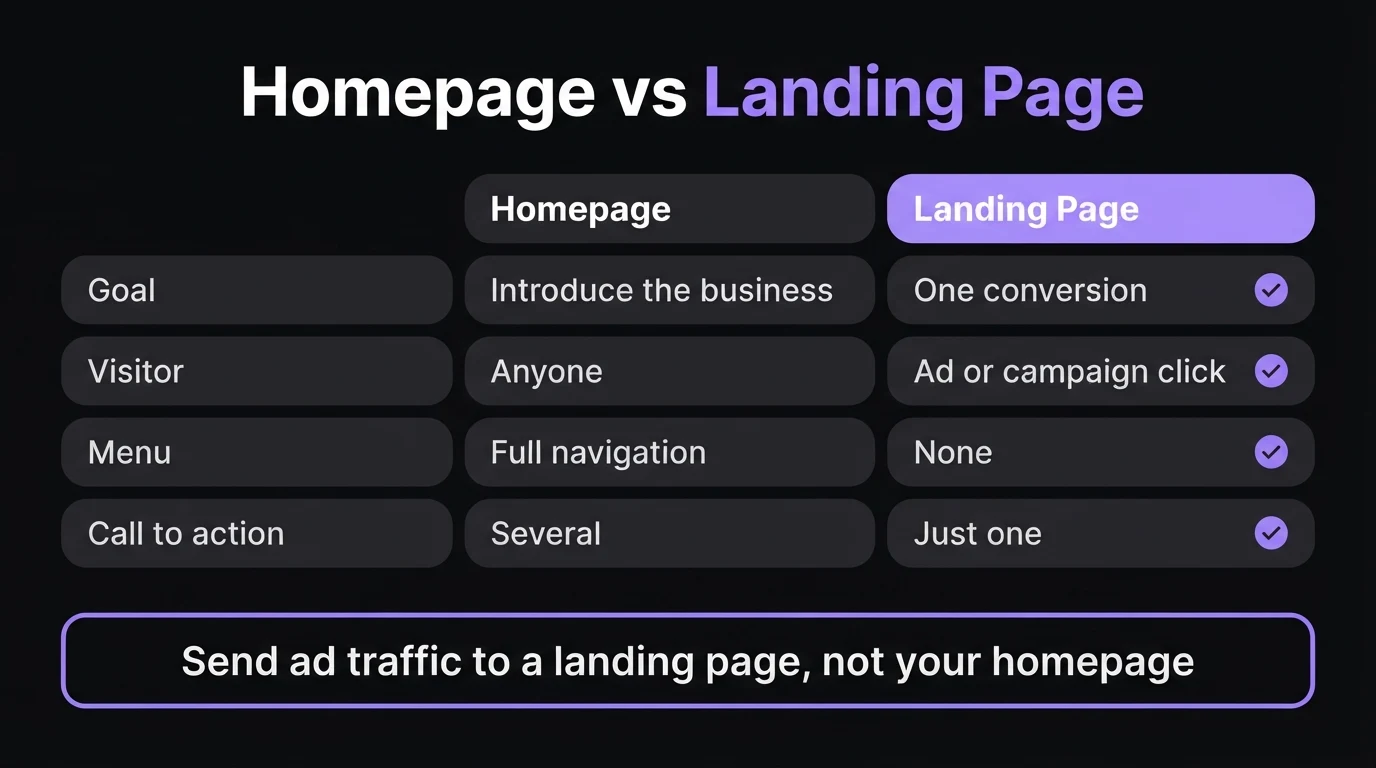
What Your Homepage Is Actually For
Your homepage is the page with the widest audience and the vaguest brief. On any given day it's visited by people who searched your business name, customers looking for your phone number, suppliers checking you exist, someone comparing three companies, and a prospect who heard about you from a friend. None of them arrived with the same question.
So a good homepage does three things well: it tells people what you do and who you do it for within a few seconds, it proves you're legitimate, and it routes each visitor to the right next page — services, pricing, portfolio, contact. That's why homepages have navigation menus, multiple sections and several calls to action. It's not a design flaw. It's the brief.
The problem only starts when you ask the homepage to do a job it wasn't built for — like converting someone who clicked a very specific ad.
Why Sending Ad Clicks to Your Homepage Leaks Leads
Picture an aircon installer in Pretoria East running a Google Ads campaign. The ad reads: "Aircon installation in Pretoria East — free on-site quote within 48 hours." Someone with a sweltering home office taps it. Here's what happens next, depending on where the ad points.
- Lands on "Welcome to Cool Air Solutions, est. 2011"
- Sees a slider about refrigeration, cold rooms and servicing
- Has to find "Installation" in a seven-item menu
- The "free quote" promise from the ad is nowhere in sight
- Hits back and taps the next ad on the results page
- Headline repeats the ad: "Aircon installation in Pretoria East"
- Offer is stated plainly: free on-site quote within 48 hours
- Photos of recent installs, reviews and accreditation right there
- One button — "WhatsApp for your free quote" — repeated down the page
- No menu to wander off into. The only exit is the back button.
Same business, same ad, same budget. The difference is that the homepage makes the visitor do the work of connecting your ad to your offer, and most people won't. When you're paying per click, every visitor who bounces because they couldn't find what the ad promised is money spent on nothing. Marketers call this message match: the page should feel like the natural continuation of the thing they clicked.
If you're deciding where to spend in the first place, our comparison of Facebook Ads vs Google Ads covers which platform suits which kind of business — but whichever you choose, the landing page is where that spend either turns into enquiries or evaporates.
Quick check: open your last ad, click it, and count how many seconds it takes to find the exact offer the ad promised.
What Goes on a Landing Page That Actually Converts
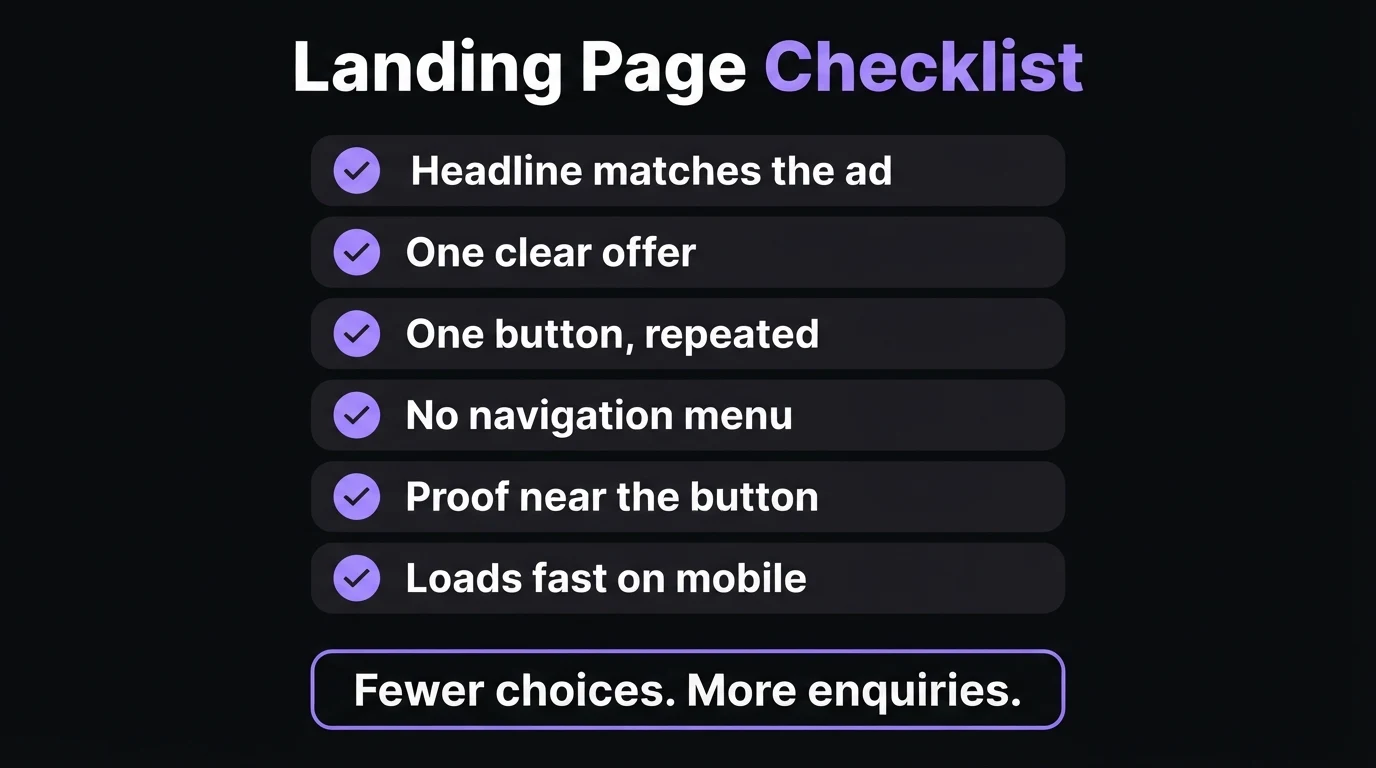
There's no magic template, but the pages that work share the same bones. If your landing page gets these six right, you're ahead of most small-business pages in South Africa.
1. A headline that matches the ad
If the ad said "Same-day blocked drain repairs in Centurion", the headline says the same thing, in close to the same words. The visitor should know within two seconds that they're in the right place. Clever or generic headlines ("Your Plumbing Partner") break the thread.
2. One clear, specific offer
"Contact us" isn't an offer. "Free on-site quote within 48 hours", "R499 geyser inspection this month" or "Book a free 15-minute consultation" are offers. Say what they get, what it costs (or that it's free) and what happens next. Specificity is what makes a stranger willing to take the first step.
3. One action, repeated
Pick a single conversion and put the button for it near the top, in the middle and at the bottom. In South Africa, that button is very often WhatsApp — people would rather send a quick message than fill in a form. Our guide to turning website visitors into WhatsApp leads covers pre-filled messages and button placement. If you do use a form, keep it to the three or four fields you genuinely need to reply.
4. No navigation menu — or as close to none as possible
This is the part business owners resist most, and the part that matters most. Every link on a landing page is an exit. Remove the main menu, drop the links to your blog and your "About" story, and keep only what supports the decision: the offer, the proof and the button. A small logo and a phone number in the header are fine.
5. Proof right next to the button
The moment before someone taps "Get a quote" is the moment doubt peaks. Put your reasons to trust you exactly there: two or three real Google reviews, photos of actual jobs, your registration or accreditation, how long you've been operating, the areas you serve. Real photos beat stock images by a wide margin here — we explain why in stock photos vs real photos.
6. Fast on a phone, on mobile data
Most ad clicks in South Africa happen on a phone. A landing page loaded with a background video and five uncompressed hero images will lose people before the headline even appears — and you've already paid for that click. Keep it light: compressed images, no autoplay video, and the headline plus button visible without scrolling.
Running ads to your homepage? Let's fix the destination first.
We'll build a live demo of a focused landing page for your main service — matched headline, one offer, WhatsApp button, real proof — in 48 hours. You only pay if you approve it.
Zero deposit · No lock-in · Based in Centurion, serving all of SA
When You Need a Landing Page (and When You Don't)
Not every business needs landing pages, and not every link should point to one. The rule is simple: the more specific the promise that brought someone to your site, the more specific the page they should land on.
| Where the visitor came from | Send them to | Why |
|---|---|---|
| Google Ads for one service | Landing page | The ad made a specific promise; the page should keep it |
| Facebook or Instagram promo | Landing page | Cold audience, short attention span, needs one clear step |
| Flyer, vehicle branding or QR code | Landing page | You know the offer they saw — continue it |
| Email to existing customers | Landing page | One campaign, one action, easy to measure |
| Someone searching your business name | Homepage | They want you, not an offer — let them choose a path |
| Google Business Profile website link | Homepage or location page | Broad intent: hours, services, proof you're real |
If you don't run any ads, campaigns or promotions, you probably don't need a separate landing page yet. Put that effort into strong service pages and a clear homepage instead. The moment you start paying for traffic, though, a landing page stops being optional — it's the cheapest way to get more out of a budget you're already spending.
Landing pages are for traffic you pay for or push; service pages are for traffic you earn. A campaign landing page is built for one audience at one moment, often with a time-limited offer — it's not what you want ranking on Google long-term. Your organic workhorses are well-written service pages that answer real questions. Build both, and don't try to make one page do the other's job.
Landing Page vs Service Page vs One-Page Website
These three get mixed up constantly, so here's the plain-English version:
- Landing page — a focused page for a specific campaign or audience, usually without the main menu, built to drive one action. Often not linked from your main navigation at all.
- Service page — a permanent page on your site about one service ("Geyser Installation", "Bookkeeping for Small Businesses"). It lives in your menu, is written to rank on Google, and has a clear call to action — but it also links to the rest of your site.
- One-page website — an entire small-business site on a single scrolling page. It can behave a lot like a landing page if you only sell one thing, but if you offer several services it ends up trying to be a homepage and a landing page at once. We cover what that costs and when it's enough in one-page website costs in South Africa.
If you're working out how many of each you need, how many pages a small business website needs walks through the structure most service businesses should start with.
Five Landing Page Mistakes We See All the Time
- One page for every ad. Your "geyser repair" ad and your "solar installation" ad should not land on the same generic "Services" page. One campaign, one page.
- The ad promises a price; the page hides it. If the ad says "from R499", that number belongs in the headline area, not buried in paragraph six.
- A nine-field form. Every extra field loses people. Name, number, suburb and the job is usually enough to call someone back.
- Copy about you, not them. "We are a passionate team founded in…" doesn't answer "can you fix my problem this week?" Lead with their outcome. Our guide to writing website copy that sells goes deeper.
- No tracking. If you can't see how many people tapped the WhatsApp button or submitted the form, you can't tell whether the ad or the page is the problem. Set up a conversion event before you spend another rand.
The Bottom Line
Your homepage and a landing page aren't competitors — they do different jobs. The homepage welcomes everyone and helps them find their way. The landing page takes someone who already raised their hand for a specific offer and makes saying yes as easy as possible.
If you run any kind of paid or campaign traffic, the highest-leverage fix is usually not a bigger budget or a cleverer ad. It's giving that traffic a page built for it: the ad's promise in the headline, one offer, one button, real proof, and nothing else to click.
- A landing page has one audience, one offer and one action. A homepage serves everyone and offers many paths.
- Send paid and campaign traffic to a landing page whose headline matches the ad — not to your homepage.
- Six essentials: matched headline, specific offer, one repeated button, no menu, proof beside the button, fast on mobile.
Go Deeper: Related Guides
Frequently Asked Questions
What is a landing page in simple terms?
A landing page is a single web page built for one specific audience and one action, such as requesting a quote, booking or sending a WhatsApp message. It is usually the page people arrive on after clicking an ad, email or campaign link, and it removes distractions like the main menu so the visitor focuses on that one offer.
What is the difference between a landing page and a homepage?
A homepage is the front door for every visitor: it introduces the business and links to services, pricing, contact and more, so it has a menu and several calls to action. A landing page serves one type of visitor who came for one reason, repeats the offer they clicked on, and has a single call to action with as few exits as possible.
Should I send Google Ads or Facebook Ads traffic to my homepage?
Usually not. Ads make a specific promise, and a homepage forces the visitor to hunt for it among everything else you do. Sending ad clicks to a landing page whose headline matches the ad, with one clear offer and one button, typically turns more of those paid clicks into enquiries. Send people searching your business name to the homepage instead.
Can a landing page rank on Google?
It can, but that is not usually its job. Campaign landing pages are built for one audience at one moment and often carry time-limited offers. For organic search, well-written service pages that answer real questions do the ranking work. Most businesses do best with service pages for SEO and separate landing pages for ads and promotions.
How much does a landing page cost in South Africa?
At CJX Studios, landing pages are built as part of our monthly website plans, which start from R1,200 per month with hosting, maintenance and support included. There is no deposit before you approve a free 48-hour live demo, so you can see the page working before you commit.

Chris Maboyi
I build websites and campaign landing pages for South African businesses in Centurion, Pretoria and across Gauteng — pages designed around the one thing you want a visitor to do next. Every project starts with a 48-hour free demo: real, live, no deposit before you approve it. Get in touch or WhatsApp me directly.