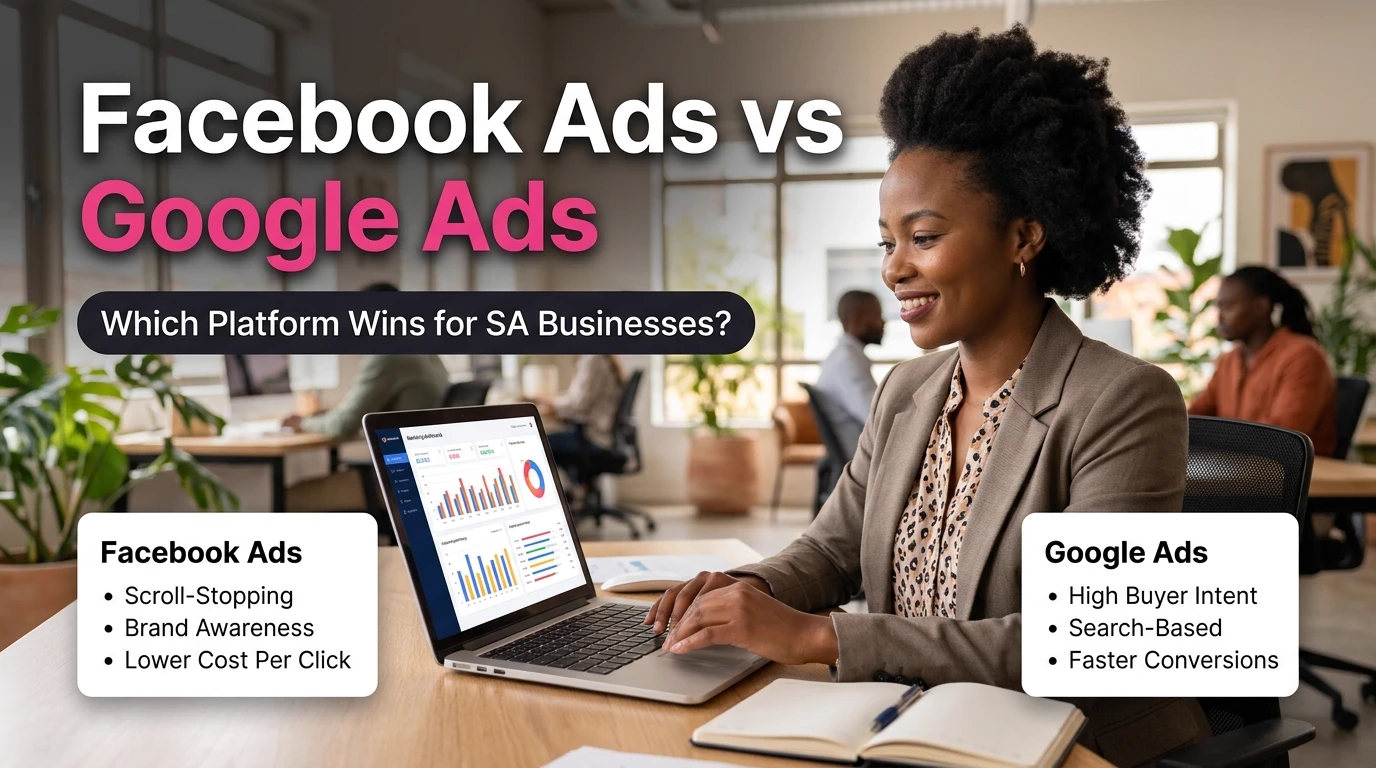
These Aren't Competing Platforms, They're Answering Different Questions
Every ads conversation with a new client starts the same way: "Should I do Facebook or Google?" It's the wrong first question, and answering it too early is how a lot of small business ad budgets get wasted. The right first question is: does my ideal customer already know they need what I sell, or do I need to convince them first?
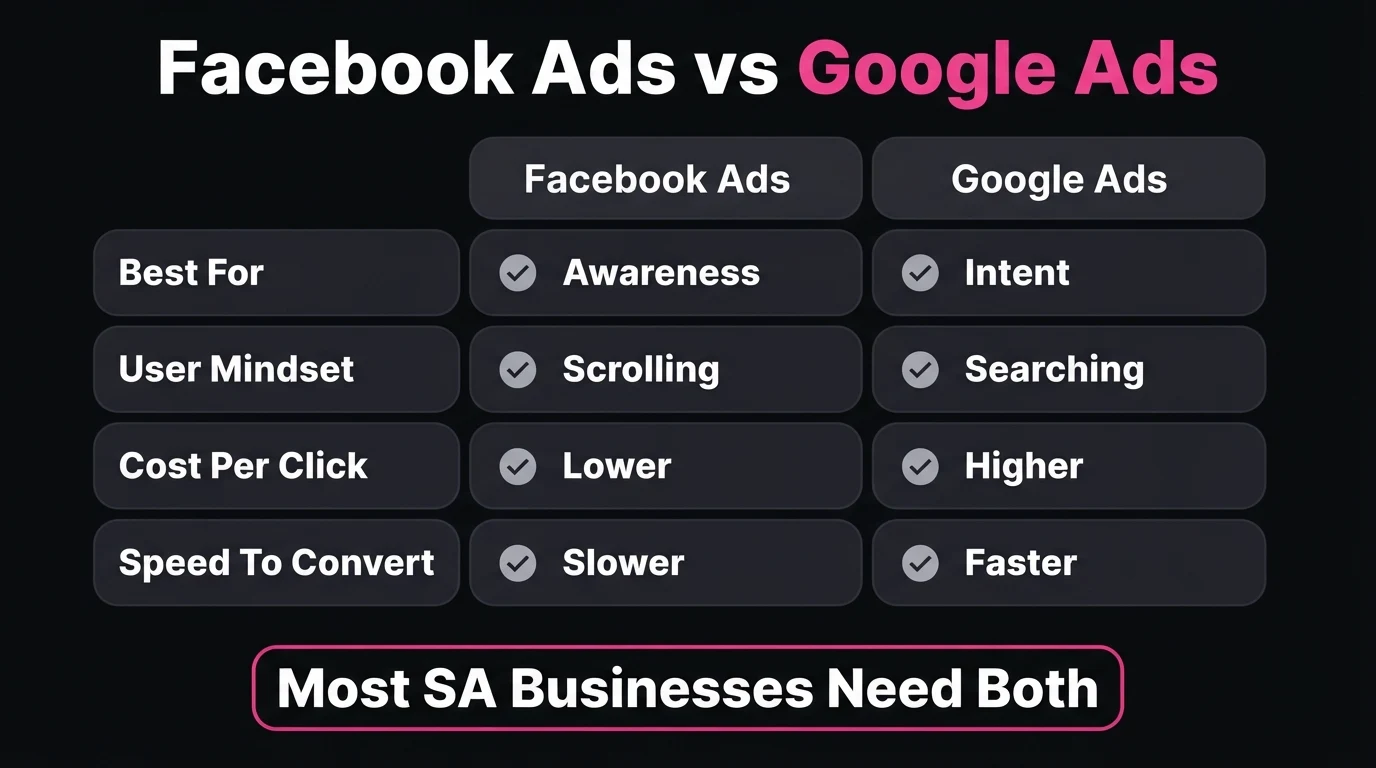
Google Ads sits at the bottom of the funnel. Someone types "electrician Centurion" or "accountant for small business Pretoria" into Google because they already have the problem and they're actively looking for the fix. You're not creating demand — you're capturing demand that already exists, at the exact moment it's most valuable. That's why the click costs more. You're not the only business bidding on that intent.
Facebook Ads (and Instagram, running through the same Meta ads platform) sits earlier in the journey. Nobody opens Facebook looking for a website designer or a new pair of running shoes — they're there to see what friends posted. A good Facebook ad interrupts that scroll and creates interest in something the viewer wasn't actively searching for. That's a harder job, which is partly why it's cheaper per click: you're competing for attention, not for a specific search term.
How Each Platform Actually Works
Google Ads: intent-based, search-triggered
Google Ads shows your listing when someone searches a term you're bidding on. You pay per click, you compete in an auction against other advertisers, and your ad quality — how relevant your landing page is to the search — directly affects both your position and your cost. This is why a fast, focused landing page isn't optional for Google Ads; it's part of what determines how much you pay per click, and a slow one quietly taxes every campaign you run.
Facebook Ads: interest-based, scroll-triggered
Facebook Ads target people based on demographics, interests, behaviours, and — most powerfully — lookalike audiences built from your existing customers. You're not answering a search; you're showing up in a feed based on who Meta's algorithm thinks is likely to care. That means the creative does more of the work than the targeting does. A generic stock photo and a vague headline get scrolled past in under a second. A specific, local, visually arresting ad earns the extra half-second it needs to land the message.
- People actively search for what you sell
- You're a local service business (trades, medical, legal, accounting)
- The purchase decision happens fast, once the need is urgent
- You need leads, not just brand recognition
- Your product or offer needs explaining or showing
- You're building a brand people don't yet search for by name
- Visual products sell themselves (retail, food, events, beauty)
- You have existing customers to build lookalike audiences from
The businesses that waste the most ad spend are the ones that pick a platform based on what a competitor is doing, not on their own buyer's behaviour. A Centurion plumber came to CJX after six months of Facebook Ads that "weren't converting" — the ads themselves were fine, but nobody scrolling Facebook at 9pm is thinking about their geyser. Two weeks after switching that budget to Google Ads targeting "emergency plumber Centurion," the call volume more than tripled. Same budget, same business, completely different platform for the way that customer actually searches.
Before you keep reading: does your ideal customer search for a solution, or do they need to be shown one? That single answer decides most of this article.
The Budget-First Decision Framework
Strategy matters less than most people think when the budget is small. Below a certain spend, the algorithm on either platform doesn't have enough data to leave its learning phase and find who actually converts — which means the platform choice matters less than choosing one platform and running it properly.
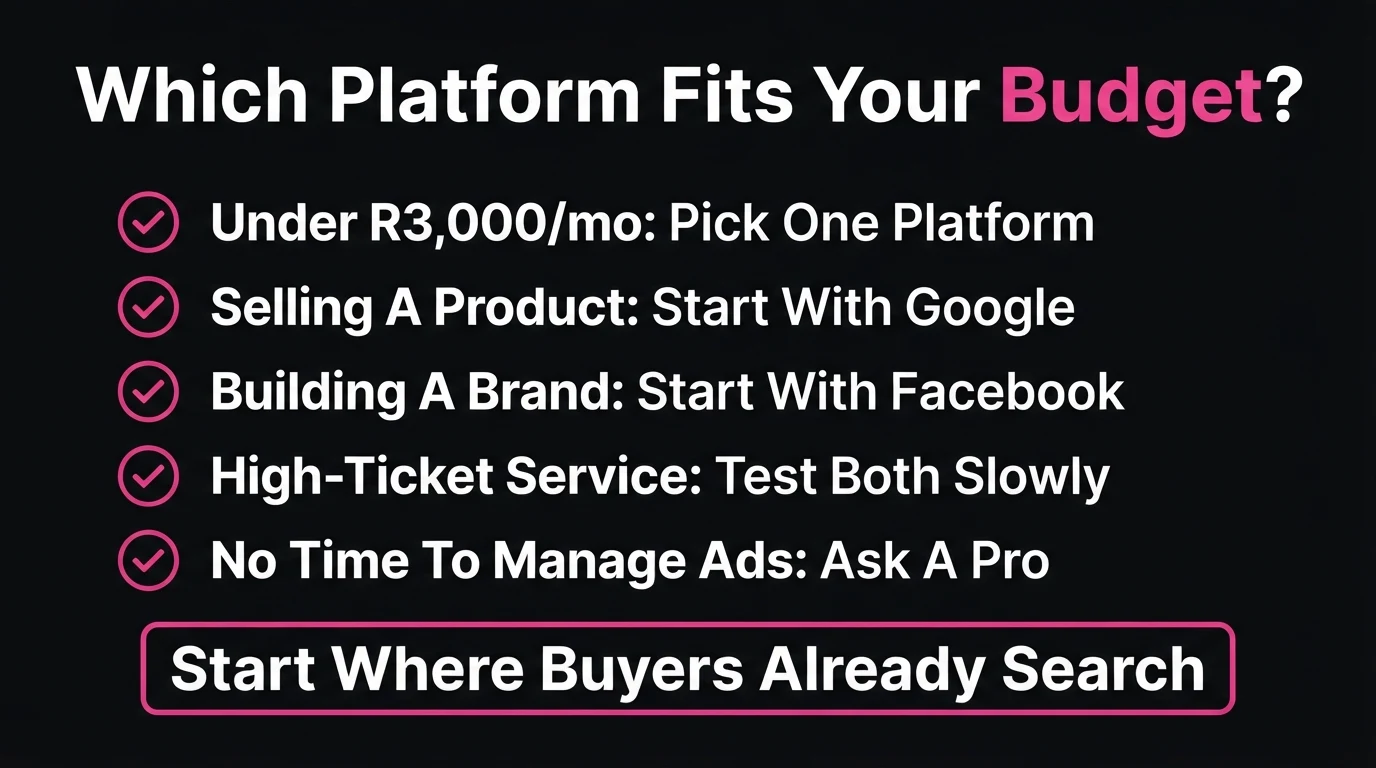
- Under R3,000/month: pick one platform. Splitting a small budget across both usually means neither gets enough spend to learn, and you end up with two mediocre campaigns instead of one that works.
- Selling a specific product or service people search for: start with Google Ads — you're capturing existing demand, which converts faster on a small budget.
- Building a brand or launching something new: start with Facebook Ads — you need awareness before anyone will search for you by name.
- Selling a high-ticket service (legal, medical, major renovations): test both slowly, because the decision cycle is long enough that a prospect may see a Facebook ad first and search on Google weeks later.
- No time to manage either properly: that's a real cost most businesses underestimate — a neglected ad account bleeds budget on autopilot. Get someone who checks it weekly, even if that's not CJX.
The Platform Doesn't Matter If the Landing Page Fails
Here's the part most ad agencies won't lead with: the platform you choose determines who clicks, but your website determines whether that click becomes a customer. A Google Ads click lands on someone with their problem already in mind — the landing page needs to answer it fast, with the call-to-action impossible to miss. A Facebook Ads click lands on someone who wasn't looking for you — that same page needs to earn attention first, with a strong headline and visible proof, before it asks for anything.
We've watched businesses run genuinely well-targeted ads on the right platform, at a sensible budget, and still get poor results — because the site the ad pointed to loaded slowly, buried the WhatsApp button three scrolls down, or looked like it hadn't been touched since 2019. The website behind the ad is not a separate decision from the ad platform — it's the half of the equation that actually converts the click you paid for.
Go Deeper: Related Guides
Running ads to a website that isn't pulling its weight?
Send Chris your site on WhatsApp for a free, plain-English look at whether it's built to convert Google or Facebook traffic — before you spend another rand on ads pointing at it.
Zero deposit · No lock-in · Pay only if you love it · From R1,200/mo
Frequently Asked Questions
Should a small SA business start with Facebook Ads or Google Ads?
It depends on whether people already search for what you sell. If your business answers a need someone types into Google — "plumber in Centurion", "accountant for small business" — start with Google Ads, because that searcher is ready to buy right now. If your offer needs explaining or isn't something people actively search for yet — a new product, a lifestyle brand, a service people don't know exists — start with Facebook Ads to build awareness first. Most SA small businesses with a limited budget get further picking one platform properly than splitting a small budget across both.
Which is cheaper, Facebook Ads or Google Ads, in South Africa?
Facebook Ads usually have a lower cost per click, often R2 to R8 depending on your industry and audience, because you're interrupting a scroll rather than answering a search. Google Ads costs more per click — commonly R5 to R40+ for competitive local service terms — because you're bidding against every other business chasing the same buyer intent. The click is more expensive on Google, but it's also a warmer lead, so cost per click alone is a misleading comparison without looking at conversion rate too.
Can I run Facebook Ads and Google Ads at the same time?
Yes, and once your budget allows it, running both is usually the stronger long-term strategy — Facebook builds familiarity with your brand, and Google catches that same person when they later search for what you offer. The mistake is splitting a very small budget (under roughly R3,000/month) across both from day one, which usually means neither platform gets enough spend to learn who converts. Prove out one platform first, then add the second once it's profitable.
Do I need a different website for Google Ads versus Facebook Ads?
You don't need two separate websites, but the page each ad sends traffic to should match the visitor's mindset. A Google Ads click lands on someone actively looking for a solution, so the landing page should answer their question fast and make the call-to-action obvious. A Facebook Ads click interrupts someone mid-scroll who wasn't looking for you, so the landing page needs to earn attention first — a strong headline, clear proof, and a reason to keep reading — before it asks for the sale.
How much should a small SA business budget for paid ads?
Most small SA businesses see meaningful results starting from R2,000 to R5,000 a month on a single platform, run consistently for at least 60-90 days before judging results — paid ads need volume to leave the learning phase and find who actually converts. Spending less than that spread across multiple campaigns or platforms usually just produces noise. It's better to run one focused campaign on one platform properly than to spread a small budget thin trying to cover every option.
- Google Ads captures demand that already exists. Use it when people actively search for what you sell — it costs more per click but converts faster.
- Facebook Ads creates demand that doesn't exist yet. Use it to build awareness for something people don't know to search for — it's cheaper per click but colder.
- Neither platform matters if the landing page fails. The website catching the click decides whether the ad spend actually pays for itself.
Keep Reading

Chris Maboyi
I build websites for South African businesses in Centurion, Pretoria, and across Gauteng — sites built to actually convert the traffic you're paying for, whether it comes from Google, Facebook, or search. Every site starts with a 48-hour free demo: real, live, no deposit, no obligation. Get in touch or WhatsApp me directly.