The Honest Answer: It Depends on How Your Customers Buy
Most advice on business blogging comes from people selling blogging. So here is the version without the sales pitch: blogging is brilliant for some South African small businesses and a waste of Saturdays for others. The deciding factor is not your industry or your budget. It is how your customer goes from "I have a problem" to "I'll hire these people".
If that journey includes research (comparing options, checking prices, asking Google a question first), a blog puts you in front of them at the exact moment they are deciding. If the journey is "my geyser burst, call someone now", a blog post will not beat a Google Business Profile with a tap-to-call button. Different tools, different jobs.
The rest of this guide helps you work out which situation you are in, what a blog realistically costs you, and how to tell, six months in, whether it is paying off.
What a Business Blog Actually Costs You
The cost most owners underestimate is not money. It is time and consistency. A genuinely useful post, one that answers a real question better than the pages already ranking, takes several hours to research, write, edit and publish. Multiply that by one or two posts a month and you are committing a real slice of your week to something that will not pay you back immediately.
The figures above are rules of thumb from how new content typically performs on newer domains, not guarantees. Your results will vary with competition, your industry and the quality of what you publish. The pattern, though, is consistent: slow start, then compounding.
Where Blogging Pays Off (and Where It Doesn't)
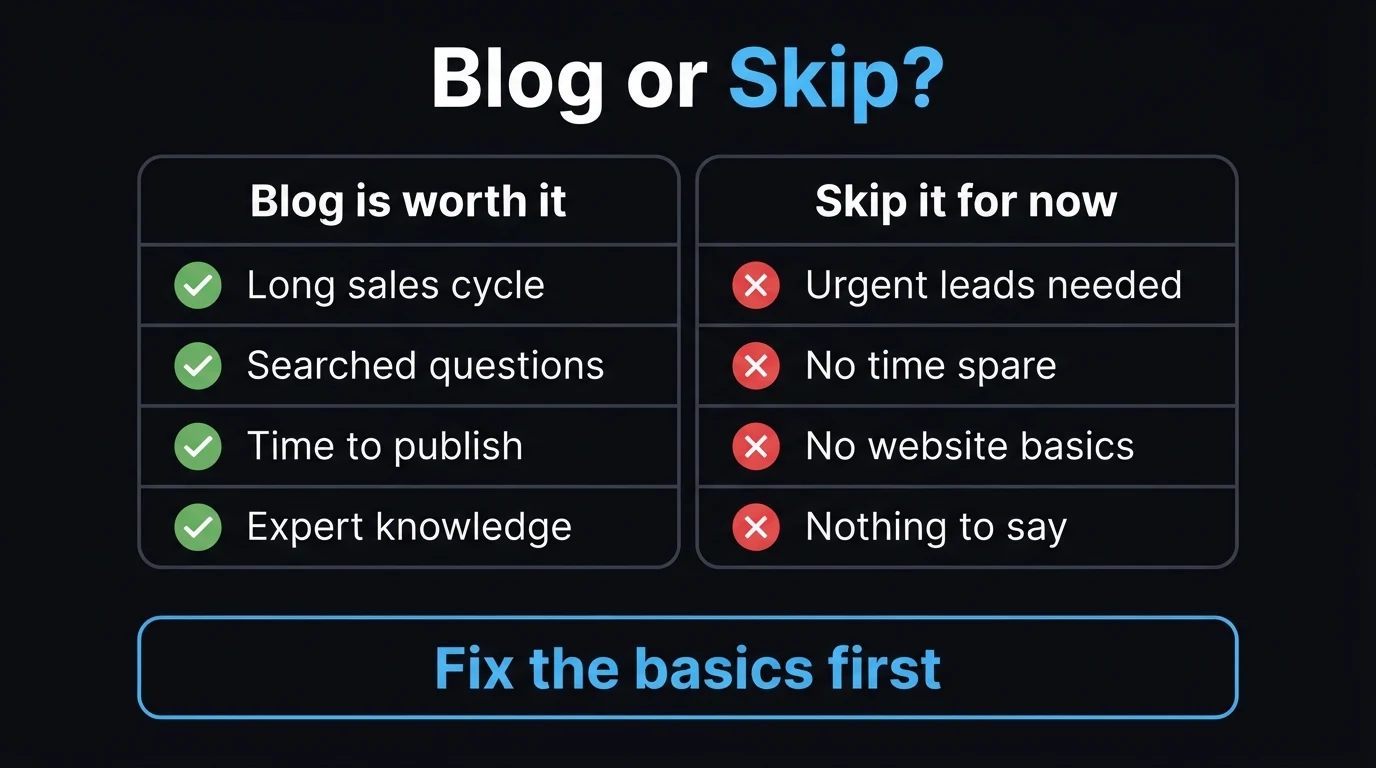
- Customers research and compare before they buy
- The sale is high-value or has a long decision cycle
- People search questions you can answer with authority
- You can commit to six months of steady publishing
- You want leads that don't cost per click
- You need enquiries within weeks
- Customers buy in an emergency, not after research
- Your site is slow, unclear or missing service pages
- No one has time to write, so posts will stop after three
- You have no Google reviews or Business Profile yet
Think of a few real examples. A financial adviser, an architect or a law firm sells high-trust, high-value services that people research carefully, so a blog that answers their questions builds credibility long before the first call. A tutoring business or a wedding venue sees parents and couples searching months ahead, so helpful posts catch them early. An emergency plumber or a tow-truck operator is the opposite: the customer does not read, they call, and the best investment is being found on Google Maps with a number to tap.
Quick check: before they buy, what is the last question a customer asks that Google could have answered?
Do the Fast Things First
Here is the lightly contrarian bit: for most small businesses, a blog should be the third or fourth thing you do online, not the first. A blog sends visitors to your website. If your website does not convert them, you have paid for traffic you cannot use.
A website that converts
Clear service pages, a fast mobile experience, and a one-tap way to call or WhatsApp. Our guide to whether you need a website covers the minimum.
Google Business Profile and reviews
For local searches this beats a blog on speed. See Google Business Profile vs a website and how to get Google reviews.
Copy that sells
If your core pages are vague, blog traffic will leak out of them. Tighten them with how to write website copy that sells.
Then, the blog
With the foundations working, every post you publish has somewhere good to send its readers.
Not sure your website is ready for a blog?
We'll build a live demo of a conversion-ready website for your business in 48 hours, with the blog structure ready when you are. You only pay if you approve it.
Zero deposit · No lock-in · Based in Centurion, serving all of SA
How to Blog Without It Eating Your Week
If you have decided a blog fits, the goal is a repeatable system, not a burst of enthusiasm. Four habits separate the blogs that last from the ones that quietly die after post three.
- Start from real customer questions. Scroll your WhatsApp chats and email. The questions people actually ask you are your topic list, and they are already bottom-of-funnel.
- Answer the question in the first paragraph. Readers and search engines both reward posts that get to the point, then go deeper.
- Write less often, but better. One strong post a fortnight beats seven forgettable ones. Add your own experience, local detail and examples a competitor cannot copy.
- Link posts to your money pages. Every post should point to the service, pricing or contact page that logically comes next.
AI tools can speed up research and first drafts, but they cannot supply your expertise, your pricing reality or the way South African customers actually talk. Generic, machine-sounding posts are exactly what search engines and readers learn to ignore. Use AI to save time, then edit until it sounds like you. For more on how AI is changing search, see is SEO dead in the age of AI search?
How to Measure Whether Blogging Is Working
Do not judge a blog by page views alone. Track the signals that predict revenue, in the order they usually appear:
| Signal | Where to see it | What it tells you |
|---|---|---|
| Impressions | Google Search Console | Google is showing your posts to searchers |
| Clicks & CTR | Google Search Console | Titles and descriptions are earning the click |
| Page-one rankings | Search Console / rank tracker | Posts are competitive for their topic |
| Enquiries citing a post | Ask: "How did you find us?" | The blog is feeding real leads |
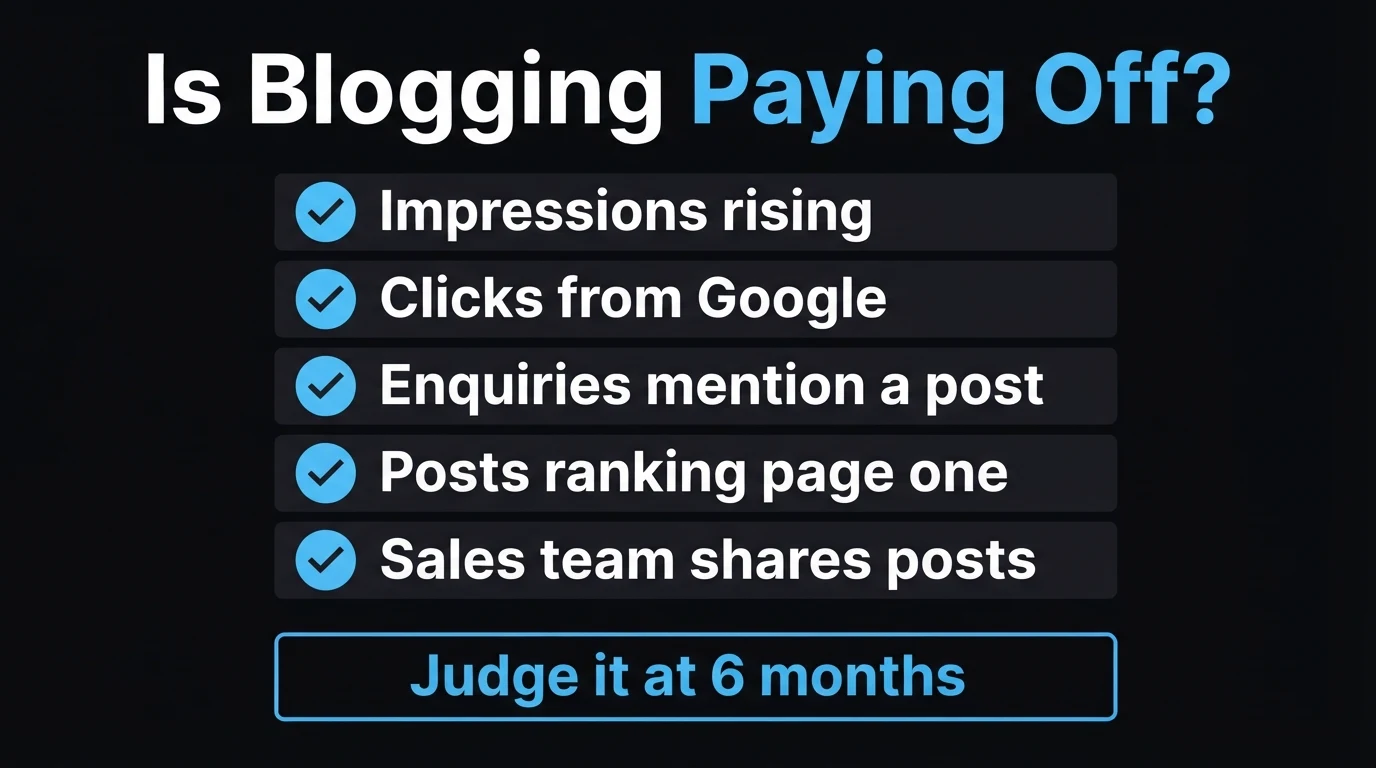
Ask every new lead, "How did you find us?" and write the answer down. Analytics will not tell you that someone read two of your posts, then WhatsApped you a week later. A simple question will, and it is the cheapest ROI tracking you can do.
The Bottom Line
Blogging is not a hack and it is not a scam. It is a slow-compounding asset that rewards businesses with real expertise, customers who research, and the discipline to keep going. If that is you, start with a handful of posts built around real customer questions and judge them at six months. If it is not you, put your energy into the faster levers first: a converting website, a strong Google Business Profile and reviews. Our website cost guide and why websites cost what they do help you budget for the foundation.
- Blog if customers research before buying and you can publish steadily for six months or more.
- Skip it for now if you need leads this month or your website basics are not in place.
- Measure honestly: impressions, clicks, rankings, and "how did you find us?" answers.
Go Deeper: Related Guides
Frequently Asked Questions
Is blogging worth it for a small business in South Africa?
It depends on how your customers buy. Blogging is worth it when people research before they buy, when you have genuine expertise to share, and when you can publish consistently for six months or more. It is usually not worth it if you need leads this month, have no time to write, or your website basics (speed, contact options, service pages) are not yet in place.
How long does it take for a business blog to generate leads?
Most business blogs take three to six months before posts start earning meaningful Google impressions, and often longer for clicks and enquiries. New domains take the longest. Blogging is a compounding asset: early posts are slow, but each good post keeps working long after it is published.
How often should a small business publish blog posts?
Consistency beats volume. One genuinely useful post every one to two weeks, written around real customer questions, will outperform daily thin posts. If you can only manage one good post a month, that is still worth doing, as long as you keep it up for at least six months.
What should a small business blog about?
Answer the questions customers ask before they buy: what something costs, how to choose between options, what to check before hiring, and what common mistakes to avoid. Posts that mirror real sales conversations bring in readers who are already close to a decision, which is worth more than broad traffic.
What can I do instead of blogging to get more customers online?
If you need results faster, put effort into a Google Business Profile, collecting Google reviews, clear service pages, and a fast mobile site with WhatsApp and call buttons. Paid ads can also bring leads immediately. These tend to pay back sooner than a blog and make later blogging more effective.

Chris Maboyi
I build websites for South African businesses in Centurion, Pretoria and across Gauteng, and run an AI-assisted content and SEO programme for CJX Studios. Every project starts with a 48-hour free demo: real, live, no deposit before you approve it. Get in touch or WhatsApp me directly.