Why Portals Alone Aren't a Strategy
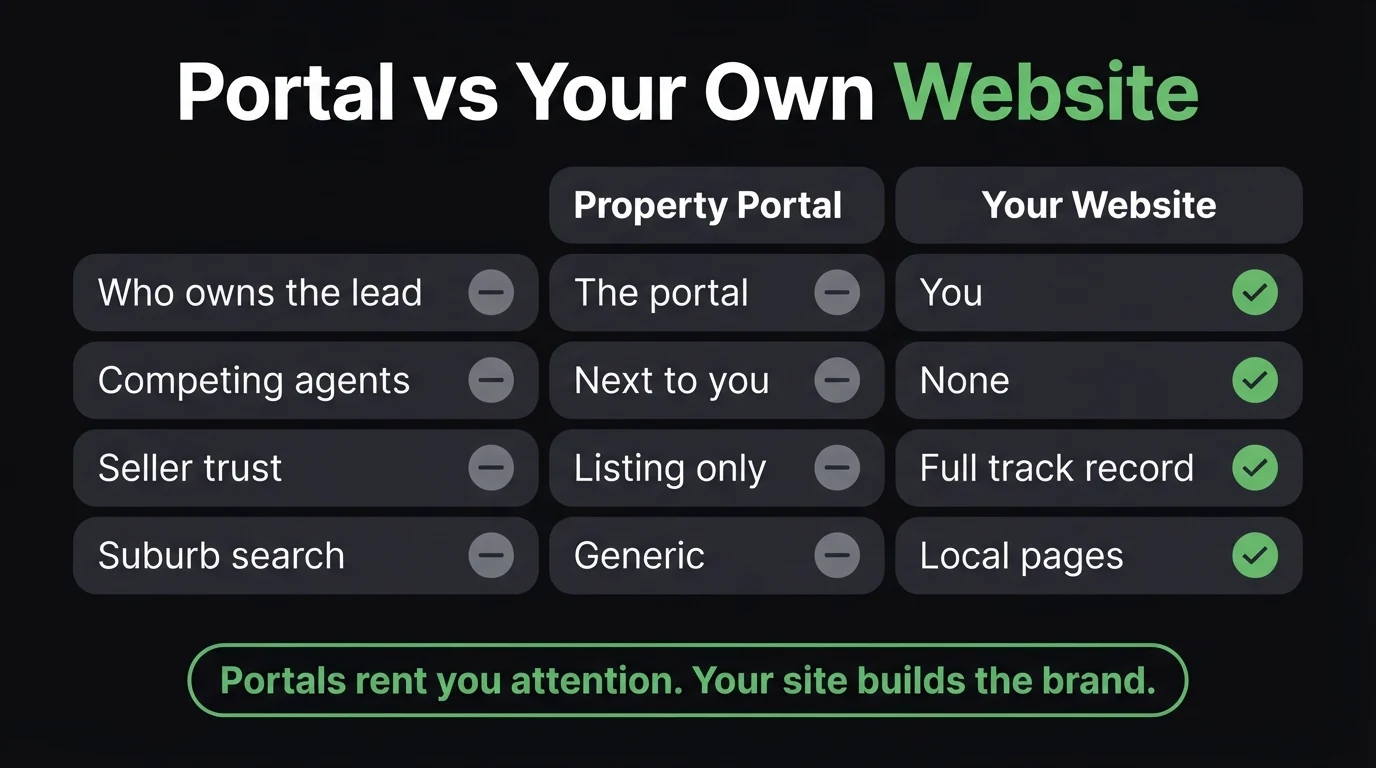
Portals are brilliant at one thing: putting a listing in front of people who are already searching for a three-bedroom in a specific suburb. Keep using them. But look at what happens on that listing page. Your stock sits in a grid next to every other agency working the same area. The enquiry form belongs to the portal. And the buyer who clicks through remembers "I saw it on Property24" — not your name.
That's fine for moving a single house. It's a weak foundation for a business, because in residential property, the scarce resource isn't buyers — it's stock. Every agent in a suburb is chasing the same limited number of homeowners who might sell this year. The agent who gets the mandate gets the commission. And the moment a homeowner decides which agent to trust with their biggest asset is exactly the moment a portal can't help you, because by then they're researching you, not the listing.
They Google your name. They look for your agency's site. They check whether you've actually sold anything on their street. If what they find is a Facebook page and a portal profile, you look like every other agent. If they find a proper site with your sold record and a sharp page about their suburb, you look like the specialist.
The Two Visitors Your Site Has to Serve
Most agency websites are built as if only buyers visit. That's backwards. Buyers are well served by the portals already — the visitor your site is uniquely placed to convert is the homeowner thinking about selling. Your site needs a clear path for both, and they want very different things.
- "What's my house worth right now?"
- "Has this agent sold anything near me?"
- "Do they understand my suburb, not just the city?"
- "Are they registered and legitimate?"
- "How fast can I get a valuation without a hard sell?"
- "Is this listing still available?"
- "When's the next show day?"
- "What else do you have in this area and budget?"
- "Can I just WhatsApp someone quickly?"
- "What are the schools and commute like here?"
Notice that the seller's questions are all about trust and local expertise, and the buyer's are about speed and access. A good agent website answers both on the homepage within one scroll: a "What's my home worth?" button for sellers, and a "Browse listings" or "Get new listings on WhatsApp" path for buyers.
Quick check: if a homeowner in your farming area landed on your site today, how many taps would it take them to request a valuation?
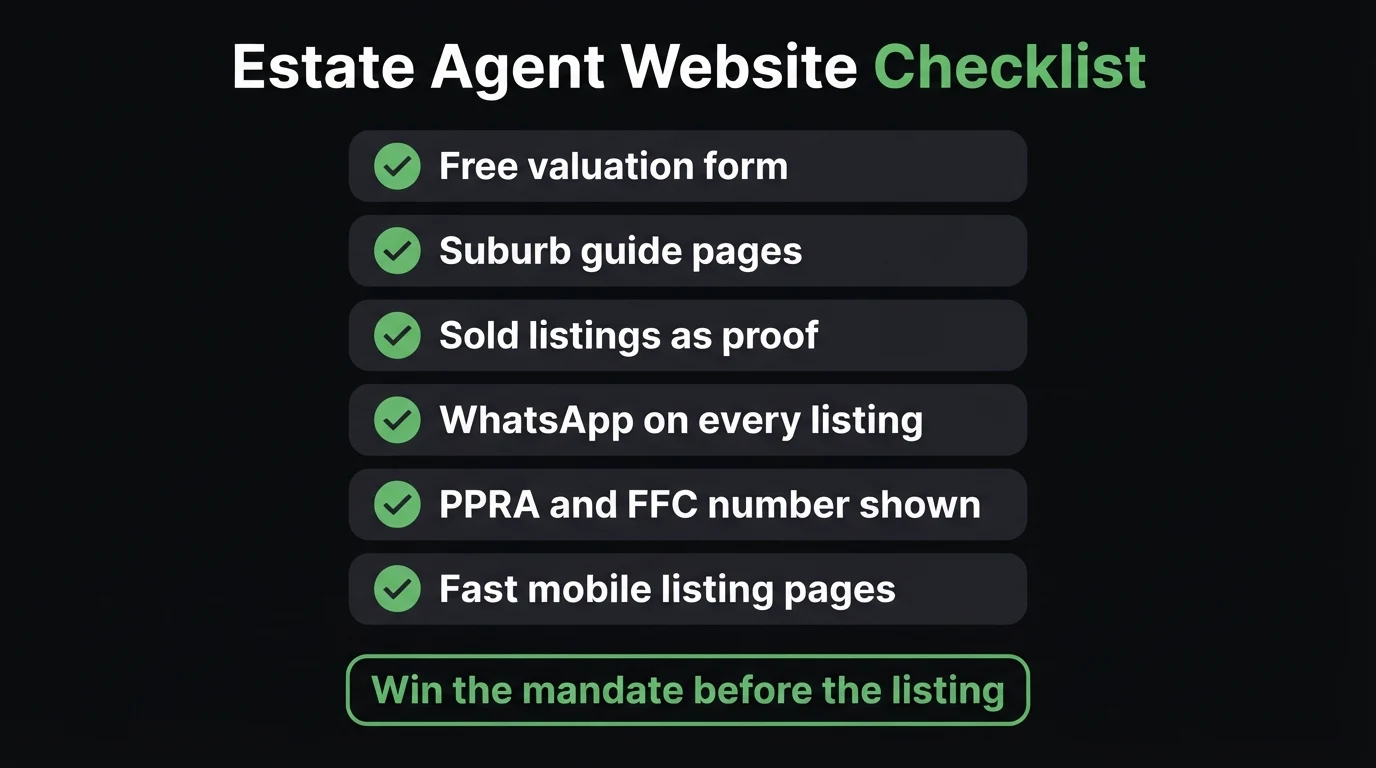
The Six Things an Estate Agent Website Must Have
1. A free valuation request that doesn't feel like a trap
This is the single most valuable form on your site, because every submission is a potential mandate. Keep it short — address, property type, rough timeline, and a WhatsApp number. Say plainly what happens next ("I'll send you three recent sales on your street within 24 hours, no obligation"). Sellers are wary of being hounded; a specific, low-pressure promise converts far better than "Contact us for a free valuation!"
2. Suburb guide pages for the areas you actually farm
This is where local search is won. A homeowner in Irene or Midstream doesn't search "estate agent Gauteng" — they search "estate agent Irene" or "selling a house in Midstream Estate". One genuinely useful page per suburb you work — what's selling, typical price bands, the schools, the estate rules, the security set-up, your recent sales there — gives Google a reason to show you for that suburb and gives the seller proof you know their patch. Only build pages for areas you truly farm; a thin page for every suburb in the metro does more harm than good.
3. A sold record as proof
Active listings show you have stock. Sold listings show you can close. A simple "Recently sold" section with suburb, property type and — where the seller is comfortable — the result against asking price is the most persuasive trust signal an agent has. It answers the question every seller is silently asking: "Will this person actually get my house sold?"
4. WhatsApp on every listing
South African buyers would rather send a quick WhatsApp than fill in a form, especially after hours. Every listing page should have a click-to-chat button that pre-fills the property reference, so the message that lands on your phone reads "Hi, is 14 Oak Street still available?" rather than "Hi". Our guide on turning website visitors into WhatsApp leads covers where that button needs to sit to actually get tapped.
5. PPRA registration and Fidelity Fund Certificate, visible
Under the Property Practitioners Act, anyone earning commission on a property sale needs to be registered with the Property Practitioners Regulatory Authority and hold a valid Fidelity Fund Certificate. Savvy sellers and conveyancers check. Showing your FFC details and agency registration in the footer and on your About page costs nothing and quietly separates you from the fly-by-night operators every suburb has. Pair it with a proper privacy policy — you're collecting names, numbers and addresses, which puts you squarely under POPIA (our POPIA legal pages guide covers what you need).
6. Listing pages that load fast on a phone
Property sites are image-heavy by nature, which makes them some of the slowest sites on the South African web. A listing page with twenty uncompressed 5MB photos will take ages on mobile data — and most buyers are browsing on their phones, often in the car on the way to a show day. Compressed modern image formats, a lightweight gallery, and a page that shows price, key specs and the WhatsApp button before the photos finish loading are what keep them on the page. The exact speed thresholds that matter are in our Core Web Vitals guide.
Are you an estate agent or principal? See your site before you pay.
We'll build a live demo of your agency website — valuation form, suburb pages for your farming area, sold record and WhatsApp on every listing — in 48 hours. You only pay if you approve it.
Zero deposit · No lock-in · Based in Centurion, serving all of SA
Local Search: Where Agents Win or Disappear
Property is about as local as search gets. Almost every high-intent query has a place in it: "estate agents in Brooklyn Pretoria", "sell my house Centurion", "houses for sale near Eldoraigne schools". Three things decide whether you show up for those.
Your Google Business Profile. For "estate agent near me" searches, the map pack usually appears above the organic results. A complete profile with your office address, accurate hours, real photos and a steady flow of reviews from buyers and sellers you've worked with is non-negotiable. It works alongside your website, not instead of it — we unpack how the two fit together in Google Business Profile vs a website.
Suburb pages with real substance. This is where the individual agent can beat the big franchise. A national brand's page for your suburb is usually a generic template. Yours can talk about the specific estate's levies and HOA rules, which streets back onto the greenbelt, and what actually sold last quarter. That depth is what ranks — and what makes a seller think "this person knows my area."
Answers for AI search. More buyers and sellers now ask ChatGPT or Google's AI Overviews things like "what should I know before selling in Midstream?" Pages that answer those questions directly, in plain language, with a clear FAQ, are the ones those tools quote. We cover how that shift works for small businesses in Is SEO dead? AI search in South Africa.
Your portal spend buys you this month's buyers. Your website builds next year's stock. A seller who reads your suburb guide in March, sees your sold record in June and requests a valuation in September never touched a portal ad. That's the lead you own outright — no per-listing fees, no competing agents on the same page, and no algorithm change that can take it away from you.
What an Agent Website Should Cost — and What It Shouldn't Do
You don't need a custom property-search engine with map filters and a mortgage calculator on day one. Most individual agents and small agencies get far more value from a fast, well-structured site that nails the six essentials above than from an expensive platform that re-creates what the portals already do better.
| Feature | Worth it for most agents? | Why |
|---|---|---|
| Valuation request | Essential | Every submission is a potential mandate |
| Suburb guide pages | Essential | How you rank for "[suburb] estate agent" |
| Sold record | Essential | The strongest trust signal you have |
| WhatsApp per listing | Essential | How SA buyers actually make first contact |
| Full portal-style search | Only at volume | Duplicates the portals unless you carry lots of stock |
| Mortgage calculator | Nice to have | Useful, but rarely the reason someone calls you |
At CJX Studios, agent websites start on the same monthly plans as any other business — see the pricing page for what each tier includes. If you work in a related professional field, our guide to websites for law firms and accountants covers a similar trust-first approach — useful if you're a conveyancer or bond originator partnering with agents.
The Bottom Line
Portals will keep sending you buyer enquiries, and you should keep paying for them. But they will never build your name, never show a homeowner your track record in their street, and never let you own the relationship. That's the job of your own website — and in a business where the mandate is everything, it's the job that pays best.
Start with the valuation form and one really good suburb page for the area you know best. Add your sold record. Make sure WhatsApp works on every listing and your FFC is visible. That's enough to put you ahead of most agents in your area — because most of them are still relying on the same portal grid as everyone else.
- Portals win buyers; your website wins sellers. Stock is the scarce resource, so build the site for the homeowner deciding which agent to trust.
- Six essentials: valuation form, suburb pages, sold record, WhatsApp per listing, visible PPRA/FFC details, fast mobile listing pages.
- Local search is won suburb by suburb — only build pages for areas you genuinely farm, and make each one useful.
Go Deeper: Related Guides
Frequently Asked Questions
Do estate agents still need a website if they list on Property24 and Private Property?
Yes. Portals are excellent for buyer reach, but they place your listings next to competing agents and keep the enquiry relationship on their platform. Your own website is where homeowners check your track record before signing a mandate, where you rank for suburb searches, and where every lead belongs to you outright. Use both: portals for reach, your site for trust and ownership.
What is the most important page on a real estate agent's website?
The free valuation request. Every submission is a homeowner thinking about selling — a potential mandate. Keep the form short, promise something specific and low-pressure (for example, recent sales on their street within 24 hours), and make it reachable from the homepage in one tap.
Should I show my PPRA registration and Fidelity Fund Certificate on my website?
Yes. Under the Property Practitioners Act, anyone earning commission on property transactions must be registered with the PPRA and hold a valid Fidelity Fund Certificate. Showing those details in your footer and About page costs nothing, reassures careful sellers and conveyancers, and separates you from unregistered operators.
How do estate agents rank on Google for their suburb?
Combine a complete Google Business Profile with genuine reviews and a dedicated, useful page for each suburb you actually farm — covering what is selling, price bands, schools, estate rules and your recent sales there. Only build pages for areas you truly work; thin pages for every suburb in the metro tend to hurt rather than help.
How much does a website for an estate agent cost in South Africa?
At CJX Studios, agent websites start from R1,200 per month with hosting, maintenance and support included, and no deposit before you approve a free 48-hour live demo. Most individual agents and small agencies do not need a custom property-search platform; a fast site with a valuation form, suburb pages, a sold record and WhatsApp per listing delivers more value.

Chris Maboyi
I build websites for South African businesses in Centurion, Pretoria and across Gauteng — including service businesses where trust decides the sale, like property, legal and professional practices. Every project starts with a 48-hour free demo: real, live, no deposit before you approve it. Get in touch or WhatsApp me directly.