
What a Prospective Client Actually Checks First
Nobody researches a lawyer or an accountant the way they research a restaurant. There is more at stake — money, a contract, a dispute, a tax return with your name on it — so the vetting is quieter but sharper. A visitor lands on your homepage and, before reading a word of your service list, runs an unconscious check: is this a real, registered, currently-practising professional, or a website that could belong to anyone? That check happens in seconds, and if it comes back uncertain, the visitor does not email to ask — they simply open the next firm's site instead.
We build and audit websites for attorneys, conveyancers and accounting practices across Centurion, Pretoria, Sandton and Johannesburg, and the same handful of missing elements show up on site after site. It is rarely a design failure. It is the absence of a few specific, unglamorous trust signals that do almost all of the work of turning a cautious searcher into a booked consultation.
The Things a Law Firm or Accounting Website Has to Get Right
Set aside the logo and the colour palette for a moment. If your practice site is missing any of the following, fix that first — everything else is secondary to a client trying to decide whether you're legitimate.
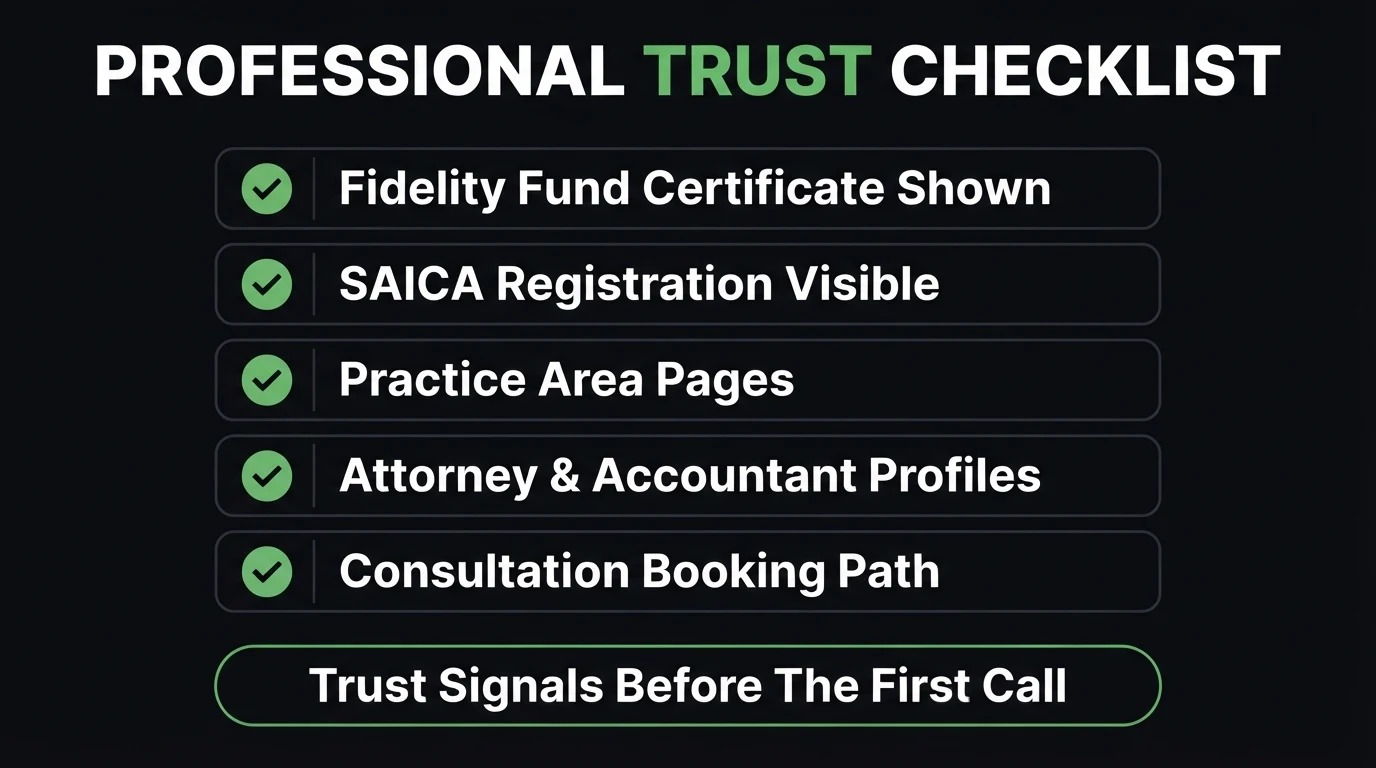
- Your professional registration, visible without hunting. For attorneys, that's your Fidelity Fund Certificate number. For accountants, SAICA, CIMA or ACCA membership and SARS eFiling registered tax practitioner status. Put it in the footer and on every profile — new clients verify this before they commit, and making it easy removes a doubt instead of leaving it to fester.
- Dedicated practice-area or service pages. A person needing conveyancing and a company needing a commercial contract reviewed are different buyers, and so are a sole trader filing a tax return and a CFO needing management accounts. One undifferentiated services list makes both feel like they landed in the wrong place. Separate pages let each visitor self-qualify and read proof relevant to their actual matter.
- Named profiles, not "our experienced team." "Adv. Naidoo — admitted 2014, specialising in labour disputes and CCMA representation" earns a consultation. A stock photo of a handshake and a paragraph about "decades of combined experience" does not. The same applies to accountants — name the person, their designation, and what they actually handle.
- A consultation path that works after hours. A property dispute or a SARS letter rarely arrives during business hours in the client's head — it arrives the moment they open the email, often at night or over a weekend. A WhatsApp consultation request or a short booking form captures that moment instead of losing it to tomorrow morning.
- Trust account and compliance cues, stated plainly. For attorneys, a line on how client funds are handled through the trust account. For accountants, seasonal tax-deadline messaging that shows you're actively managing the SA tax calendar, not just listing services. Both signal a practice that is properly run, not just professionally designed.
- A free consultation or discovery call CTA that's easy to find. Most first-time visitors are not ready to commit to a full engagement — they want to talk to someone first. Make that the obvious, low-friction next step, not something buried under a generic "Contact Us" link.
What Most Professional-Services Websites Get Wrong
The same mistakes recur across law firm and accounting sites, usually because the site was built to look impressive in a pitch deck rather than to survive a cautious first-time client checking you out at 9pm on a Sunday:
- No registration number anywhere — no Fidelity Fund Certificate, no SAICA membership, nothing to verify
- One generic services list that treats a divorce and a commercial contract as the same enquiry
- Vague "our team" copy with no named attorneys or accountants, no year of admission, no specialisation
- Contact form only, with no way to request a consultation outside office hours
- Fidelity Fund or SAICA number visible in the footer and on every profile
- Dedicated practice-area or service pages a client can self-qualify against
- Named profiles with year of admission or designation and specialisation
- WhatsApp consultation request or booking form, working day or night
When we run a lead-leak check on a law firm or accounting site, the self-qualification structure is nearly always the biggest gap. A firm with genuine expertise and decent local visibility will still be funnelling a labour dispute enquiry and a routine tax return through the exact same "Contact Us" form. The traffic is arriving; the site just isn't built to sort it. Adding practice-area or service pages, moving the registration number above the fold, and giving each professional a real profile usually improves the enquiry-to-consultation rate more than a full visual redesign would.
Quick question before you read on: how many of this month's new-client calls started with "are you actually registered?" — a question your homepage should have already answered?
Practice Areas and Service Pages: Letting Clients Self-Qualify
A law firm handling conveyancing, family law, commercial contracts, labour disputes and debt recovery is really running five different sales conversations under one roof, each with its own urgency, vocabulary and proof requirements. The same is true for an accounting practice split between individual tax returns, annual financials, payroll processing, business registration, SARS disputes and management accounts. Cramming all of it onto one "Our Services" page forces every visitor to do the sorting themselves — and a visitor doing your sorting for you is a visitor one click from leaving.
Dedicated pages solve this cleanly. A person needing urgent debt recovery reads different proof — turnaround time, recovery rate, what happens next — than a company scoping a commercial lease review. A SARS dispute page can speak directly to the anxiety of a client who's just received a letter, while a management-accounts page speaks to a growing business that wants monthly numbers it can actually use. Neither client should have to read past the other's content to find their own.
Here is how we'd prioritise fixing an existing law firm or accounting site, ranked by impact against effort — not every improvement deserves the same slice of your month:
| Fix | Why it matters | Effort |
|---|---|---|
| Registration number visible | Clears the first and fastest trust check a cautious client makes — costs nothing to add | Low |
| Practice-area / service pages | Lets each visitor self-qualify and read proof relevant to their specific matter | Medium |
| Named professional profiles | Turns "our experienced team" into a reason to book with a specific person | Low |
| Consultation request path | Captures intent outside office hours instead of losing it to a competitor overnight | Low |
| Full client portal / e-signature integration | Worth it once volume is genuinely unmanageable through email — not before | High |
Trust Signals and Compliance That Matter
Legal and financial services are high-trust, high-stakes purchases, so the compliance details on your site aren't box-ticking — they're conversion tools. A visible Fidelity Fund Certificate number, a line on how trust account funds are handled, and a plain-English POPIA privacy note covering how client information is stored all tell a cautious prospect they're dealing with a properly run practice, not a side hustle with a nice template. The same logic applies to real photography over stock imagery — this is exactly why real photos beat stock photos for trust, and a professional-services site benefits from it as much as any industry we work with.
For accountants specifically, seasonal messaging is an underused trust signal. A homepage that references the current provisional tax deadline or SARS eFiling season shows you're actively practising, not running a static brochure site that hasn't been touched since it launched. It costs a small content update a few times a year and it quietly reassures a client that you're on top of the calendar that governs their compliance.
Run a law firm or accounting practice? See a trust-first site built for it.
Send Chris your practice areas or services, professional profiles and Fidelity Fund or SAICA details on WhatsApp, and see a live demo — registration proof, practice-area pages and a consultation booking path included — before you pay anything.
Zero deposit before approval · No lock-in · 48-hour free demo · From R1,200/mo
How CJX Studios Builds Law Firm and Accounting Websites
Every professional-services site we build starts with the registration proof and the self-qualification structure, not the colour scheme. That means a footer Fidelity Fund or SAICA number by default, dedicated practice-area or service pages, named profiles with year of admission or designation, a WhatsApp consultation request path, and a POPIA privacy note — built mobile-first, because a fair share of your prospective clients will find you on a phone, often outside office hours. If you run a firm or practice and your current site is quietly funnelling every enquiry through one generic contact form, that's the first thing we'd fix. Have a look at our website packages, or see the structure in place on our law firm site for a Johannesburg practice and our accounting practice site built for Sandton.
Go Deeper: Related Guides
Frequently Asked Questions
What is the single most important trust signal on a law firm or accounting website?
Your professional registration number, visible without hunting for it. For attorneys, that is the Fidelity Fund Certificate number; for accountants, SAICA, CIMA or ACCA membership and SARS eFiling registered tax practitioner status. Put it in the footer and on every profile. A prospective client verifying you before the first call should not have to email and ask.
Should a law firm or accounting practice list every service on one page?
No. A person needing a divorce and a company needing a commercial contract reviewed are different buyers with different urgency and budget, and a single undifferentiated services list makes both feel like they landed in the wrong place. Dedicated practice-area or service pages let each visitor self-qualify and read proof relevant to their specific matter.
Do clients actually book a consultation through a website, or do they always just phone?
A growing share book or enquire outside office hours, particularly younger clients and business owners who are dealing with the problem after their own workday ends. A WhatsApp consultation request or a simple booking form captures that moment. A phone number alone means anyone who searches at 8pm has to wait until morning, and by then they may have already messaged your competitor.
Why do attorney and accountant profiles matter so much for conversion?
Professional services are a relationship purchase, not a product purchase. A prospective client wants to know who will actually handle their matter, how long that person has practised, and what they specialise in, before they commit to a consultation. "Our experienced team" answers nothing. A named profile with year of admission and specialisation answers everything.
How fast can CJX Studios build a law firm or accounting practice website?
You see a live demo within 48 hours of sending Chris your practice details, practice areas or services, attorney or accountant profiles and Fidelity Fund or SAICA numbers over WhatsApp. There is no deposit before you approve what you see, and plans start from R1,200 per month.
- Clients decide in under a minute: are you registered, verifiable and easy to book a consultation with?
- Practice-area or service pages beat one generic list, because different matters are different buyers.
- Registration number, named profiles and a consultation path are cheap, fast trust wins — do those before a full rebuild.
Keep Reading

Chris Maboyi
I build websites for South African attorneys, conveyancers and accounting practices across Centurion, Pretoria, Sandton and Gauteng — built around registration proof and self-qualification first, everything else second. Every site starts with a 48-hour free demo: real, live, no deposit, no obligation. Get in touch or WhatsApp me directly.