Trade Sites Don't Need to Impress. They Need to Convert Urgency.
Nobody searches for "plumber near me" or "electrician Centurion" to admire a homepage. They search because a geyser is leaking, a distribution board tripped, or a compliance certificate is overdue — and they are going to call whichever result answers their question fastest. That's the entire brief for a trade website: remove friction between "I found you" and "I called you." Most tradespeople's sites get this exactly backwards, spending the budget on a polished hero banner while the phone number sits in 10-point font in the footer.
We've built and audited enough plumber and electrician sites in Gauteng to know the pattern by now. It's rarely the design that's losing leads — it's the absence of three specific, unglamorous features that do almost all of the conversion work.
The Three Features That Actually Move the Needle
Skip the debate about fonts and colour schemes. If your site is missing any of these three, fix that first — everything else is secondary.
- A sticky call or WhatsApp button. Visible on every scroll position, on every page, on mobile especially — because most trade searches happen on a phone, often mid-emergency. If a visitor has to hunt for your number, you've already lost them to the next result.
- Dedicated service-area pages. One generic "Our Services" page can't compete with a page built specifically for "electrician Menlyn" or "plumber Centurion." Google rewards specificity, and so do the people typing the search.
- A before/after gallery with real photos. Six to ten actual job photos, each with one line of context, outperform thirty stock images. It's the fastest way to prove competence to someone who has never met you.
- Visible registration and compliance proof. PIRB and IOPSA for plumbers, COC and EASA for electricians — placed near the contact button, not buried on an About page nobody reads.
- A quote or callout flow with no dead ends. Whether it's a form, a WhatsApp link, or a phone number, the path from "interested" to "contacted you" should take one tap, not three.
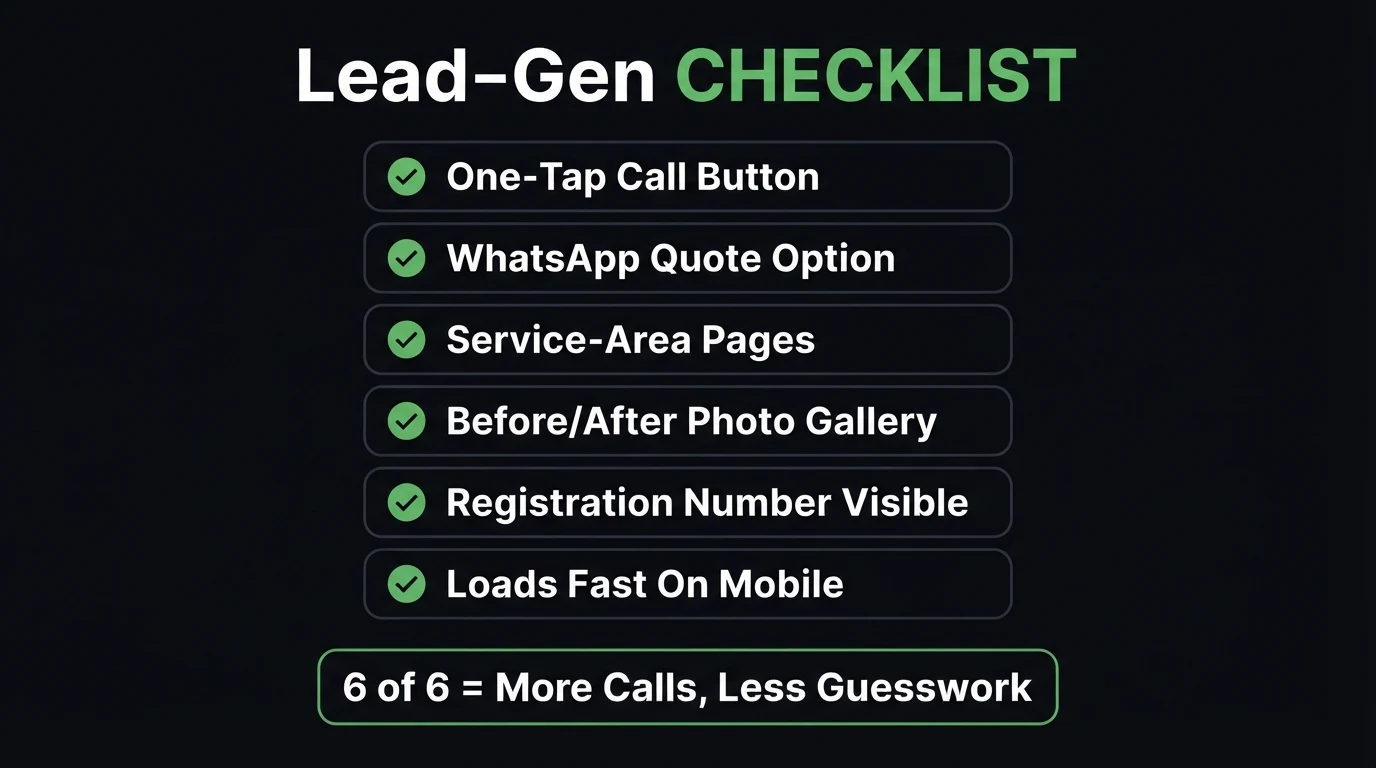
What Most Tradespeople's Sites Get Wrong
The same handful of mistakes show up on trade website after trade website, usually because a template was built for a generic "local business" rather than for how urgently people search for a plumber or electrician:
- Phone number buried in the footer — visitors scroll past it or never see it on mobile
- One contact form for every service area — no suburb-specific pages for Google to match
- Stock photography instead of real completed jobs, which reads as generic instantly
- PIRB, IOPSA, COC or EASA numbers left off entirely — or hidden on an About page
- Sticky call/WhatsApp button visible on every screen, every scroll position
- Dedicated pages per suburb — matched to how people actually phrase the search
- Real before/after photos with one line of context per job
- Registration numbers placed right beside the contact button, where trust decisions happen
A Centurion-based electrician came to us with a homepage that looked sharp but generated almost no online enquiries. It had no phone number above the fold, one generic contact form covering every suburb, and stock photography instead of the electrician's own completed work. We rebuilt the site with a sticky WhatsApp button, dedicated pages for Centurion, Midstream and Irene, and a real before/after gallery pulled from finished jobs. WhatsApp enquiries picked up noticeably within the first few weeks — before the page had even had time to rank higher. The site simply stopped losing the visitors it was already getting.
Before you keep reading: which of these three does your current site actually get right? Most trade sites nail one and quietly lose leads on the other two.
Service-Area Pages: The SEO Move Most Trades Skip
Most plumbers and electricians run one page that lists every suburb they cover in a single paragraph, then wonder why they don't rank for any of them. Google matches intent to specificity — a page written for "electrician Centurion" with the actual estate names, load-shedding context, and local landmarks will consistently outrank a generic city-wide page, even one with more total content.
You don't need fifteen suburb pages on day one. Two or three of your highest-value service areas, each with genuinely local copy — not a find-and-replace of the suburb name — will out-convert a single catch-all page every time. See what that looks like in practice on our plumber Centurion and electrical & solar Pretoria service-area pages.
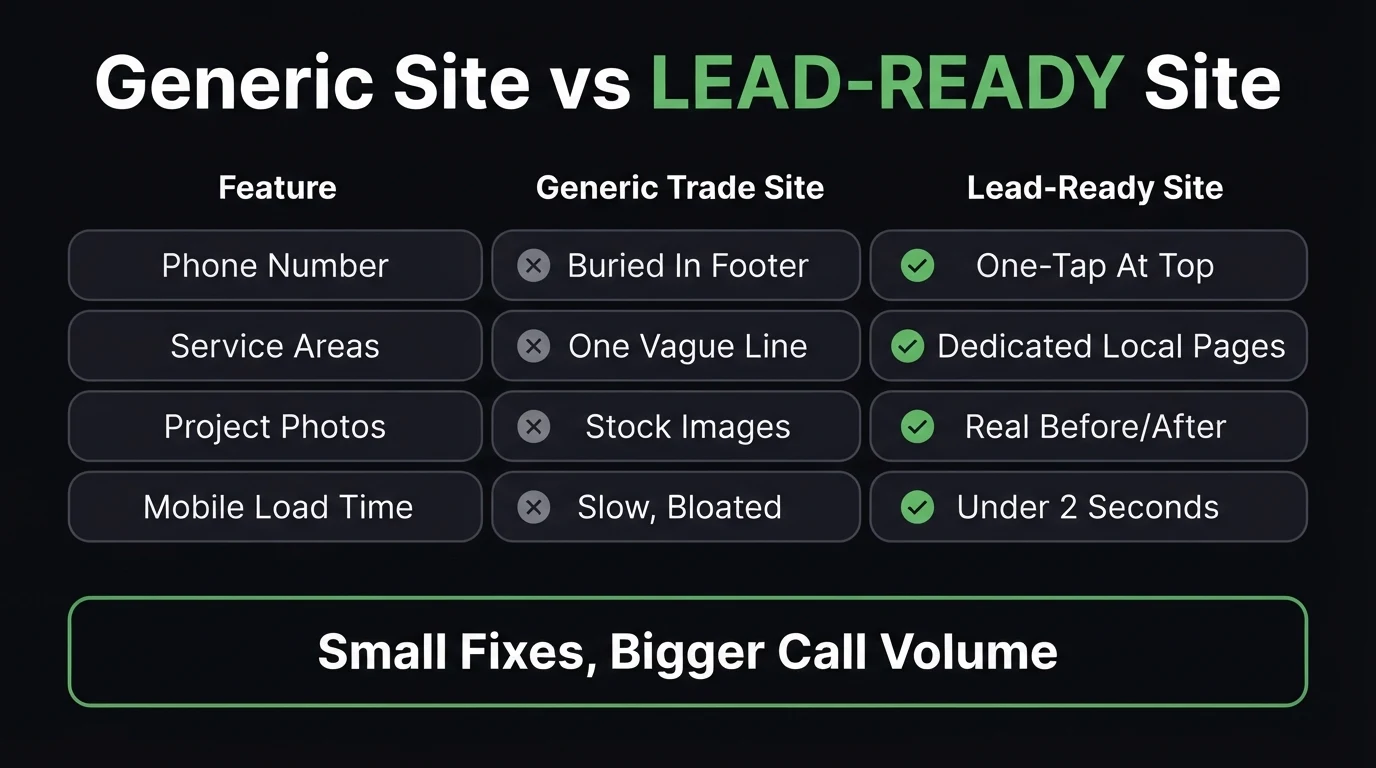
Here's how we'd prioritise fixing an existing trade site, ranked by impact against effort — because not every improvement deserves the same amount of your time this month:
| Fix | Why it matters | Effort |
|---|---|---|
| Call/WhatsApp button | Removes friction at the exact moment someone is ready to contact you | Low |
| Before/after gallery | Proves the work instead of just claiming it — six real photos beat thirty stock ones | Low |
| Registration proof | PIRB, IOPSA, COC or EASA visible near the CTA builds trust before the first ring | Low |
| Service-area pages | Matches how people actually search — the single biggest local SEO lever most trades skip | Medium |
| Full site rebuild | Only worth it if the underlying foundation — speed, structure, mobile — is broken | High |
How CJX Studios Builds Sites for Plumbers and Electricians
Every trade site we build starts with the call-to-action, not the colour palette. That means a sticky call/WhatsApp button by default, dedicated service-area pages for your top suburbs, a before/after gallery built for your real work, and your PIRB, IOPSA, COC or EASA registration placed exactly where a nervous first-time caller looks for it — before they dial. If you're a plumber or electrician and your current site is quietly losing calls to a competitor with a worse reputation but a better button placement, that's the first thing we'd fix.
Go Deeper: Related Guides
Get a trade website built around what actually gets the phone ringing.
Send Chris your services, service areas and registration number on WhatsApp, and see a live demo built around a sticky call button, real photos, and suburb-specific pages — before you pay anything.
Zero deposit · No lock-in · Pay only if you love it · From R1,200/mo
Frequently Asked Questions
What's the single most important feature on a plumber or electrician website?
A one-tap call or WhatsApp button that stays visible on every screen, not just the homepage. Trade searches are high-urgency — a burst geyser or tripped DB board doesn't wait — and the site that makes contact effortless wins the call even if a competitor's page looks nicer.
Do I need a page for every suburb I service?
Not every suburb, but your two or three highest-value service areas should each get a dedicated page. Google matches searches like "electrician Centurion" or "plumber Menlyn" far more precisely to a page built for that suburb than to one generic services page trying to cover a whole city.
Should I show my PIRB, IOPSA, COC or EASA number on my website?
Yes, and it should sit near the contact button, not buried on an About page. Homeowners and body corporates increasingly check registration before they call, especially for compliance-linked work like geyser replacements or COC issuance — visible proof shortens that hesitation.
How many photos do I need for a before/after gallery to work?
Six to ten real job photos outperform thirty stock images. Pair each with one line of context — what the job was, roughly how long it took — because context is what turns a photo into proof rather than decoration.
How fast can CJX Studios build a trade website like this?
The live demo is ready within 48 hours of sending your services, service areas and registration details over WhatsApp. You see the real page before paying anything — no deposit until you approve it.
- Three features do almost all the work: a sticky call/WhatsApp button, dedicated service-area pages, and a real before/after gallery.
- Registration proof belongs near the CTA, not on an About page — PIRB, IOPSA, COC or EASA, whichever applies to your trade.
- Fix the cheap, high-impact items first: call button, gallery, and registration badges before you consider a full rebuild.
Keep Reading

Chris Maboyi
I build websites for South African plumbers, electricians and other trades across Centurion, Pretoria, and Gauteng — built around a call button first, everything else second. Every site starts with a 48-hour free demo: real, live, no deposit, no obligation. Get in touch or WhatsApp me directly.