The Short Version: It Depends What the Website Is For
Ask ten South African agencies this question and you will get ten answers, usually matching whatever that agency sells. So here is the disclosure up front: CJX Studios builds custom sites, so we have a view. We will still tell you where WordPress is the smarter pick, because choosing the wrong platform costs far more than choosing the "wrong" agency.
The useful way to frame it is not "which technology is better" but "which one makes my website do its job with the least friction." A website for a plumber in Centurion who needs calls has different needs from a publisher posting daily articles or a shop with 2,000 products.
What Each Option Actually Is
- A content management system that powers a huge share of the web
- Built from a theme plus plugins for forms, SEO, shops and more
- Lets you log in and edit pages yourself
- Huge pool of developers and ready-made add-ons
- Pages designed and coded around your business, with no template underneath
- Only the code each page needs, so it loads lean
- Few or no third-party plugins to maintain
- Changes usually go through your developer or a managed service
There is also a middle road: a custom WordPress build, where a developer writes a bespoke theme instead of buying one. That can give you the best of both, at a higher price than either a template or a lean custom site.
The Five Trade-Offs That Actually Matter
1. Cost: cheaper to start versus cheaper to own
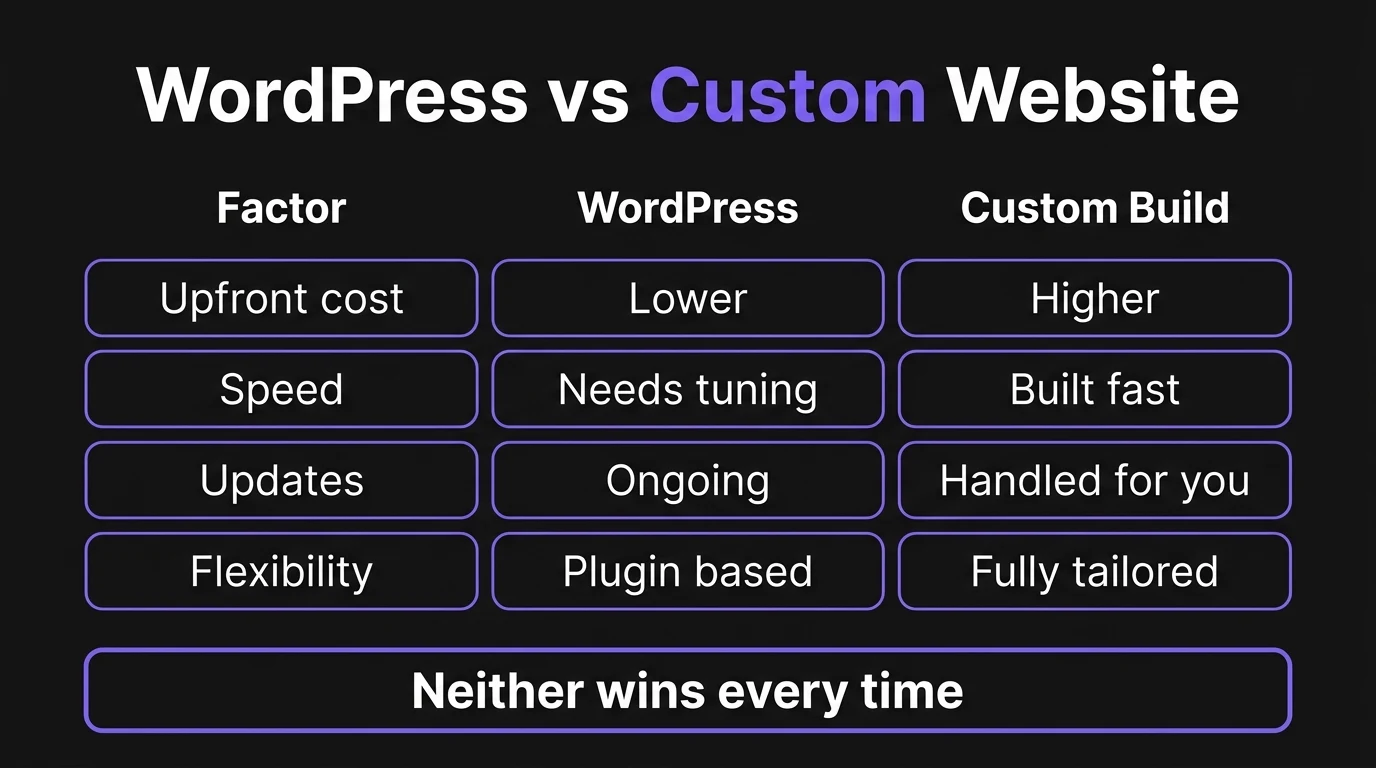
WordPress usually wins the first invoice, because a premium theme and a handful of plugins shorten the build. But the website then needs hosting, plugin licences, backups, security monitoring and someone to run updates, and those costs repeat every year. A custom build can ask for more upfront thinking, but it carries fewer moving parts. Compare the total over two to three years, not the quote on day one. Our website cost guide and why websites cost what they do break the numbers down.
2. Speed: lean code versus layers of plugins
Most visitors reach your site on a phone, often on a patchy connection. A custom page ships what it needs and little else. A typical WordPress page loads a theme, a page builder and several plugins before it shows anything. A well-tuned WordPress site with good hosting and caching can be quick, but that tuning is ongoing work, not a one-off. Speed matters because people leave slow pages and search engines notice.
3. Security: smaller attack surface versus bigger target
WordPress core is actively maintained. The risk lives in outdated plugins, abandoned themes and weak passwords, and because WordPress is so popular, automated attacks target it constantly. A WordPress site is exactly as secure as its maintenance routine. A custom site is not magically unhackable, but with far fewer third-party parts there is simply less to go wrong.
4. Updates and upkeep: who looks after it?
This is the cost most owners do not see coming. WordPress asks for regular core, theme and plugin updates, and occasionally an update breaks something on the page. If nobody is responsible, the site quietly decays. With a custom site on a managed plan, upkeep is handled for you. That is how we run it: hosting, maintenance, edits and support are included in the monthly fee, so there is no plugin to forget about.
5. Flexibility and editing: your hands versus ours
Here WordPress genuinely shines. If you want to log in on a Sunday night, rewrite a headline and add a new page without calling anyone, WordPress is built for that, and so are the thousands of plugins for bookings, memberships and shops. A custom site gives you design freedom (nothing is forced into a template), but editing usually goes through your developer. If you edit your site weekly, weigh that seriously.
Quick check: how often will you realistically change the website yourself in the next year?
Side by Side
| Factor | WordPress | Custom-built |
|---|---|---|
| Upfront cost | Usually lower | Usually higher |
| Long-run cost | Hosting, plugins and updates add up | Fewer parts; often a flat monthly fee |
| Speed | Good only with tuning | Lean by default |
| Security | Depends on maintenance | Smaller attack surface |
| Self-editing | Excellent | Usually via your developer |
| Design freedom | Limited by theme unless customised | Fully tailored |
| Best for | Content-heavy sites, shops, editors | Lead-generation and service sites |
Want to see a custom build before you commit?
We'll build a live demo of your website in 48 hours, designed around your services and your customers. You only pay if you approve it, and hosting, edits and support are included.
Zero deposit · No lock-in · Based in Centurion, serving all of SA
When WordPress Is the Right Call
Be honest about these, because they are real. Choose WordPress when:
- You publish often. A news site, a busy blog or a resource library is exactly what WordPress was built for.
- Several people need to edit. User roles and a familiar dashboard make team editing easy.
- You need a specific plugin. Memberships, course platforms and complex booking can be faster to assemble from proven plugins.
- Upfront budget is the hard limit. A well-chosen theme gets you online sooner for less, provided you budget for upkeep.
When a Custom Build Is the Better Bet
- The site exists to generate leads. A plumber, accountant, clinic or law firm needs a fast page, clear trust signals and a one-tap call or WhatsApp button, not a thousand features.
- Speed and Google visibility matter. Lean pages are easier to keep fast on mobile, and our AI search guide covers why clear, well-structured pages matter more than ever.
- Nobody wants to babysit updates. A managed plan means your site is looked after without you logging in.
- You want to stand out. A template looks like a template. A bespoke design signals that you take your business seriously.
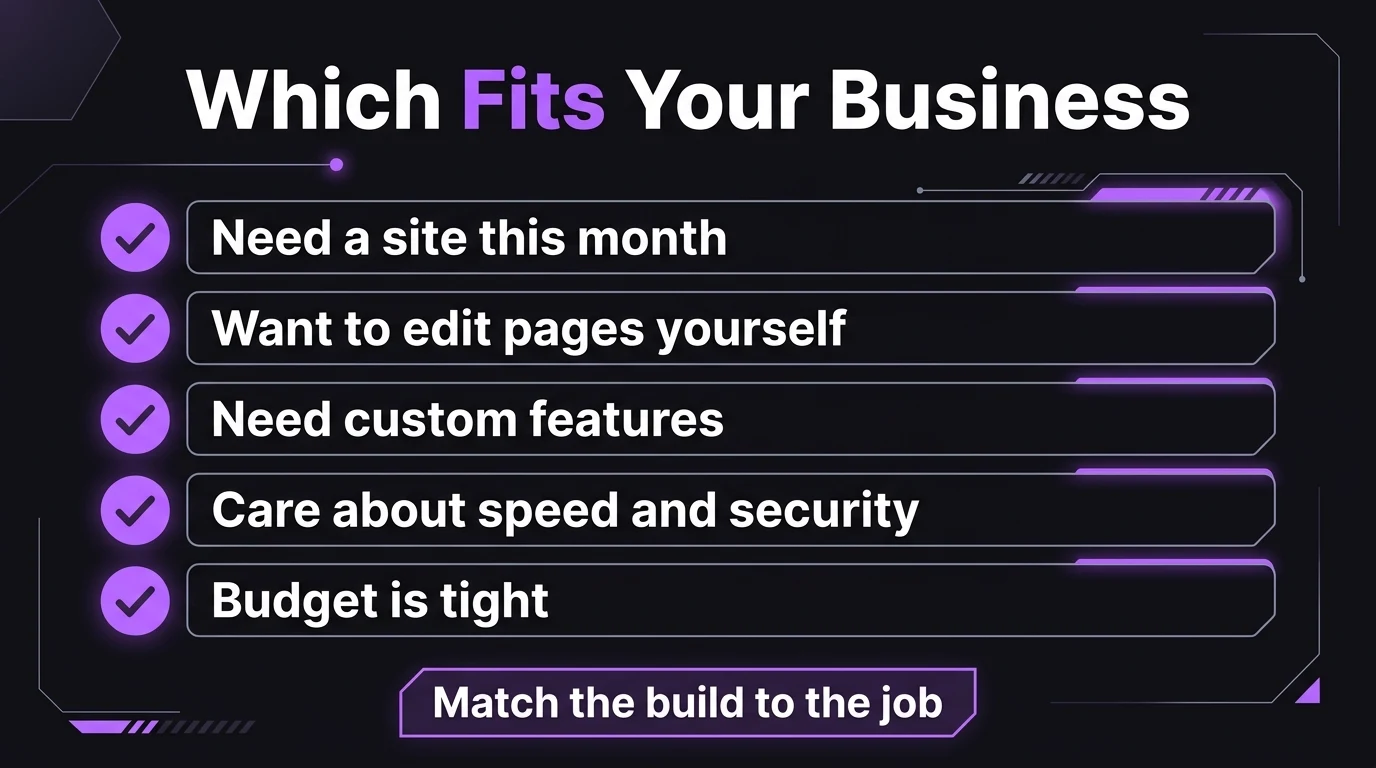
Ask who will look after the site in month 14. If the honest answer is "me, regularly, and I enjoy it", WordPress is a good fit. If it is "nobody, I just want it to work and bring in enquiries", a managed custom build removes the problem entirely.
Already on WordPress? Do You Need to Switch?
Not necessarily. If your WordPress site is fast, updated, secure and generating enquiries, leave it alone. Consider a rebuild when pages load slowly on mobile, you keep seeing update warnings, the site has been hacked or broken by a plugin, or the design makes the business look dated. A good migration keeps your page addresses (or adds 301 redirects) plus your titles, descriptions and internal links, so your Google rankings carry across. Our once-off vs monthly packages guide explains the pricing models you will meet along the way.
The Bottom Line
WordPress is a strong, proven tool, and it is the right answer more often than a custom-build agency would like to admit. A custom-built website is the better answer when you want a fast, secure, lead-focused site that someone else keeps healthy. Decide by what the site must do, who will maintain it, and what you will have paid after three years, not the headline price. If you are still weighing up whether to use a DIY builder instead, see Wix vs a professional website.
- Choose WordPress if you edit often, publish content, or need specific plugins on a tight starting budget.
- Choose custom if you want a fast, secure, lead-focused site with no plugin upkeep.
- Compare over 2-3 years, not the first invoice, and decide who maintains the site.
Go Deeper: Related Guides
Frequently Asked Questions
Is WordPress or a custom website better for a small business in South Africa?
Neither wins every time. WordPress suits businesses that want to edit content themselves, need a large plugin ecosystem, or have a tight upfront budget. A custom-built website suits businesses that want speed, tighter security and a design built around their sales process, without managing plugins and updates. For most small service businesses that just need leads, a fast custom build with managed hosting usually involves less hassle.
Is WordPress cheaper than a custom-built website?
WordPress is usually cheaper to start, because themes and plugins cut build time. Over a few years the gap often narrows, because WordPress needs hosting, premium plugin licences, updates, backups and security monitoring. A custom build costs more or needs more planning upfront but can carry fewer ongoing parts. Compare total cost over two to three years, not just the first invoice.
Is a custom-built website faster than WordPress?
Usually, yes. A custom site ships only the code the pages need, while a typical WordPress site loads a theme and several plugins on every page. A well-tuned WordPress site with caching can be fast, but it takes ongoing effort to keep it that way. Speed matters because slow mobile pages lose visitors and can hurt search performance.
Is WordPress secure?
WordPress core is actively maintained, but its popularity makes it a constant target, and most problems come from outdated plugins, themes and weak passwords. A WordPress site is as secure as its maintenance. If nobody updates it, it becomes a risk. A custom-built site has a smaller attack surface because it has far fewer third-party parts.
Can I switch from WordPress to a custom website later?
Yes. Your content, images and URLs can be carried across. The key is to keep your existing page addresses or set up 301 redirects, so you do not lose search rankings. A good migration also keeps your meta titles, descriptions and internal links intact.

Chris Maboyi
I build websites for South African businesses in Centurion, Pretoria and across Gauteng, and run an AI-assisted content and SEO programme for CJX Studios. Every project starts with a 48-hour free demo: real, live, no deposit before you approve it. Get in touch or WhatsApp me directly.