The Domain Name Decision Framework, in One Paragraph
Most domain name advice online is either too vague ("pick something memorable!") or too obsessed with one variable — usually whether your exact keyword sits in the URL. Neither approach reflects how Google, or your customers, actually behave. The honest framework is this: start with length and brandability, layer in loose keyword relevance if it fits naturally, choose the TLD that matches where your customers actually are, strip out hyphens and numbers, be skeptical of exact-match domains, and weigh migration risk before you register anything you might outgrow. Get those six calls right and the domain becomes an asset that compounds. Get them wrong and you are either rebuilding trust from zero in three years, or sitting on a domain nobody can spell over the phone.
None of this means keywords or TLDs do not matter — they do, and we will get specific about both. It means the order you apply them in determines whether your domain still serves you in five years, or becomes the thing you quietly apologise for on sales calls.
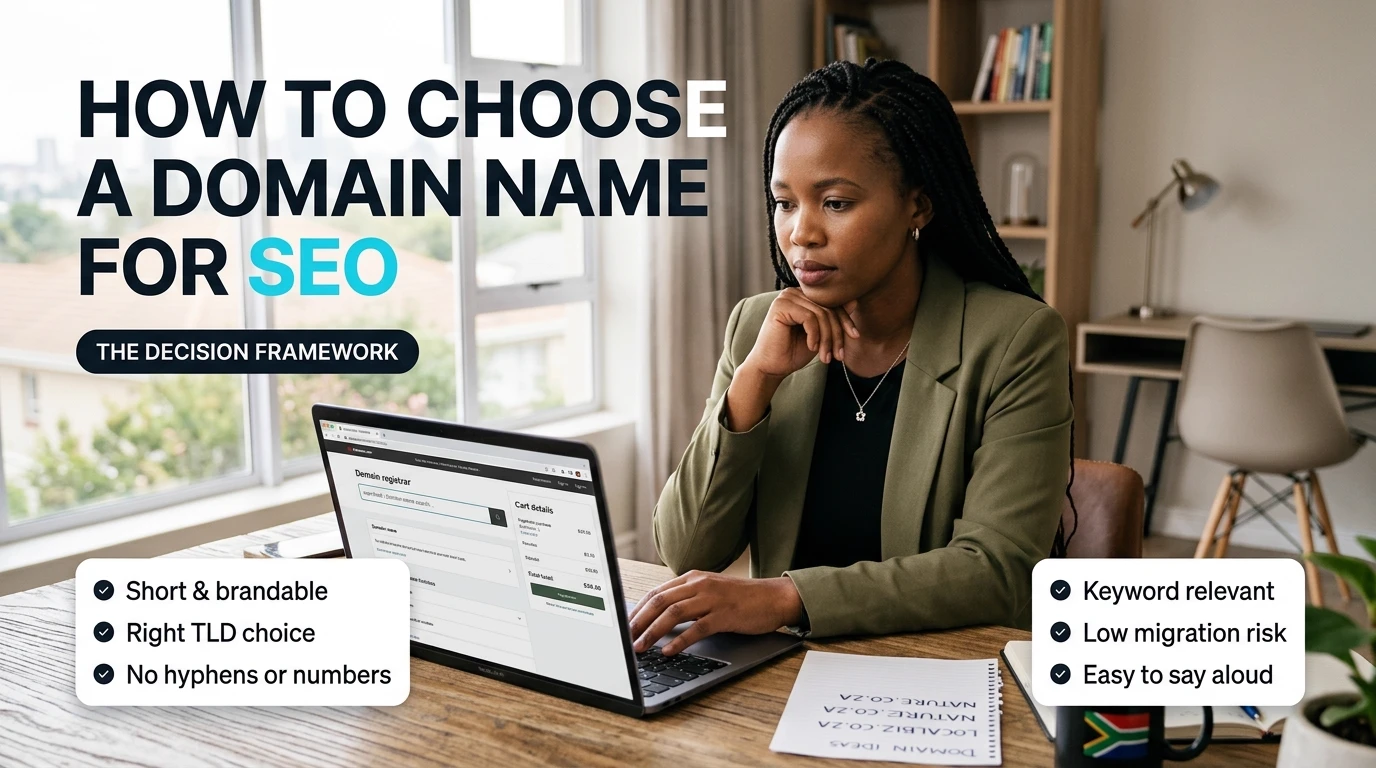
1. Length and Brandability Come Before Everything Else
Google does not measure domain length directly. Your customers do — every time they read your name off a signboard, repeat it over the phone, or retype it after a typo wiped their first attempt. A domain under roughly 15 characters is where brandability, typing accuracy, and word-of-mouth recall all peak. Beyond that, every extra syllable is a small tax on every single interaction your business has with a stranger.
Brandability is not the same as being clever. It means the name is pronounceable on first read, spells the way it sounds, and does not require an explanation. "CJX" works because it is four characters spoken as three sounds. "besttilingcontractorjoburg" does not, no matter how relevant the keywords are, because nobody can hold it in their head after hearing it once — and a domain nobody remembers cannot generate the direct type-ins and branded searches that quietly boost your organic visibility over time.
2. Should You Put Your Keyword in the Domain? Exact-Match Domains in 2026
This is the question that generates the most bad advice. An exact-match domain (EMD) — something like bestpretoriaelectrician.co.za — contains the precise phrase someone might search. Before 2012, EMDs carried a genuine, outsized ranking advantage. Google's algorithm updates since then specifically targeted low-quality EMD sites, and the automatic boost is largely gone. What remains is a domain that reads as spam to a human, even when Google itself no longer penalises it directly.
- You are a single-service, single-location business with no plans to expand
- The phrase reads naturally, not as a stacked keyword string
- You are competing in a low-competition niche with thin content from rivals
- You treat it as a functional URL, not your actual spoken brand name
- You plan to add services, products, or cities within the next 2–3 years
- The keyword string needs a hyphen or reads awkwardly aloud
- You want referral traffic — nobody refers a friend to a keyword string
- You are building a brand you might one day sell or franchise
In practice, most South African businesses are better served by a short brand name plus a genuinely strong on-page SEO strategy — proper title tags, headings, and content that actually answers the search — than by an EMD that boxes them into one service forever.
Before you keep reading: are you building a single-service local business, or a brand that might grow beyond what it does today? That answer changes how much weight keywords deserve.
3. Picking the Right TLD: .co.za, .com, or Something Else
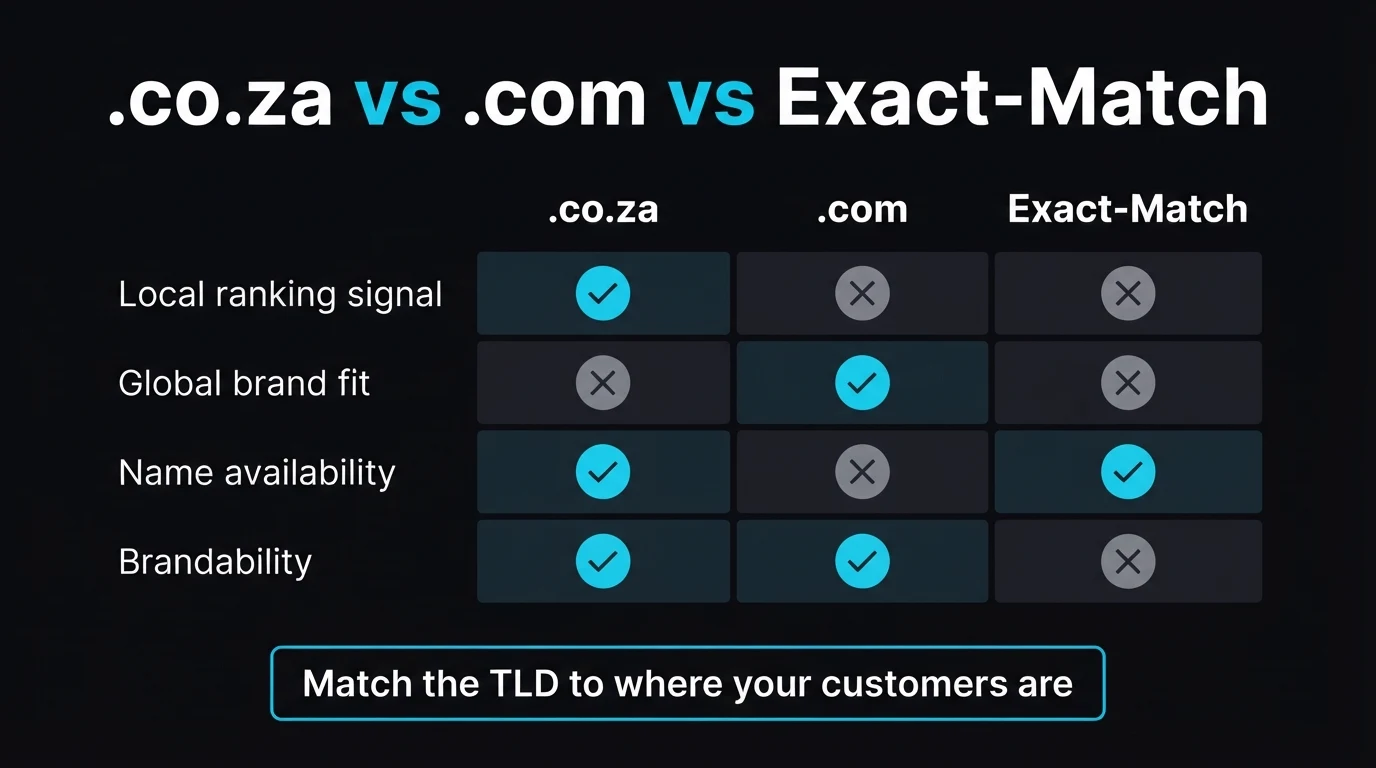
Your top-level domain is a geographic and trust signal before it is anything else. For a business serving South African customers, .co.za is the stronger default — it is a recognised country-code signal Google uses for local relevance, it typically costs less to register, and it tends to reach page 1 faster for South African local searches than an equivalent .com. We cover the full data and registrar comparison in our dedicated .co.za vs .com guide — this section focuses on how the TLD decision fits into the broader domain-name framework.
| TLD | Best for | SEO signal | Verdict |
|---|---|---|---|
| .co.za | Businesses serving South African customers | Strong local/geographic signal | Default choice |
| .com | International or pan-African brands | Neutral — no geographic signal | Use if global |
| .africa | Multi-country African expansion | Emerging, not yet locally dominant | Niche, growing |
| .joburg / .capetown / .durban | Hyper-local city branding | Weak beyond brand novelty | Branding only |
| New gTLDs (.online, .store, .shop) | Backup when your ideal name is taken | Neutral, lower trust perception | Last resort |
4. Hyphens and Numbers: Small Choices, Real SEO Cost
Hyphens and numbers will not trigger a manual Google penalty. What they do is quietly erode every downstream metric that feeds rankings. A hyphenated domain is strongly associated in most people's minds with spam pages and low-quality directories — an association that costs you click-through rate on the search results page before anyone even reaches your site. Numbers create ambiguity: does "4" mean the digit or the word "for"? Every person who has to guess is a person who might type it wrong, and a mistyped domain is a lost visitor.
"I have watched two nearly identical Gauteng tiling businesses launch within months of each other — same service, same city, same price point. One registered a clean, five-letter brand name. The other went with a hyphenated, keyword-stuffed domain to 'help the SEO.' Eighteen months later, the short-domain business had more branded search volume, a higher click-through rate on identical rankings, and noticeably more word-of-mouth referrals — because people could actually repeat the name to a friend. The hyphenated domain ranked adequately, but converted less of that ranking into enquiries. Same traffic, fewer leads. That gap is the real cost of a name nobody wants to say out loud."
5. Migration Risk: What It Really Costs to Change Domains Later
Every domain-name compromise you accept today because "we can always change it later" carries a hidden bill. A correctly executed migration — 301 redirects from every old URL, Google Search Console's Change of Address tool, updated Google Business Profile and citations, resubmitted sitemaps — typically produces 2 to 6 weeks of ranking fluctuation before full recovery. A poorly executed one, or one attempted after years of accumulated backlinks and brand equity, can lose authority permanently. This is the strongest argument for getting the domain-name decision right at the start, before you have anything meaningful to lose. If you are still comparing where to actually register and host the domain once you have decided on a name, our Afrihost vs Xneelo vs HostAfrica comparison and full domain and website registration cost breakdown cover that next step.
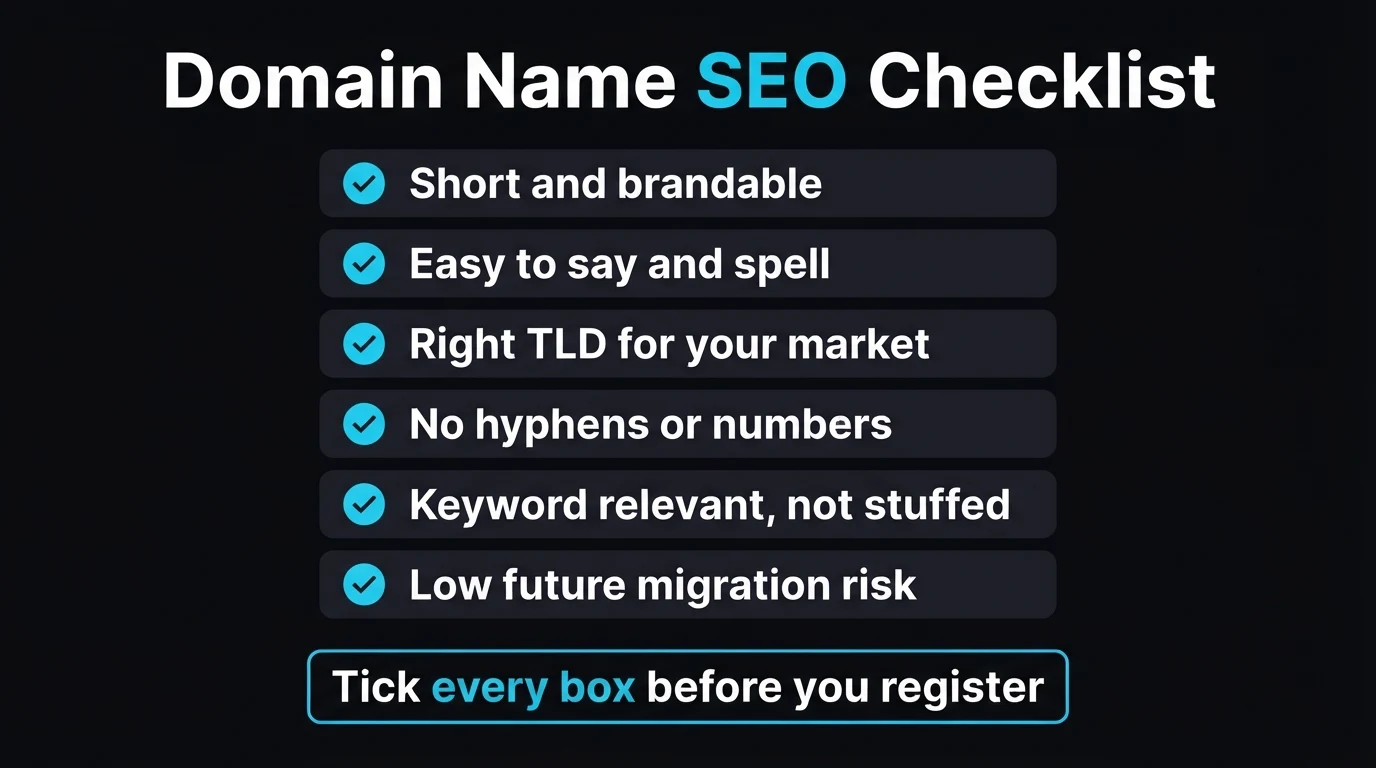
Still reading? Good. The checklist below turns all six factors into a five-minute decision you can actually act on today.
The Step-by-Step Framework: How to Actually Choose Your Domain
Write down 5 brandable name options first — no keywords yet
Short, pronounceable, spelt the way it sounds. Say each one aloud to a colleague without spelling it and see if they can write it down correctly.
Check whether a keyword fits naturally — do not force one in
If your business name already implies your service or city, good. If adding a keyword requires a hyphen or awkward phrasing, drop it and rely on on-page SEO instead.
Decide your TLD based on where your customers are, not habit
South African customers → .co.za by default. International ambitions from day one → .com. Check both are available before falling in love with either.
Eliminate any option with a hyphen or a number
No exceptions unless every brandable alternative is genuinely unavailable — and even then, treat it as a compromise, not a strategy.
Stress-test for exact-match temptation
If you are choosing an EMD, confirm you are a genuinely single-service, single-location business with no expansion plans — otherwise you are trading future flexibility for a ranking boost that mostly no longer exists.
Register for the long term and lock in migration protection
Register for a minimum of 2 years, enable auto-renewal, and register the matching .com alongside your .co.za where possible so a future migration is a redirect, not a rebrand.
Go Deeper: Related Guides
Domain registered right. Website live in 48 hours. R0 upfront.
CJX Studios helps you choose and register the right domain name, handles SA hosting and SSL, builds your SEO-optimised website, and shows it to you live — before you pay a single rand.
No deposit before approval · No lock-in · 48-hour free demo · Based in Centurion, serving all of SA
Frequently Asked Questions
Does a domain name actually affect SEO rankings?
Directly, very little — Google has repeatedly said keyword-in-domain carries minimal weight on its own. Indirectly, a lot: a short, brandable, correctly-targeted domain earns more clicks, more direct type-ins, more word-of-mouth links, and fewer typos, and all of those behavioural signals feed rankings over time. Choose for humans first and the SEO follows.
Should I put my main keyword in my domain name?
Only if it reads naturally as a brand name too. A domain like paintersjohannesburg.co.za can still work for a genuinely local, single-service business, but a stacked keyword string looks spammy to visitors and gives you nowhere to grow if you add services or cities later. In most cases a short brand name plus a strong on-page SEO strategy outperforms an exact-match domain over 12 months.
Is .co.za or .com better for SEO in South Africa?
For a business that serves South African customers, .co.za is the stronger choice — it is a recognised geographic signal Google uses for local relevance, and it typically ranks faster for South African local searches. .com only makes sense if you are building an international or pan-African brand from day one. We cover the full data behind this in our dedicated .co.za vs .com guide.
Do hyphens or numbers in a domain name hurt SEO?
They will not get you penalised outright, but they quietly cost you clicks and trust. Hyphenated domains are strongly associated with spam and low-quality sites in most people's minds, they are painful to say aloud or read off a vehicle wrap, and they are easy to mistype. Numbers create the same problem — nobody is sure if you mean the digit or the word. Avoid both unless there is truly no alternative.
What is an exact-match domain and is it still worth it in 2026?
An exact-match domain (EMD) contains the precise keyword someone searches, like bestpretoriaelectrician.co.za. Google's algorithm updates since 2012 stripped most of the automatic ranking boost EMDs once had, and low-quality EMD sites are now actively filtered. An EMD can still help a single hyper-local service business with no expansion plans, but for most brands it trades long-term flexibility for a short-term SEO edge that barely exists any more.
How risky is it to change my domain name later?
Riskier the longer you wait. A correctly executed migration — 301 redirects, Google Search Console's Change of Address tool, updated citations and backlinks — typically causes 2–6 weeks of ranking fluctuation before recovery. A poorly executed one can lose months of accumulated authority permanently. This is exactly why getting the domain name decision right before you register, rather than after you have built an audience, matters so much. See our full domain and website registration cost guide for what a fresh registration actually costs versus a migration.
- Brandability beats keywords. A short, pronounceable, correctly-spelled name earns more direct traffic and referrals than a keyword-stuffed one — and keyword-in-domain barely moves rankings any more.
- Match the TLD to your market. .co.za for South African customers, .com only if you are genuinely building an international brand from day one.
- No hyphens, no numbers, and think about migration before you register. A compromise you accept today because "we can change it later" gets expensive the moment you actually have something worth protecting.
Keep Reading

Chris Maboyi
I build websites for South African businesses in Centurion, Pretoria, and across Gauteng — handling everything from domain registration to hosting, SSL, design, and SEO. Every site starts with a 48-hour free demo: real, live, no deposit, no obligation. Get in touch or WhatsApp me directly.